The Complete End-to-End Process Catalog
A practical map of 35+ processes across six business domains — for anyone building, refining, or simply trying to understand how work really flows through an enterprise.
In today’s dynamic and competitive business environment, enterprises must constantly strive for efficiency, agility, and customer satisfaction. One of the most effective ways to achieve these goals is by building a clear, comprehensive end-to-end process catalog — a single source of truth that maps how work actually flows across an organization, from a customer’s first interaction to final invoice, and from a new hire’s first day to a retired product’s last update.
This guide walks through a complete, ready-to-use end-to-end process catalog covering six core business domains and more than 35 individual processes. Whether you’re building your first process map or refining an existing one, you can use this as a practical template or a benchmark for your own organization.
What Is an End-to-End Process Catalog?
An end-to-end process catalog is a structured inventory of the major workflows that span an organization from start to finish — crossing departments, systems, and teams rather than stopping at a single function’s boundary. Instead of looking at „what does the sales team do“ or „what does IT do“ in isolation, an end-to-end view follows a process all the way through, such as how a customer’s order eventually becomes an invoice, a payment, and recognized revenue.
This guide presents a template that can be adapted by any enterprise, including:
- An end-to-end process map diagram
- Process descriptions organized by domain
- Goals, steps, examples, and best practices for each process
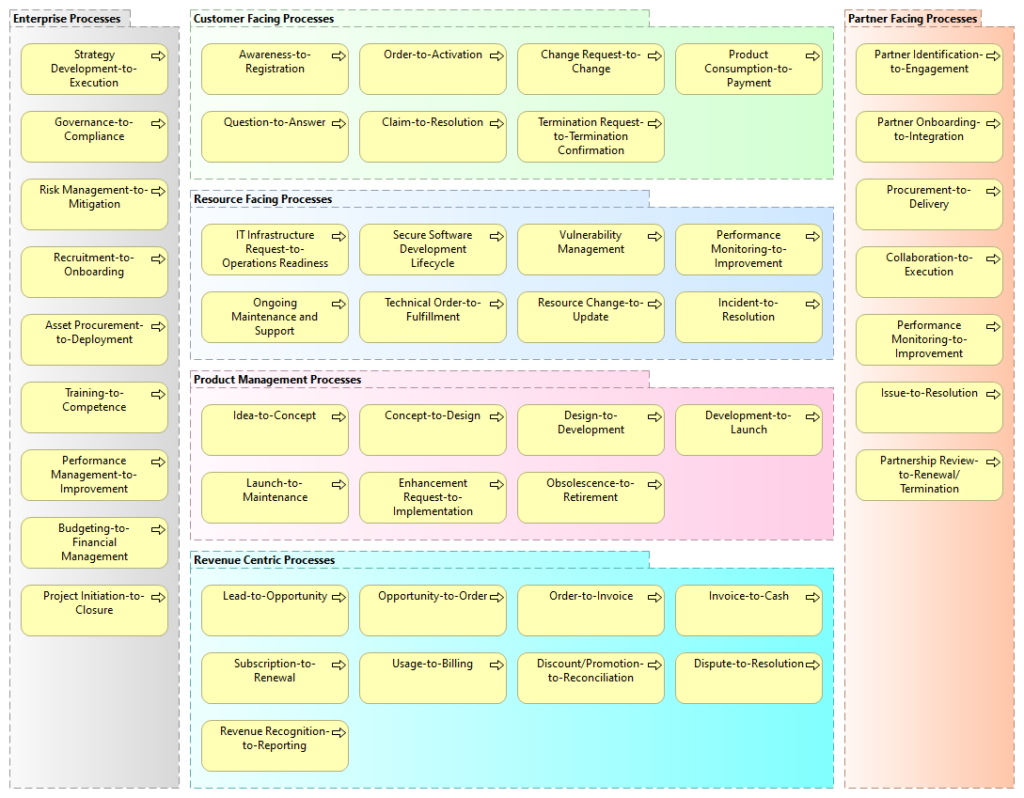
The processes are grouped into six domains:
| # | Domain |
|---|---|
| 01 | Customer Facing Processes |
| 02 | Resource Facing Processes |
| 03 | Product Management Processes |
| 04 | Partner Facing Processes |
| 05 | Revenue Centric Processes |
| 06 | Enterprise Processes |
Each domain is explored in detail below, with every process broken down by goal, typical steps, a real-world example, and best practices you can apply right away.
Why Build an End-to-End Process Catalog?
Before diving into the catalog itself, it’s worth understanding why this exercise matters. Here are the core motivations for maintaining a catalog of end-to-end processes:
1. Improved Coordination and Collaboration
In complex enterprises, different departments and teams often work in silos, which leads to miscommunication and inefficiency. A process catalog fosters better coordination by providing a unified framework that shows how processes interconnect and depend on one another — helping teams understand their role within the bigger picture.
2. Enhanced Customer Experience
Customer-facing processes are critical to delivering exceptional service. Cataloging these processes helps ensure every customer interaction is seamless and consistent. By understanding the entire customer journey — from first contact to post-sale support — businesses can identify and fix pain points, improving the overall experience.
3. Agility and Adaptability
In a fast-changing market, the ability to quickly adapt is crucial. A documented process catalog gives an organization the flexibility to reconfigure how it operates, whether that means responding to new regulations, adopting new technology, or launching new products faster.
4. Strategic Alignment
Aligning business processes with strategic objectives is essential for long-term success. A process catalog ensures every activity supports the organization’s mission and goals, and makes it easier to review and update processes as priorities shift.
5. Knowledge Management and Continuity
Documenting processes preserves institutional knowledge and ensures continuity — especially valuable during employee turnover. A well-maintained catalog becomes a living knowledge base that supports onboarding, training, and long-term consistency.
Customer Facing Processes
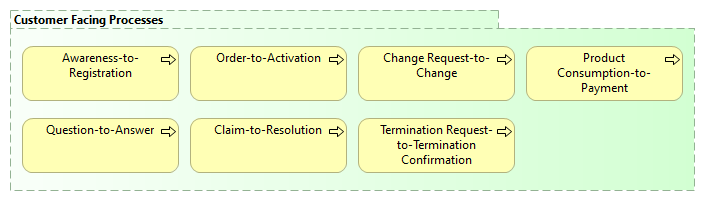
The Customer Facing domain captures the complete end-to-end processes involved in managing customer interactions, from initial interest and registration to termination requests. Each process is designed to deliver a smooth, efficient experience for the customer while maintaining operational accuracy for the business. Customer-facing processes frequently trigger resource-facing processes behind the scenes, such as technical implementation tasks.
Awareness-to-Registration
Goal: Convert potential customer interest into a desire to use the company’s products or services, capturing leads and encouraging registration (including free sign-ups and, optionally, orders).
Steps: Targeted advertising → Content marketing → Product demonstrations/webinars → Customer testimonials → Engaging follow-up communications → Marketing campaigns → Lead generation → Website/social media visits → Registration form completion → Confirmation of registration → Feedback collection
Example: A software company running a webinar series to generate leads and drive registrations for a free trial.
Best Practices:
- Ensure all customer touchpoints are tracked.
- Follow up with personalized communications post-registration.
Order-to-Activation
Goal: Facilitate the process from placing an order to activating the purchased product or service.
Steps: Product/service selection → Order placement → Order processing → Payment confirmation → Product/service activation → Customer notification → Feedback collection
Example: A SaaS company ensuring customers can access their new subscription software immediately after purchase.
Best Practices:
- Automate order processing and payment confirmation.
- Send clear notifications at each stage of the process.
- Provide real-time inventory updates to avoid overselling.
- Integrate systems for seamless information flow.
- Offer proactive customer support during activation.
- Collect feedback through automated surveys post-activation.
Change Request-to-Change
Goal: Handle customer requests for changes to their existing products or services.
Steps: Customer request submission → Request evaluation → Approval/rejection → Implementation of changes → Customer notification → Feedback collection
Example: A cloud service provider enabling customers to upgrade their storage plans through a self-service portal.
Best Practices:
- Implement a streamlined request submission process.
- Use automated systems for quick evaluation and approval.
- Communicate clearly with customers throughout the process.
- Ensure changes are implemented accurately and promptly.
- Gather feedback to improve the change request process.
Claim-to-Resolution
Goal: Manage and resolve customer claims or complaints.
Steps: Claim submission → Acknowledgement of receipt → Investigation → Resolution proposal → Customer agreement → Implementation of resolution → Feedback collection → Closure of claim
Example: An e-commerce company handling product return claims efficiently.
Best Practices:
- Provide a simple and accessible claim submission process.
- Acknowledge receipt of claims promptly to reassure customers.
- Conduct thorough investigations to understand the issue.
- Propose fair and feasible resolutions.
- Communicate clearly and regularly with the customer.
- Implement resolutions swiftly and accurately.
- Collect feedback to improve the claims process.
- Ensure claims are formally closed once resolved.
Question-to-Answer
Goal: Provide timely and accurate answers to customer questions, which can also lead to new orders.
Steps: Question submission → Routing to appropriate department → Research/consultation → Response formulation → Customer response delivery → Feedback collection
Example: A tech support team responding to customer inquiries about product features, leading to increased sales.
Best Practices:
- Implement a user-friendly question submission interface.
- Ensure questions are quickly routed to the appropriate department.
- Provide thorough and accurate research for responses.
- Formulate clear and helpful responses.
- Deliver responses promptly through the customer’s preferred communication channel.
- Collect feedback to improve the quality of answers and the response process.
Product Consumption-to-Payment
Goal: Track product or service usage and ensure accurate billing and payment collection.
Steps: Usage monitoring → Usage data collection → Invoice generation → Invoice delivery → Payment processing → Payment confirmation
Example: An internet service provider monitoring data usage and billing customers accordingly each month.
Best Practices:
- Implement accurate and real-time usage monitoring systems.
- Ensure seamless collection of usage data.
- Automate invoice generation to reflect actual usage.
- Deliver invoices promptly and through preferred customer channels.
- Offer multiple payment processing options.
- Confirm payments quickly and update customer accounts accordingly.
Termination Request-to-Termination Confirmation
Goal: Process customer requests for terminating products or services and confirm the termination.
Steps: Termination request submission → Request validation → Feedback collection → Termination processing → Final bill generation → Confirmation of termination
Example: A subscription-based streaming service processing customer requests to cancel their subscription and providing confirmation along with a final bill.
Best Practices:
- Provide an easy and accessible termination request process.
- Validate requests promptly to prevent unauthorized terminations.
- Collect feedback to understand reasons for termination and improve services.
- Process terminations efficiently to ensure a smooth customer experience.
- Generate and deliver the final bill accurately.
- Send timely confirmation of termination and any relevant information.
Resource Facing Processes
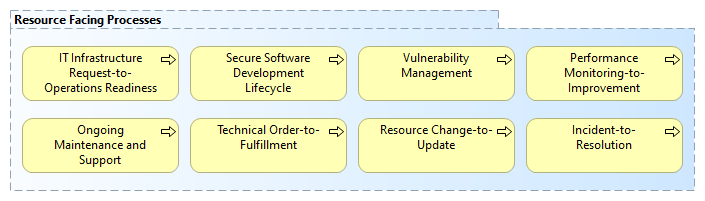
The Resource Facing domain includes end-to-end processes for managing internal resources. These processes support the overall operational effectiveness of the enterprise, ensuring necessary resources are available and optimally utilized to meet business needs. Linking these processes to customer-facing flows keeps internal and external operations aligned.
IT Infrastructure Request-to-Operations Readiness
Goal: Set up and maintain IT infrastructure to support business operations.
Steps: Requirements analysis → Infrastructure design → Procurement → Installation and setup → Configuration → Handover to operations
Example: An IT department setting up a new server for a company’s expanding data storage needs.
Best Practices:
- Conduct thorough requirements analysis.
- Design for scalability and security.
- Streamline procurement processes.
- Follow best practices for installation and setup.
- Optimize configuration for performance.
- Provide comprehensive documentation and training during handover.
Secure Software Development Lifecycle
Goal: Ensure that software development processes incorporate security best practices from inception to deployment.
Steps: Requirements analysis → Threat modeling → Secure design → Secure coding → Static code analysis → Dynamic application testing → Security reviews → Deployment
Example: A financial services company developing a new mobile banking app with robust security measures integrated at every stage.
Best Practices:
- Conduct thorough requirements analysis with a focus on security.
- Implement threat modeling to identify potential security risks.
- Follow secure design principles.
- Adhere to secure coding standards.
- Perform static code analysis to detect vulnerabilities early.
- Conduct dynamic application testing to uncover runtime issues.
- Regularly perform security reviews throughout development.
- Ensure secure deployment practices.
Ongoing Maintenance and Support
Goal: Provide continuous maintenance and support for IT systems to ensure optimal performance.
Steps: Regular system checks → Preventive maintenance → Incident management → Patch management → System upgrades → Performance monitoring
Example: An IT team regularly updating and monitoring a company’s network infrastructure to prevent downtime.
Best Practices:
- Perform regular system checks to detect issues early.
- Implement preventive maintenance to avoid unexpected failures.
- Manage incidents promptly to minimize impact.
- Keep systems updated with regular patch management.
- Plan and execute timely system upgrades.
- Continuously monitor performance to ensure optimal operation.
Vulnerability Management
Goal: Identify, assess, and remediate vulnerabilities in IT systems.
Steps: Vulnerability scanning → Risk assessment → Remediation planning → Implementation of fixes → Verification → Reporting
Example: A cybersecurity team performing regular scans on company servers to detect and fix security vulnerabilities.
Best Practices:
- Conduct regular vulnerability scanning to identify potential threats.
- Perform thorough risk assessments to prioritize vulnerabilities.
- Develop and follow a clear remediation plan.
- Implement fixes promptly to address identified vulnerabilities.
- Verify that fixes are effective and do not introduce new issues.
- Report on vulnerabilities and remediation efforts to stakeholders.
Technical Order-to-Fulfillment
Goal: Handle internal resource requests to support business operations.
Steps: Request submission → Approval process → Resource allocation → Fulfillment → Confirmation → Record keeping
Example: An IT department processing a request for new laptops for a team of developers.
Best Practices:
- Streamline the request submission process.
- Implement a clear and efficient approval process.
- Allocate resources based on priority and availability.
- Ensure timely fulfillment of requests.
- Provide confirmation to the requester once fulfilled.
- Maintain accurate records of all resource allocations.
Resource Change-to-Update
Goal: Manage changes to resource allocation and update relevant systems.
Steps: Change request → Impact assessment → Approval → Implementation → System update → Communication to stakeholders
Example: An IT team reallocating server resources to accommodate increased demand for a particular application.
Best Practices:
- Establish a clear process for submitting change requests.
- Conduct thorough impact assessments to understand potential effects.
- Ensure timely and transparent approval processes.
- Implement changes efficiently with minimal disruption.
- Update all relevant systems to reflect changes.
- Communicate changes and their impacts to all stakeholders promptly.
Incident-to-Resolution
Goal: Manage and resolve internal incidents affecting resources or operations.
Steps: Incident reporting → Prioritization → Investigation → Resolution plan → Implementation → Follow-up → Closure
Example: An IT department resolving a network outage that impacts business operations.
Best Practices:
- Implement an easy-to-use incident reporting system.
- Prioritize incidents based on their impact and urgency.
- Conduct thorough investigations to determine root causes.
- Develop clear and actionable resolution plans.
- Implement solutions promptly to restore normal operations.
- Conduct follow-up to ensure the incident is fully resolved.
- Document and close the incident formally.
Performance Monitoring-to-Improvement (Resource Facing)
Goal: Monitor resource performance and implement improvements.
Steps: Define KPIs → Data collection → Performance analysis → Identify improvement areas → Implement changes → Monitor impact
Example: An IT team monitoring server performance metrics and optimizing configurations to improve speed and reliability.
Best Practices:
- Clearly define key performance indicators (KPIs) aligned with business goals.
- Collect performance data consistently and accurately.
- Analyze performance data to identify trends and areas for improvement.
- Prioritize and implement necessary changes.
- Continuously monitor the impact of changes to ensure effectiveness.
- Regularly review and update KPIs and strategies based on performance insights.
Product Management Processes
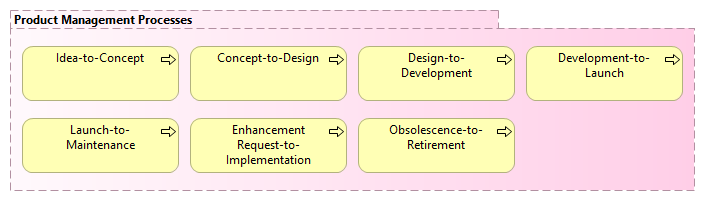
The Product Management domain covers the entire lifecycle of a product, from initial idea generation to eventual retirement. These end-to-end processes ensure a structured approach to developing, launching, maintaining, and phasing out products — supporting product quality, customer satisfaction, and continuous improvement while staying aligned with overall business goals.
Idea-to-Concept
Goal: Transform initial product ideas into viable concepts.
Steps: Idea generation → Market research → Feasibility analysis → Concept development → Initial validation → Concept approval
Example: A tech company brainstorming and developing a new app concept based on user feedback and market trends.
Best Practices:
- Encourage diverse idea generation from multiple sources.
- Conduct thorough market research to understand demand and competition.
- Perform feasibility analysis to assess technical, financial, and operational viability.
- Develop detailed concepts that outline key features and benefits.
- Validate concepts with initial testing or prototypes.
- Secure approval from key stakeholders to proceed to the next stage.
Concept-to-Design
Goal: Develop detailed designs from approved concepts.
Steps: Requirements gathering → Design specifications → Prototype development → Design review → Design approval
Example: A software development team creating detailed designs for a new mobile application based on an approved concept.
Best Practices:
- Gather comprehensive requirements from stakeholders and users.
- Develop clear and detailed design specifications.
- Create prototypes to visualize and test design ideas.
- Conduct thorough design reviews with key stakeholders.
- Obtain formal design approval before proceeding to development.
Design-to-Development
Goal: Move from detailed designs to actual product development.
Steps: Development planning → Resource allocation → Coding/manufacturing → Iterative testing → Quality assurance → Development completion
Example: A team of developers turning the detailed designs of a new software feature into a functional product.
Best Practices:
- Create a comprehensive development plan outlining timelines and milestones.
- Allocate resources effectively, ensuring the right skills and tools are available.
- Follow best practices in coding or manufacturing to ensure quality and efficiency.
- Conduct iterative testing throughout development to catch and fix issues early.
- Implement rigorous quality assurance processes to ensure the final product meets standards.
- Complete development with thorough documentation and readiness for the next phase.
Development-to-Launch
Goal: Prepare and launch the developed product onto the market.
Steps: Pre-launch testing → Market readiness → Production setup → Marketing strategy → Product launch → Initial customer feedback
Example: A tech company conducting final tests and setting up a marketing campaign before releasing a new app.
Best Practices:
- Conduct thorough pre-launch testing to ensure the product is bug-free and user-friendly.
- Ensure market readiness by aligning the product with market needs and regulatory requirements.
- Set up production processes to handle initial demand efficiently.
- Develop a comprehensive marketing strategy to create buzz and attract early adopters.
- Execute a well-coordinated product launch to maximize visibility and impact.
- Collect and analyze initial customer feedback to make necessary adjustments quickly.
Launch-to-Maintenance
Goal: Ensure ongoing product support and improvements after launch.
Steps: Customer support setup → Continuous monitoring → Bug fixing → Regular updates → Feature enhancements → Customer feedback loop
Example: A software company providing continuous updates and support for a newly launched app to ensure it remains competitive and functional.
Best Practices:
- Set up robust customer support to handle inquiries and issues.
- Continuously monitor the product’s performance and user feedback.
- Promptly fix any bugs or issues that arise.
- Implement regular updates to improve security and functionality.
- Enhance features based on user needs and market trends.
- Establish a feedback loop to gather and act on customer insights.
Enhancement Request-to-Implementation
Goal: Manage and implement product enhancement requests.
Steps: Enhancement request submission → Prioritization → Design and development → Testing → Release → Customer notification
Example: A software company adding new features to an existing application based on user requests.
Best Practices:
- Provide an easy-to-use submission process for enhancement requests.
- Prioritize requests based on customer impact and strategic value.
- Follow rigorous design and development processes to ensure quality.
- Conduct thorough testing to verify the enhancement works as intended.
- Release enhancements in a controlled manner to ensure stability.
- Notify customers about new features and enhancements to maintain engagement and satisfaction.
Obsolescence-to-Retirement
Goal: Manage the end-of-life process for products.
Steps: Obsolescence planning → Customer communication → Support phase-out → Data migration → Product retirement → Post-retirement support
Example: A tech company retiring an outdated software version and migrating users to a newer version.
Best Practices:
- Plan obsolescence to ensure a smooth transition for users.
- Communicate clearly and early with customers about the product’s end-of-life timeline.
- Gradually phase out support to give customers time to adapt.
- Ensure seamless data migration to new systems or products.
- Retire the product efficiently and securely.
- Provide post-retirement support to assist customers with the transition and address any lingering issues.
Partner Facing Processes
The Partner Facing domain encompasses the entire lifecycle of partner relationships, from initial identification and engagement to ongoing collaboration, performance monitoring, and eventual renewal or termination. Maintaining strong, productive relationships with partners helps businesses enhance their capabilities, expand their reach, and achieve strategic goals more effectively.
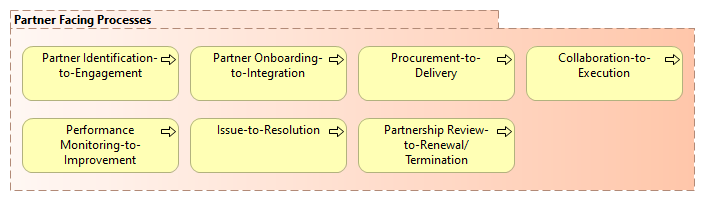
Partner Identification-to-Engagement
Goal: Identify and engage potential partners to collaborate with the business.
Steps: Market research → Identify potential partners → Initial outreach → Evaluation of partnership potential → Formal engagement → Agreement signing
Example: A tech startup researching and reaching out to potential hardware manufacturers for collaboration.
Best Practices:
- Conduct thorough market research to identify potential partners that align with business goals.
- Create a comprehensive list of potential partners based on market research.
- Initiate contact with potential partners through formal and professional outreach.
- Evaluate the potential of each partnership based on strategic fit, capabilities, and mutual benefits.
- Engage formally with selected partners to discuss collaboration opportunities.
- Ensure clear and mutually beneficial terms are established and sign formal agreements to solidify the partnership.
Partner Onboarding-to-Integration
Goal: Seamlessly integrate new partners into the business operations.
Steps: Onboarding planning → System integration → Training and orientation → Communication setup → Initial collaboration → Performance monitoring
Example: A software company integrating a new cloud service provider into its operations.
Best Practices:
- Develop a detailed onboarding plan to ensure a smooth transition.
- Integrate the partner’s systems with existing business operations for seamless data and process flow.
- Provide comprehensive training and orientation to familiarize the partner with your systems and processes.
- Establish clear communication channels to facilitate ongoing collaboration.
- Begin with initial collaborative projects to build rapport and ensure smooth working relationships.
- Continuously monitor performance to identify and address any issues early.
Procurement-to-Delivery
Goal: Manage the procurement process from order placement to delivery.
Steps: Procurement planning → Request for proposal → Vendor selection → Contract negotiation → Order placement → Delivery tracking → Receipt confirmation → Quality check
Example: A manufacturing company sourcing raw materials from suppliers.
Best Practices:
- Develop a thorough procurement plan outlining requirements and timelines.
- Issue detailed requests for proposals (RFPs) to potential vendors.
- Select vendors based on criteria such as cost, quality, and reliability.
- Negotiate contracts to ensure favorable terms and conditions.
- Place orders promptly and clearly communicate requirements.
- Track deliveries to ensure timely arrival.
- Confirm receipt of goods and conduct quality checks to verify they meet standards.
Collaboration-to-Execution
Goal: Facilitate effective collaboration with partners to execute joint projects or operations.
Steps: Joint planning → Resource allocation → Task assignment → Regular communication → Progress monitoring → Issue resolution → Project completion
Example: A tech company collaborating with a marketing agency to launch a new product.
Best Practices:
- Engage in thorough joint planning to align goals and expectations.
- Allocate resources effectively to ensure both parties have what they need.
- Clearly assign tasks and responsibilities to avoid confusion.
- Maintain regular communication to keep all stakeholders informed and engaged.
- Monitor progress continuously to stay on track and make adjustments as needed.
- Address issues promptly to minimize disruptions.
- Ensure the project is completed on time and meets the agreed-upon standards.
Performance Monitoring-to-Improvement (Partner Facing)
Goal: Monitor partner performance and implement necessary improvements.
Steps: Define performance metrics → Data collection → Performance analysis → Feedback gathering → Improvement planning → Implementation → Re-evaluation
Example: An e-commerce company monitoring the performance of its logistics partner to ensure timely deliveries.
Best Practices:
- Define clear and relevant performance metrics aligned with business goals.
- Collect performance data consistently and accurately.
- Analyze performance data to identify trends and areas for improvement.
- Gather feedback from stakeholders to gain insights into performance issues.
- Develop a detailed improvement plan addressing identified issues.
- Implement improvements in collaboration with the partner.
- Re-evaluate performance after changes are made to ensure effectiveness.
Issue-to-Resolution (Partner Facing)
Goal: Address and resolve any issues arising in the partnership.
Steps: Issue reporting → Prioritization → Investigation → Resolution plan → Implementation → Partner communication → Follow-up
Example: A software company resolving a compatibility issue with a third-party API used by a partner.
Best Practices:
- Implement a straightforward issue reporting system.
- Prioritize issues based on impact and urgency.
- Conduct thorough investigations to understand the root cause.
- Develop a clear and actionable resolution plan.
- Implement solutions efficiently to minimize disruptions.
- Maintain open communication with the partner throughout the process.
- Follow up to ensure the issue is fully resolved and to prevent recurrence.
Partnership Review-to-Renewal/Termination
Goal: Periodically review partnerships to decide on renewal or termination.
Steps: Performance review → Strategic alignment assessment → Renewal/termination decision → Renewal negotiation/termination process → Transition planning → Execution → Update systems of records
Example: A retail company reviewing its partnership with a logistics provider to decide whether to renew the contract.
Best Practices:
- Conduct regular and thorough performance reviews of the partnership.
- Assess the strategic alignment of the partnership with long-term business goals.
- Make informed decisions on renewal or termination based on performance and alignment.
- Negotiate terms for renewal or manage the termination process smoothly.
- Plan transitions carefully to minimize disruptions.
- Execute the renewal or termination plan efficiently.
- Ensure all systems of records are updated to reflect the current partnership status.
Revenue Centric Processes
The Revenue domain encompasses the entire lifecycle of financial transactions related to sales and billing — from lead generation and conversion to invoicing, payment collection, and financial reporting. Maintaining accurate, transparent revenue processes improves cash flow, enhances customer satisfaction, and ensures compliance with financial regulations.
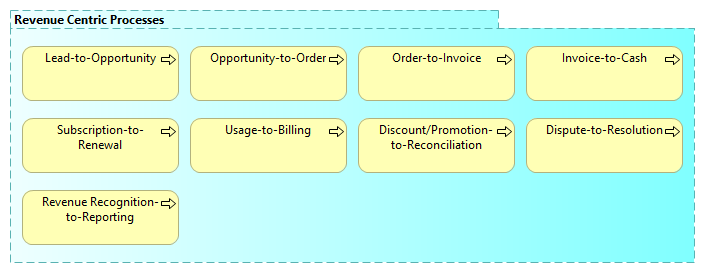
It’s important to distinguish customer-facing/partner-facing processes from revenue-centric processes, since they represent different perspectives within the organization. Customer-facing and partner-facing processes focus on the interactions and experience of the customer or partner, while revenue-centric processes emphasize the financial transactions and revenue-generation side of the business. Both are crucial and interrelated, but serve distinct purposes:
- Customer-Facing Processes manage all interactions with the customer, from initial contact to ongoing support, aiming for a seamless and satisfying experience. Examples: Awareness-to-Registration, Order-to-Activation, Claim-to-Resolution.
- Revenue-Centric Processes focus on managing the financial transactions associated with sales and services, ensuring the business efficiently generates and collects revenue. Examples: Lead-to-Opportunity, Order-to-Invoice, Invoice-to-Cash.
Customer-facing processes often trigger revenue-centric processes — for instance, Order-to-Activation in the customer-facing domain initiates Order-to-Invoice in the revenue-centric domain.
Lead-to-Opportunity
Goal: Convert potential customer leads into sales opportunities.
Steps: Lead generation → Lead qualification → Initial engagement → Needs assessment → Opportunity creation → Sales pitch → Opportunity tracking
Example: A SaaS company using targeted marketing campaigns to generate leads, qualify them, and convert them into sales opportunities.
Best Practices:
- Implement effective lead generation strategies to attract potential customers.
- Qualify leads systematically to focus on high-potential prospects.
- Engage with leads promptly and professionally to build interest.
- Conduct thorough needs assessments to understand customer requirements.
- Create opportunities based on the customer’s needs and potential value.
- Deliver compelling sales pitches tailored to the customer’s needs.
- Track opportunities diligently to manage the sales pipeline effectively.
Opportunity-to-Order
Goal: Convert sales opportunities into confirmed orders.
Steps: Proposal development → Quotation → Negotiation → Agreement finalization → Order placement → Order confirmation → Contract signing
Example: An IT services company converting a project opportunity with a potential client into a signed contract.
Best Practices:
- Develop detailed and tailored proposals that meet the specific needs of the customer.
- Provide clear and competitive quotations.
- Engage in effective negotiations to reach mutually beneficial terms.
- Finalize agreements with thorough attention to detail.
- Ensure the order is placed promptly and accurately.
- Confirm orders with clear communication to the customer.
- Execute contract signing to formalize the agreement and commence the project.
Order-to-Invoice
Goal: Generate and issue invoices based on confirmed orders.
Steps: Order review → Invoice creation → Approval process → Invoice delivery to customer → Invoice tracking
Example: A manufacturing company generating invoices for confirmed orders from retailers.
Best Practices:
- Conduct a thorough review of confirmed orders to ensure accuracy.
- Create detailed and clear invoices that reflect the order specifics.
- Implement an approval process to verify invoice accuracy before sending.
- Deliver invoices promptly to customers through their preferred channels.
- Track invoices to ensure timely payment and address any discrepancies quickly.
Invoice-to-Cash
Goal: Manage the collection of payments from issued invoices.
Steps: Invoice delivery → Payment follow-up → Payment receipt → Payment processing → Confirmation of payment → Update financial records
Example: An accounting firm tracking payments from clients after delivering invoices for services rendered.
Best Practices:
- Ensure prompt and accurate delivery of invoices.
- Follow up regularly with customers to remind them of outstanding payments.
- Record payments as soon as they are received.
- Process payments efficiently to minimize delays.
- Confirm receipt of payment with the customer.
- Update financial records to reflect the payment and maintain accurate accounts.
Subscription-to-Renewal
Goal: Manage subscription services from initiation to renewal.
Steps: Subscription initiation → Service delivery → Usage tracking → Renewal reminder → Renewal processing → Update subscription records
Example: A software company managing yearly subscriptions for its cloud services, ensuring timely renewals.
Best Practices:
- Initiate subscriptions promptly and accurately.
- Deliver services consistently and maintain high quality.
- Track usage to provide insights and ensure fair billing.
- Send timely renewal reminders to customers.
- Process renewals efficiently to prevent service interruptions.
- Update subscription records accurately to reflect the current status.
Usage-to-Billing
Goal: Track product or service usage and generate corresponding bills.
Steps: Usage monitoring → Data collection → Billing cycle processing → Bill generation → Bill delivery → Payment follow-up
Example: An internet service provider tracking data usage and billing customers accordingly each month.
Best Practices:
- Implement accurate and real-time usage monitoring systems.
- Ensure consistent and reliable data collection.
- Process billing cycles efficiently to prepare timely bills.
- Generate clear and detailed bills that reflect actual usage.
- Deliver bills promptly through preferred customer channels.
- Follow up on payments to ensure timely collection and address any billing inquiries.
Discount/Promotion-to-Reconciliation
Goal: Apply discounts or promotions and reconcile them with financial records.
Steps: Discount/promotion creation → Customer application → Transaction recording → Reconciliation with financial records → Reporting
Example: A retail company offering seasonal discounts and ensuring all sales transactions reflect these promotions accurately in financial records.
Best Practices:
- Develop clear and attractive discount or promotion offers.
- Ensure seamless application of discounts at the point of sale.
- Accurately record transactions reflecting applied discounts.
- Reconcile discounts and promotions with financial records regularly to maintain accuracy.
- Generate reports to review the effectiveness and financial impact of discounts and promotions.
Dispute-to-Resolution
Goal: Address and resolve any billing or payment disputes with customers.
Steps: Dispute notification → Investigation → Customer communication → Resolution proposal → Implementation → Confirmation → Record update
Example: A telecom company resolving a customer’s dispute over incorrect billing charges.
Best Practices:
- Provide a clear and easy way for customers to notify disputes.
- Investigate disputes thoroughly to understand the root cause.
- Communicate with customers promptly and transparently during the investigation.
- Propose a fair and feasible resolution to the customer.
- Implement the resolution efficiently to address the issue.
- Confirm with the customer that the dispute has been resolved to their satisfaction.
- Update records to reflect the resolution and prevent future occurrences.
Revenue Recognition-to-Reporting
Goal: Accurately recognize revenue and prepare financial reports.
Steps: Revenue recognition → Financial record updating → Periodic closing → Financial analysis → Report generation → Stakeholder review
Example: A software company recognizing subscription revenue monthly and preparing quarterly financial reports for stakeholders.
Best Practices:
- Implement robust revenue recognition policies that comply with accounting standards.
- Update financial records promptly to reflect recognized revenue.
- Perform periodic closing procedures to ensure accurate financial statements.
- Conduct thorough financial analysis to interpret revenue data and trends.
- Generate detailed and accurate financial reports.
- Review reports with stakeholders to provide transparency and inform decision-making.
Enterprise Processes
The Enterprise domain includes end-to-end processes that support the overall strategic, governance, risk management, and operational needs of the organization. These processes ensure the enterprise operates efficiently, adheres to regulations, manages risks effectively, and continuously improves its performance.
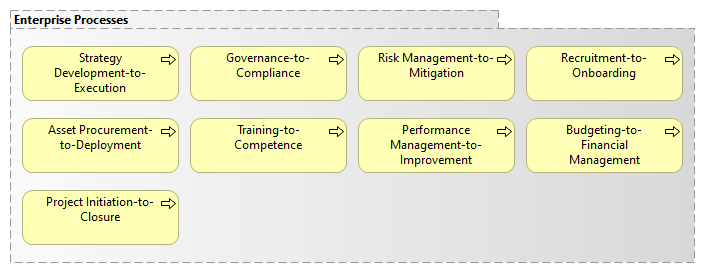
Strategy Development-to-Execution
Goal: Develop and execute the organization’s strategic goals and objectives.
Steps: Market analysis → Strategy formulation → Goal setting → Action plan development → Resource allocation → Implementation → Monitoring and evaluation
Example: A tech company analyzing market trends to formulate a strategy for entering a new market segment, setting specific goals, and implementing the strategy with regular progress evaluations.
Best Practices:
- Conduct comprehensive market analysis to understand trends, opportunities, and threats.
- Formulate a clear and actionable strategy aligned with the organization’s vision and mission.
- Set specific, measurable, achievable, relevant, and time-bound (SMART) goals.
- Develop a detailed action plan outlining steps, timelines, and responsibilities.
- Allocate resources efficiently to support the execution of the strategy.
- Implement the strategy systematically and ensure all team members are aligned.
- Monitor progress regularly and evaluate outcomes to make necessary adjustments and ensure strategic objectives are met.
Governance-to-Compliance
Goal: Establish governance frameworks and ensure compliance with regulations and internal policies.
Steps: Policy development → Regulatory compliance assessment → Risk management → Internal audit → Compliance reporting → Corrective actions → Continuous improvement
Example: A financial institution developing policies to comply with new regulatory requirements, conducting regular audits, and taking corrective actions to address any issues found.
Best Practices:
- Develop comprehensive policies that align with regulatory requirements and internal standards.
- Regularly assess compliance with relevant regulations to identify any gaps.
- Implement robust risk management practices to mitigate potential compliance risks.
- Conduct periodic internal audits to ensure adherence to policies and regulations.
- Report compliance status and findings to stakeholders transparently.
- Take prompt corrective actions to address any compliance issues identified.
- Foster a culture of continuous improvement to enhance governance and compliance practices over time.
Risk Management-to-Mitigation
Goal: Identify, assess, and mitigate risks to the organization.
Steps: Risk identification → Risk assessment → Risk prioritization → Mitigation planning → Implementation of mitigation strategies → Monitoring → Review and update
Example: A healthcare organization identifying and mitigating risks associated with patient data security.
Best Practices:
- Implement a structured process for identifying potential risks across the organization.
- Assess the impact and likelihood of identified risks to understand their significance.
- Prioritize risks based on their potential impact on the organization.
- Develop detailed mitigation plans to address high-priority risks.
- Implement mitigation strategies effectively to reduce or eliminate risks.
- Monitor the effectiveness of mitigation efforts continuously.
- Regularly review and update risk management plans to reflect new risks and changes in the environment.
Recruitment-to-Onboarding
Goal: Attract, recruit, and effectively onboard new employees.
Steps: Job posting → Application collection → Candidate screening → Interviews → Job offer → Acceptance → Onboarding process → Training and orientation
Example: A tech company recruiting software engineers and providing comprehensive onboarding and training to ensure they are quickly integrated into the team.
Best Practices:
- Create clear and attractive job postings that accurately reflect the role and company culture.
- Collect and manage applications efficiently using an applicant tracking system.
- Screen candidates thoroughly to ensure they meet the required qualifications and fit the company culture.
- Conduct structured interviews to evaluate candidates‘ skills and potential.
- Make timely and competitive job offers to selected candidates.
- Ensure a smooth acceptance process with clear communication and support.
- Develop a comprehensive onboarding process that includes all necessary administrative tasks.
- Provide thorough training and orientation to help new employees acclimate and become productive quickly.
Asset Procurement-to-Deployment
Goal: Procure and deploy necessary assets for business operations.
Steps: Needs assessment → Vendor selection → Purchase order → Delivery → Quality check → Deployment → Inventory update
Example: A retail company procuring new point-of-sale systems and deploying them across multiple store locations.
Best Practices:
- Conduct a thorough needs assessment to determine the exact requirements for assets.
- Select vendors based on reliability, cost, and quality.
- Generate and manage purchase orders efficiently.
- Ensure timely delivery of assets and verify shipment contents.
- Perform quality checks to ensure assets meet specifications and standards.
- Deploy assets promptly to minimize downtime and maximize operational efficiency.
- Update inventory records accurately to reflect new assets and their locations.
Training-to-Competence
Goal: Train employees to develop competencies needed for their roles.
Steps: Training needs analysis → Curriculum development → Training delivery → Assessment → Feedback → Continuous improvement
Example: A financial services firm developing a training program for new hires to ensure they are competent in regulatory compliance and customer service.
Best Practices:
- Conduct a detailed training needs analysis to identify skill gaps and requirements.
- Develop a comprehensive curriculum tailored to the identified needs.
- Deliver training using effective and engaging methods, such as interactive workshops and e-learning modules.
- Assess trainees‘ understanding and competency through tests and practical evaluations.
- Collect feedback from trainees to gauge the effectiveness of the training program.
- Continuously improve the training program based on feedback and changing requirements to ensure ongoing relevance and effectiveness.
Performance Management-to-Improvement
Goal: Monitor and improve organizational and employee performance.
Steps: Performance planning → Goal setting → Regular performance reviews → Feedback and coaching → Performance improvement plans → Rewards and recognition
Example: A marketing agency implementing a structured performance management system to boost employee productivity and engagement.
Best Practices:
- Develop clear performance plans that align with organizational goals.
- Set specific, measurable, achievable, relevant, and time-bound (SMART) goals for employees.
- Conduct regular performance reviews to evaluate progress and provide constructive feedback.
- Offer continuous feedback and coaching to support employee development.
- Create performance improvement plans for employees who need additional support to meet expectations.
- Implement a rewards and recognition program to acknowledge and incentivize high performance.
Budgeting-to-Financial Management
Goal: Develop and manage the organization’s budget and financial resources.
Steps: Budget planning → Resource allocation → Financial forecasting → Expense tracking → Financial reporting → Variance analysis → Budget adjustments
Example: A non-profit organization creating an annual budget and tracking expenses to ensure funds are used effectively and efficiently.
Best Practices:
- Conduct thorough budget planning to align with organizational goals and priorities.
- Allocate resources strategically to support key initiatives and operations.
- Perform financial forecasting to predict future revenue and expenses.
- Track expenses meticulously to monitor spending and identify cost-saving opportunities.
- Generate regular financial reports to provide insights into the organization’s financial health.
- Analyze variances between actual and budgeted figures to understand discrepancies.
- Make timely budget adjustments based on variance analysis and changing circumstances.
Project Initiation-to-Closure
Goal: Manage projects from initiation to successful closure.
Steps: Project initiation → Planning → Resource allocation → Execution → Monitoring and control → Project closure → Post-project review
Example: An IT company managing the development and deployment of a new software application from start to finish.
Best Practices:
- Initiate projects with clear objectives, scope, and stakeholder alignment.
- Develop a detailed project plan outlining tasks, timelines, and deliverables.
- Allocate resources effectively to ensure the project is adequately staffed and equipped.
- Execute the project according to the plan, maintaining clear communication among team members.
- Monitor and control project progress to identify and address any issues or deviations from the plan.
- Close the project systematically, ensuring all deliverables are completed and stakeholders are satisfied.
- Conduct a post-project review to capture lessons learned and improve future project management practices.
Quick Reference: All 35 Processes by Domain
| Domain | Processes |
|---|---|
| 01 · Customer Facing | Awareness-to-Registration, Order-to-Activation, Change Request-to-Change, Claim-to-Resolution, Question-to-Answer, Product Consumption-to-Payment, Termination Request-to-Termination Confirmation |
| 02 · Resource Facing | IT Infrastructure Request-to-Operations Readiness, Secure Software Development Lifecycle, Ongoing Maintenance and Support, Vulnerability Management, Technical Order-to-Fulfillment, Resource Change-to-Update, Incident-to-Resolution, Performance Monitoring-to-Improvement |
| 03 · Product Management | Idea-to-Concept, Concept-to-Design, Design-to-Development, Development-to-Launch, Launch-to-Maintenance, Enhancement Request-to-Implementation, Obsolescence-to-Retirement |
| 04 · Partner Facing | Partner Identification-to-Engagement, Partner Onboarding-to-Integration, Procurement-to-Delivery, Collaboration-to-Execution, Performance Monitoring-to-Improvement, Issue-to-Resolution, Partnership Review-to-Renewal/Termination |
| 05 · Revenue Centric | Lead-to-Opportunity, Opportunity-to-Order, Order-to-Invoice, Invoice-to-Cash, Subscription-to-Renewal, Usage-to-Billing, Discount/Promotion-to-Reconciliation, Dispute-to-Resolution, Revenue Recognition-to-Reporting |
| 06 · Enterprise | Strategy Development-to-Execution, Governance-to-Compliance, Risk Management-to-Mitigation, Recruitment-to-Onboarding, Asset Procurement-to-Deployment, Training-to-Competence, Performance Management-to-Improvement, Budgeting-to-Financial Management, Project Initiation-to-Closure |
Frequently Asked Questions
What is the difference between a process and an end-to-end process?
A process is typically a single, contained activity within one function or department. An end-to-end process crosses multiple departments, systems, and teams to deliver a complete outcome — for example, going from a customer „order“ all the way through to „activation,“ which may touch sales, billing, IT, and customer support.
How many process domains should an end-to-end catalog have?
This template uses six domains — Customer Facing, Resource Facing, Product Management, Partner Facing, Revenue Centric, and Enterprise — but the right number depends on your organization’s structure and complexity. Six domains works well as a starting framework that most enterprises can adapt.
Who should own an end-to-end process catalog?
Ownership is often shared between Enterprise/Business Architecture, Process Excellence, or Operations teams, with individual process owners assigned within each domain (e.g., a Sales leader owning Lead-to-Opportunity, an IT leader owning Incident-to-Resolution).
Can this template be used for any industry?
Yes. The structure is industry-agnostic. The specific steps, tools, and examples will vary by sector, but the underlying domains and process names apply broadly across SaaS, telecom, manufacturing, financial services, and more.
Putting the Catalog to Work
An end-to-end process catalog is most valuable when it’s treated as a living document rather than a one-time exercise. Start by mapping your highest-impact processes — often those in the Customer Facing and Revenue Centric domains — then expand outward into Resource Facing, Product Management, Partner Facing, and Enterprise processes as your organization matures its process management practice.
Use this template as a starting point: adapt the domains, rename processes to match your organization’s terminology, and add the specific tools, systems, and KPIs relevant to your business. The goal isn’t a perfect, exhaustive diagram — it’s a shared, evolving reference that helps every team understand how their work connects to the bigger picture.
This article is based on the „End-2-End Processes Template“ (Version 0.1) by Yury Bury-Burymski, licensed under Creative Commons Attribution-NonCommercial-ShareAlike 4.0 International. The original template is available on GitHub.