Kategorie: Architecture

All about solution and software architecture

  • The Complete End-to-End Process Catalog

    Process Architecture · Reference Guide

    The Complete End-to-End Process Catalog

    A practical map of 35+ processes across six business domains — for anyone building, refining, or simply trying to understand how work really flows through an enterprise.

    6 domains 35+ processes ~25 min read

    In today’s dynamic and competitive business environment, enterprises must constantly strive for efficiency, agility, and customer satisfaction. One of the most effective ways to achieve these goals is by building a clear, comprehensive end-to-end process catalog — a single source of truth that maps how work actually flows across an organization, from a customer’s first interaction to final invoice, and from a new hire’s first day to a retired product’s last update.

    This guide walks through a complete, ready-to-use end-to-end process catalog covering six core business domains and more than 35 individual processes. Whether you’re building your first process map or refining an existing one, you can use this as a practical template or a benchmark for your own organization.

    What Is an End-to-End Process Catalog?

    An end-to-end process catalog is a structured inventory of the major workflows that span an organization from start to finish — crossing departments, systems, and teams rather than stopping at a single function’s boundary. Instead of looking at „what does the sales team do“ or „what does IT do“ in isolation, an end-to-end view follows a process all the way through, such as how a customer’s order eventually becomes an invoice, a payment, and recognized revenue.

    This guide presents a template that can be adapted by any enterprise, including:

    • An end-to-end process map diagram
    • Process descriptions organized by domain
    • Goals, steps, examples, and best practices for each process
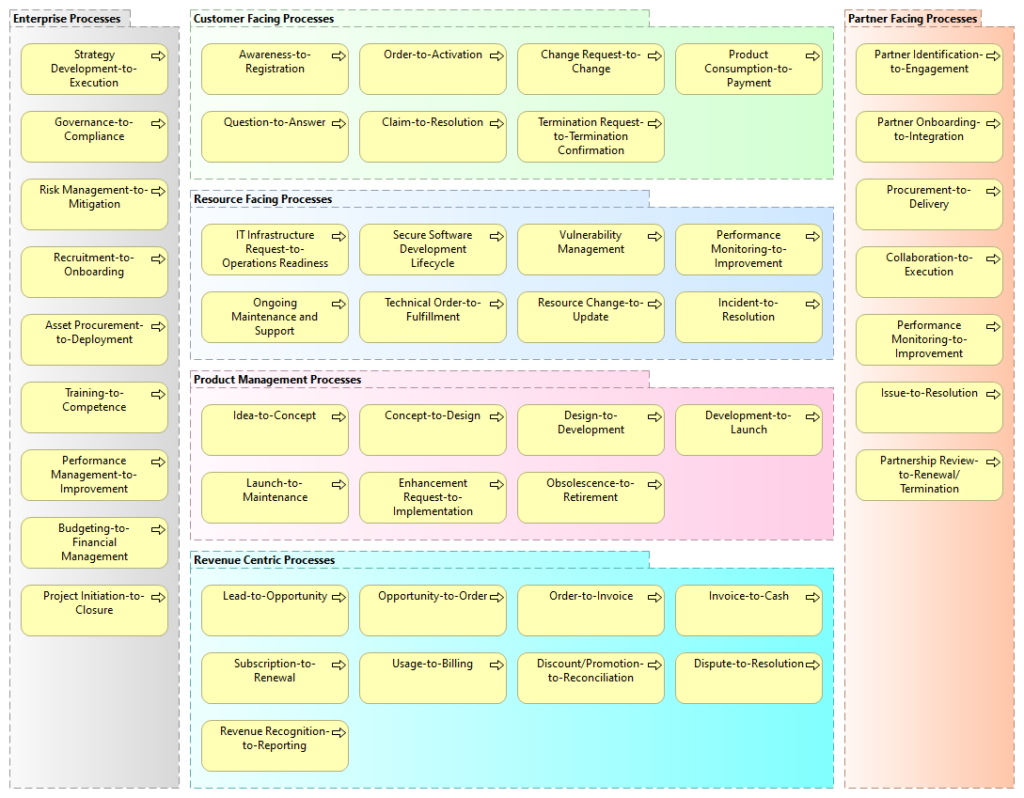
    Generic End-to-End Process Map

    The processes are grouped into six domains:

    #Domain
    01Customer Facing Processes
    02Resource Facing Processes
    03Product Management Processes
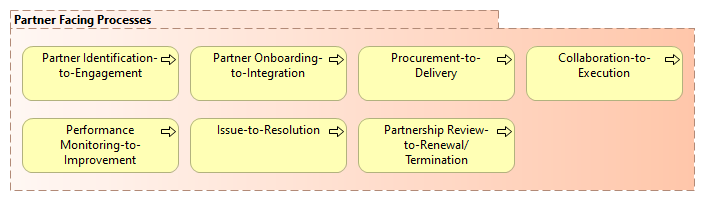
    04Partner Facing Processes
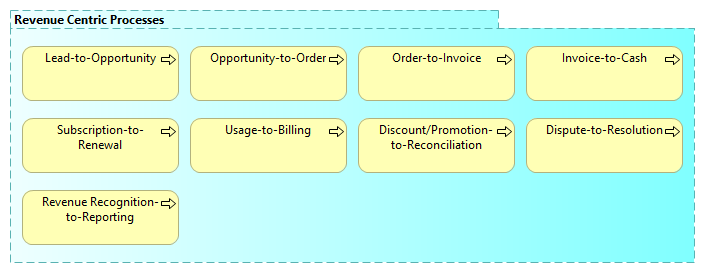
    05Revenue Centric Processes
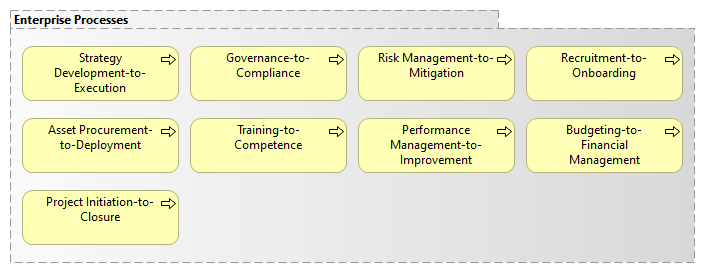
    06Enterprise Processes

    Each domain is explored in detail below, with every process broken down by goal, typical steps, a real-world example, and best practices you can apply right away.

    Why Build an End-to-End Process Catalog?

    Before diving into the catalog itself, it’s worth understanding why this exercise matters. Here are the core motivations for maintaining a catalog of end-to-end processes:

    1. Improved Coordination and Collaboration

    In complex enterprises, different departments and teams often work in silos, which leads to miscommunication and inefficiency. A process catalog fosters better coordination by providing a unified framework that shows how processes interconnect and depend on one another — helping teams understand their role within the bigger picture.

    2. Enhanced Customer Experience

    Customer-facing processes are critical to delivering exceptional service. Cataloging these processes helps ensure every customer interaction is seamless and consistent. By understanding the entire customer journey — from first contact to post-sale support — businesses can identify and fix pain points, improving the overall experience.

    3. Agility and Adaptability

    In a fast-changing market, the ability to quickly adapt is crucial. A documented process catalog gives an organization the flexibility to reconfigure how it operates, whether that means responding to new regulations, adopting new technology, or launching new products faster.

    4. Strategic Alignment

    Aligning business processes with strategic objectives is essential for long-term success. A process catalog ensures every activity supports the organization’s mission and goals, and makes it easier to review and update processes as priorities shift.

    5. Knowledge Management and Continuity

    Documenting processes preserves institutional knowledge and ensures continuity — especially valuable during employee turnover. A well-maintained catalog becomes a living knowledge base that supports onboarding, training, and long-term consistency.


    01

    Customer Facing Processes

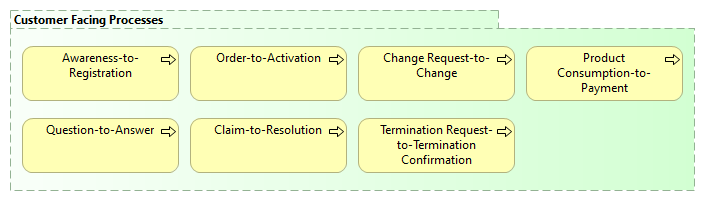
    The Customer Facing domain captures the complete end-to-end processes involved in managing customer interactions, from initial interest and registration to termination requests. Each process is designed to deliver a smooth, efficient experience for the customer while maintaining operational accuracy for the business. Customer-facing processes frequently trigger resource-facing processes behind the scenes, such as technical implementation tasks.

    Customer Facing End-to-End Processes

    Awareness-to-Registration

    Goal: Convert potential customer interest into a desire to use the company’s products or services, capturing leads and encouraging registration (including free sign-ups and, optionally, orders).

    Steps: Targeted advertising → Content marketing → Product demonstrations/webinars → Customer testimonials → Engaging follow-up communications → Marketing campaigns → Lead generation → Website/social media visits → Registration form completion → Confirmation of registration → Feedback collection

    Example: A software company running a webinar series to generate leads and drive registrations for a free trial.

    Best Practices:

    • Ensure all customer touchpoints are tracked.
    • Follow up with personalized communications post-registration.

    Order-to-Activation

    Goal: Facilitate the process from placing an order to activating the purchased product or service.

    Steps: Product/service selection → Order placement → Order processing → Payment confirmation → Product/service activation → Customer notification → Feedback collection

    Example: A SaaS company ensuring customers can access their new subscription software immediately after purchase.

    Best Practices:

    • Automate order processing and payment confirmation.
    • Send clear notifications at each stage of the process.
    • Provide real-time inventory updates to avoid overselling.
    • Integrate systems for seamless information flow.
    • Offer proactive customer support during activation.
    • Collect feedback through automated surveys post-activation.

    Change Request-to-Change

    Goal: Handle customer requests for changes to their existing products or services.

    Steps: Customer request submission → Request evaluation → Approval/rejection → Implementation of changes → Customer notification → Feedback collection

    Example: A cloud service provider enabling customers to upgrade their storage plans through a self-service portal.

    Best Practices:

    • Implement a streamlined request submission process.
    • Use automated systems for quick evaluation and approval.
    • Communicate clearly with customers throughout the process.
    • Ensure changes are implemented accurately and promptly.
    • Gather feedback to improve the change request process.

    Claim-to-Resolution

    Goal: Manage and resolve customer claims or complaints.

    Steps: Claim submission → Acknowledgement of receipt → Investigation → Resolution proposal → Customer agreement → Implementation of resolution → Feedback collection → Closure of claim

    Example: An e-commerce company handling product return claims efficiently.

    Best Practices:

    • Provide a simple and accessible claim submission process.
    • Acknowledge receipt of claims promptly to reassure customers.
    • Conduct thorough investigations to understand the issue.
    • Propose fair and feasible resolutions.
    • Communicate clearly and regularly with the customer.
    • Implement resolutions swiftly and accurately.
    • Collect feedback to improve the claims process.
    • Ensure claims are formally closed once resolved.

    Question-to-Answer

    Goal: Provide timely and accurate answers to customer questions, which can also lead to new orders.

    Steps: Question submission → Routing to appropriate department → Research/consultation → Response formulation → Customer response delivery → Feedback collection

    Example: A tech support team responding to customer inquiries about product features, leading to increased sales.

    Best Practices:

    • Implement a user-friendly question submission interface.
    • Ensure questions are quickly routed to the appropriate department.
    • Provide thorough and accurate research for responses.
    • Formulate clear and helpful responses.
    • Deliver responses promptly through the customer’s preferred communication channel.
    • Collect feedback to improve the quality of answers and the response process.

    Product Consumption-to-Payment

    Goal: Track product or service usage and ensure accurate billing and payment collection.

    Steps: Usage monitoring → Usage data collection → Invoice generation → Invoice delivery → Payment processing → Payment confirmation

    Example: An internet service provider monitoring data usage and billing customers accordingly each month.

    Best Practices:

    • Implement accurate and real-time usage monitoring systems.
    • Ensure seamless collection of usage data.
    • Automate invoice generation to reflect actual usage.
    • Deliver invoices promptly and through preferred customer channels.
    • Offer multiple payment processing options.
    • Confirm payments quickly and update customer accounts accordingly.

    Termination Request-to-Termination Confirmation

    Goal: Process customer requests for terminating products or services and confirm the termination.

    Steps: Termination request submission → Request validation → Feedback collection → Termination processing → Final bill generation → Confirmation of termination

    Example: A subscription-based streaming service processing customer requests to cancel their subscription and providing confirmation along with a final bill.

    Best Practices:

    • Provide an easy and accessible termination request process.
    • Validate requests promptly to prevent unauthorized terminations.
    • Collect feedback to understand reasons for termination and improve services.
    • Process terminations efficiently to ensure a smooth customer experience.
    • Generate and deliver the final bill accurately.
    • Send timely confirmation of termination and any relevant information.

    02

    Resource Facing Processes

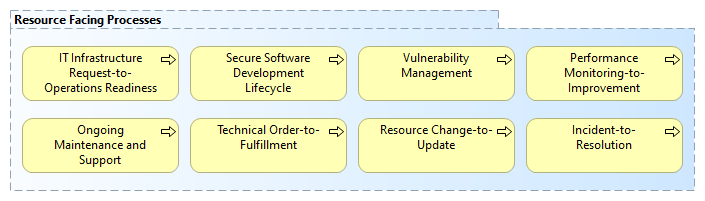
    The Resource Facing domain includes end-to-end processes for managing internal resources. These processes support the overall operational effectiveness of the enterprise, ensuring necessary resources are available and optimally utilized to meet business needs. Linking these processes to customer-facing flows keeps internal and external operations aligned.

    Resource Facing End-to-End Processes

    IT Infrastructure Request-to-Operations Readiness

    Goal: Set up and maintain IT infrastructure to support business operations.

    Steps: Requirements analysis → Infrastructure design → Procurement → Installation and setup → Configuration → Handover to operations

    Example: An IT department setting up a new server for a company’s expanding data storage needs.

    Best Practices:

    • Conduct thorough requirements analysis.
    • Design for scalability and security.
    • Streamline procurement processes.
    • Follow best practices for installation and setup.
    • Optimize configuration for performance.
    • Provide comprehensive documentation and training during handover.

    Secure Software Development Lifecycle

    Goal: Ensure that software development processes incorporate security best practices from inception to deployment.

    Steps: Requirements analysis → Threat modeling → Secure design → Secure coding → Static code analysis → Dynamic application testing → Security reviews → Deployment

    Example: A financial services company developing a new mobile banking app with robust security measures integrated at every stage.

    Best Practices:

    • Conduct thorough requirements analysis with a focus on security.
    • Implement threat modeling to identify potential security risks.
    • Follow secure design principles.
    • Adhere to secure coding standards.
    • Perform static code analysis to detect vulnerabilities early.
    • Conduct dynamic application testing to uncover runtime issues.
    • Regularly perform security reviews throughout development.
    • Ensure secure deployment practices.

    Ongoing Maintenance and Support

    Goal: Provide continuous maintenance and support for IT systems to ensure optimal performance.

    Steps: Regular system checks → Preventive maintenance → Incident management → Patch management → System upgrades → Performance monitoring

    Example: An IT team regularly updating and monitoring a company’s network infrastructure to prevent downtime.

    Best Practices:

    • Perform regular system checks to detect issues early.
    • Implement preventive maintenance to avoid unexpected failures.
    • Manage incidents promptly to minimize impact.
    • Keep systems updated with regular patch management.
    • Plan and execute timely system upgrades.
    • Continuously monitor performance to ensure optimal operation.

    Vulnerability Management

    Goal: Identify, assess, and remediate vulnerabilities in IT systems.

    Steps: Vulnerability scanning → Risk assessment → Remediation planning → Implementation of fixes → Verification → Reporting

    Example: A cybersecurity team performing regular scans on company servers to detect and fix security vulnerabilities.

    Best Practices:

    • Conduct regular vulnerability scanning to identify potential threats.
    • Perform thorough risk assessments to prioritize vulnerabilities.
    • Develop and follow a clear remediation plan.
    • Implement fixes promptly to address identified vulnerabilities.
    • Verify that fixes are effective and do not introduce new issues.
    • Report on vulnerabilities and remediation efforts to stakeholders.

    Technical Order-to-Fulfillment

    Goal: Handle internal resource requests to support business operations.

    Steps: Request submission → Approval process → Resource allocation → Fulfillment → Confirmation → Record keeping

    Example: An IT department processing a request for new laptops for a team of developers.

    Best Practices:

    • Streamline the request submission process.
    • Implement a clear and efficient approval process.
    • Allocate resources based on priority and availability.
    • Ensure timely fulfillment of requests.
    • Provide confirmation to the requester once fulfilled.
    • Maintain accurate records of all resource allocations.

    Resource Change-to-Update

    Goal: Manage changes to resource allocation and update relevant systems.

    Steps: Change request → Impact assessment → Approval → Implementation → System update → Communication to stakeholders

    Example: An IT team reallocating server resources to accommodate increased demand for a particular application.

    Best Practices:

    • Establish a clear process for submitting change requests.
    • Conduct thorough impact assessments to understand potential effects.
    • Ensure timely and transparent approval processes.
    • Implement changes efficiently with minimal disruption.
    • Update all relevant systems to reflect changes.
    • Communicate changes and their impacts to all stakeholders promptly.

    Incident-to-Resolution

    Goal: Manage and resolve internal incidents affecting resources or operations.

    Steps: Incident reporting → Prioritization → Investigation → Resolution plan → Implementation → Follow-up → Closure

    Example: An IT department resolving a network outage that impacts business operations.

    Best Practices:

    • Implement an easy-to-use incident reporting system.
    • Prioritize incidents based on their impact and urgency.
    • Conduct thorough investigations to determine root causes.
    • Develop clear and actionable resolution plans.
    • Implement solutions promptly to restore normal operations.
    • Conduct follow-up to ensure the incident is fully resolved.
    • Document and close the incident formally.

    Performance Monitoring-to-Improvement (Resource Facing)

    Goal: Monitor resource performance and implement improvements.

    Steps: Define KPIs → Data collection → Performance analysis → Identify improvement areas → Implement changes → Monitor impact

    Example: An IT team monitoring server performance metrics and optimizing configurations to improve speed and reliability.

    Best Practices:

    • Clearly define key performance indicators (KPIs) aligned with business goals.
    • Collect performance data consistently and accurately.
    • Analyze performance data to identify trends and areas for improvement.
    • Prioritize and implement necessary changes.
    • Continuously monitor the impact of changes to ensure effectiveness.
    • Regularly review and update KPIs and strategies based on performance insights.

    03

    Product Management Processes

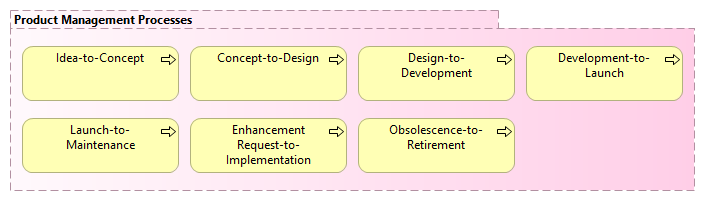
    The Product Management domain covers the entire lifecycle of a product, from initial idea generation to eventual retirement. These end-to-end processes ensure a structured approach to developing, launching, maintaining, and phasing out products — supporting product quality, customer satisfaction, and continuous improvement while staying aligned with overall business goals.

    Product Management End-to-End Processes

    Idea-to-Concept

    Goal: Transform initial product ideas into viable concepts.

    Steps: Idea generation → Market research → Feasibility analysis → Concept development → Initial validation → Concept approval

    Example: A tech company brainstorming and developing a new app concept based on user feedback and market trends.

    Best Practices:

    • Encourage diverse idea generation from multiple sources.
    • Conduct thorough market research to understand demand and competition.
    • Perform feasibility analysis to assess technical, financial, and operational viability.
    • Develop detailed concepts that outline key features and benefits.
    • Validate concepts with initial testing or prototypes.
    • Secure approval from key stakeholders to proceed to the next stage.

    Concept-to-Design

    Goal: Develop detailed designs from approved concepts.

    Steps: Requirements gathering → Design specifications → Prototype development → Design review → Design approval

    Example: A software development team creating detailed designs for a new mobile application based on an approved concept.

    Best Practices:

    • Gather comprehensive requirements from stakeholders and users.
    • Develop clear and detailed design specifications.
    • Create prototypes to visualize and test design ideas.
    • Conduct thorough design reviews with key stakeholders.
    • Obtain formal design approval before proceeding to development.

    Design-to-Development

    Goal: Move from detailed designs to actual product development.

    Steps: Development planning → Resource allocation → Coding/manufacturing → Iterative testing → Quality assurance → Development completion

    Example: A team of developers turning the detailed designs of a new software feature into a functional product.

    Best Practices:

    • Create a comprehensive development plan outlining timelines and milestones.
    • Allocate resources effectively, ensuring the right skills and tools are available.
    • Follow best practices in coding or manufacturing to ensure quality and efficiency.
    • Conduct iterative testing throughout development to catch and fix issues early.
    • Implement rigorous quality assurance processes to ensure the final product meets standards.
    • Complete development with thorough documentation and readiness for the next phase.

    Development-to-Launch

    Goal: Prepare and launch the developed product onto the market.

    Steps: Pre-launch testing → Market readiness → Production setup → Marketing strategy → Product launch → Initial customer feedback

    Example: A tech company conducting final tests and setting up a marketing campaign before releasing a new app.

    Best Practices:

    • Conduct thorough pre-launch testing to ensure the product is bug-free and user-friendly.
    • Ensure market readiness by aligning the product with market needs and regulatory requirements.
    • Set up production processes to handle initial demand efficiently.
    • Develop a comprehensive marketing strategy to create buzz and attract early adopters.
    • Execute a well-coordinated product launch to maximize visibility and impact.
    • Collect and analyze initial customer feedback to make necessary adjustments quickly.

    Launch-to-Maintenance

    Goal: Ensure ongoing product support and improvements after launch.

    Steps: Customer support setup → Continuous monitoring → Bug fixing → Regular updates → Feature enhancements → Customer feedback loop

    Example: A software company providing continuous updates and support for a newly launched app to ensure it remains competitive and functional.

    Best Practices:

    • Set up robust customer support to handle inquiries and issues.
    • Continuously monitor the product’s performance and user feedback.
    • Promptly fix any bugs or issues that arise.
    • Implement regular updates to improve security and functionality.
    • Enhance features based on user needs and market trends.
    • Establish a feedback loop to gather and act on customer insights.

    Enhancement Request-to-Implementation

    Goal: Manage and implement product enhancement requests.

    Steps: Enhancement request submission → Prioritization → Design and development → Testing → Release → Customer notification

    Example: A software company adding new features to an existing application based on user requests.

    Best Practices:

    • Provide an easy-to-use submission process for enhancement requests.
    • Prioritize requests based on customer impact and strategic value.
    • Follow rigorous design and development processes to ensure quality.
    • Conduct thorough testing to verify the enhancement works as intended.
    • Release enhancements in a controlled manner to ensure stability.
    • Notify customers about new features and enhancements to maintain engagement and satisfaction.

    Obsolescence-to-Retirement

    Goal: Manage the end-of-life process for products.

    Steps: Obsolescence planning → Customer communication → Support phase-out → Data migration → Product retirement → Post-retirement support

    Example: A tech company retiring an outdated software version and migrating users to a newer version.

    Best Practices:

    • Plan obsolescence to ensure a smooth transition for users.
    • Communicate clearly and early with customers about the product’s end-of-life timeline.
    • Gradually phase out support to give customers time to adapt.
    • Ensure seamless data migration to new systems or products.
    • Retire the product efficiently and securely.
    • Provide post-retirement support to assist customers with the transition and address any lingering issues.

    04

    Partner Facing Processes

    The Partner Facing domain encompasses the entire lifecycle of partner relationships, from initial identification and engagement to ongoing collaboration, performance monitoring, and eventual renewal or termination. Maintaining strong, productive relationships with partners helps businesses enhance their capabilities, expand their reach, and achieve strategic goals more effectively.

    Partner Facing End-to-End Processes

    Partner Identification-to-Engagement

    Goal: Identify and engage potential partners to collaborate with the business.

    Steps: Market research → Identify potential partners → Initial outreach → Evaluation of partnership potential → Formal engagement → Agreement signing

    Example: A tech startup researching and reaching out to potential hardware manufacturers for collaboration.

    Best Practices:

    • Conduct thorough market research to identify potential partners that align with business goals.
    • Create a comprehensive list of potential partners based on market research.
    • Initiate contact with potential partners through formal and professional outreach.
    • Evaluate the potential of each partnership based on strategic fit, capabilities, and mutual benefits.
    • Engage formally with selected partners to discuss collaboration opportunities.
    • Ensure clear and mutually beneficial terms are established and sign formal agreements to solidify the partnership.

    Partner Onboarding-to-Integration

    Goal: Seamlessly integrate new partners into the business operations.

    Steps: Onboarding planning → System integration → Training and orientation → Communication setup → Initial collaboration → Performance monitoring

    Example: A software company integrating a new cloud service provider into its operations.

    Best Practices:

    • Develop a detailed onboarding plan to ensure a smooth transition.
    • Integrate the partner’s systems with existing business operations for seamless data and process flow.
    • Provide comprehensive training and orientation to familiarize the partner with your systems and processes.
    • Establish clear communication channels to facilitate ongoing collaboration.
    • Begin with initial collaborative projects to build rapport and ensure smooth working relationships.
    • Continuously monitor performance to identify and address any issues early.

    Procurement-to-Delivery

    Goal: Manage the procurement process from order placement to delivery.

    Steps: Procurement planning → Request for proposal → Vendor selection → Contract negotiation → Order placement → Delivery tracking → Receipt confirmation → Quality check

    Example: A manufacturing company sourcing raw materials from suppliers.

    Best Practices:

    • Develop a thorough procurement plan outlining requirements and timelines.
    • Issue detailed requests for proposals (RFPs) to potential vendors.
    • Select vendors based on criteria such as cost, quality, and reliability.
    • Negotiate contracts to ensure favorable terms and conditions.
    • Place orders promptly and clearly communicate requirements.
    • Track deliveries to ensure timely arrival.
    • Confirm receipt of goods and conduct quality checks to verify they meet standards.

    Collaboration-to-Execution

    Goal: Facilitate effective collaboration with partners to execute joint projects or operations.

    Steps: Joint planning → Resource allocation → Task assignment → Regular communication → Progress monitoring → Issue resolution → Project completion

    Example: A tech company collaborating with a marketing agency to launch a new product.

    Best Practices:

    • Engage in thorough joint planning to align goals and expectations.
    • Allocate resources effectively to ensure both parties have what they need.
    • Clearly assign tasks and responsibilities to avoid confusion.
    • Maintain regular communication to keep all stakeholders informed and engaged.
    • Monitor progress continuously to stay on track and make adjustments as needed.
    • Address issues promptly to minimize disruptions.
    • Ensure the project is completed on time and meets the agreed-upon standards.

    Performance Monitoring-to-Improvement (Partner Facing)

    Goal: Monitor partner performance and implement necessary improvements.

    Steps: Define performance metrics → Data collection → Performance analysis → Feedback gathering → Improvement planning → Implementation → Re-evaluation

    Example: An e-commerce company monitoring the performance of its logistics partner to ensure timely deliveries.

    Best Practices:

    • Define clear and relevant performance metrics aligned with business goals.
    • Collect performance data consistently and accurately.
    • Analyze performance data to identify trends and areas for improvement.
    • Gather feedback from stakeholders to gain insights into performance issues.
    • Develop a detailed improvement plan addressing identified issues.
    • Implement improvements in collaboration with the partner.
    • Re-evaluate performance after changes are made to ensure effectiveness.

    Issue-to-Resolution (Partner Facing)

    Goal: Address and resolve any issues arising in the partnership.

    Steps: Issue reporting → Prioritization → Investigation → Resolution plan → Implementation → Partner communication → Follow-up

    Example: A software company resolving a compatibility issue with a third-party API used by a partner.

    Best Practices:

    • Implement a straightforward issue reporting system.
    • Prioritize issues based on impact and urgency.
    • Conduct thorough investigations to understand the root cause.
    • Develop a clear and actionable resolution plan.
    • Implement solutions efficiently to minimize disruptions.
    • Maintain open communication with the partner throughout the process.
    • Follow up to ensure the issue is fully resolved and to prevent recurrence.

    Partnership Review-to-Renewal/Termination

    Goal: Periodically review partnerships to decide on renewal or termination.

    Steps: Performance review → Strategic alignment assessment → Renewal/termination decision → Renewal negotiation/termination process → Transition planning → Execution → Update systems of records

    Example: A retail company reviewing its partnership with a logistics provider to decide whether to renew the contract.

    Best Practices:

    • Conduct regular and thorough performance reviews of the partnership.
    • Assess the strategic alignment of the partnership with long-term business goals.
    • Make informed decisions on renewal or termination based on performance and alignment.
    • Negotiate terms for renewal or manage the termination process smoothly.
    • Plan transitions carefully to minimize disruptions.
    • Execute the renewal or termination plan efficiently.
    • Ensure all systems of records are updated to reflect the current partnership status.

    05

    Revenue Centric Processes

    The Revenue domain encompasses the entire lifecycle of financial transactions related to sales and billing — from lead generation and conversion to invoicing, payment collection, and financial reporting. Maintaining accurate, transparent revenue processes improves cash flow, enhances customer satisfaction, and ensures compliance with financial regulations.

    Revenue Centric End-to-End Processes

    It’s important to distinguish customer-facing/partner-facing processes from revenue-centric processes, since they represent different perspectives within the organization. Customer-facing and partner-facing processes focus on the interactions and experience of the customer or partner, while revenue-centric processes emphasize the financial transactions and revenue-generation side of the business. Both are crucial and interrelated, but serve distinct purposes:

    • Customer-Facing Processes manage all interactions with the customer, from initial contact to ongoing support, aiming for a seamless and satisfying experience. Examples: Awareness-to-Registration, Order-to-Activation, Claim-to-Resolution.
    • Revenue-Centric Processes focus on managing the financial transactions associated with sales and services, ensuring the business efficiently generates and collects revenue. Examples: Lead-to-Opportunity, Order-to-Invoice, Invoice-to-Cash.

    Customer-facing processes often trigger revenue-centric processes — for instance, Order-to-Activation in the customer-facing domain initiates Order-to-Invoice in the revenue-centric domain.


    Lead-to-Opportunity

    Goal: Convert potential customer leads into sales opportunities.

    Steps: Lead generation → Lead qualification → Initial engagement → Needs assessment → Opportunity creation → Sales pitch → Opportunity tracking

    Example: A SaaS company using targeted marketing campaigns to generate leads, qualify them, and convert them into sales opportunities.

    Best Practices:

    • Implement effective lead generation strategies to attract potential customers.
    • Qualify leads systematically to focus on high-potential prospects.
    • Engage with leads promptly and professionally to build interest.
    • Conduct thorough needs assessments to understand customer requirements.
    • Create opportunities based on the customer’s needs and potential value.
    • Deliver compelling sales pitches tailored to the customer’s needs.
    • Track opportunities diligently to manage the sales pipeline effectively.

    Opportunity-to-Order

    Goal: Convert sales opportunities into confirmed orders.

    Steps: Proposal development → Quotation → Negotiation → Agreement finalization → Order placement → Order confirmation → Contract signing

    Example: An IT services company converting a project opportunity with a potential client into a signed contract.

    Best Practices:

    • Develop detailed and tailored proposals that meet the specific needs of the customer.
    • Provide clear and competitive quotations.
    • Engage in effective negotiations to reach mutually beneficial terms.
    • Finalize agreements with thorough attention to detail.
    • Ensure the order is placed promptly and accurately.
    • Confirm orders with clear communication to the customer.
    • Execute contract signing to formalize the agreement and commence the project.

    Order-to-Invoice

    Goal: Generate and issue invoices based on confirmed orders.

    Steps: Order review → Invoice creation → Approval process → Invoice delivery to customer → Invoice tracking

    Example: A manufacturing company generating invoices for confirmed orders from retailers.

    Best Practices:

    • Conduct a thorough review of confirmed orders to ensure accuracy.
    • Create detailed and clear invoices that reflect the order specifics.
    • Implement an approval process to verify invoice accuracy before sending.
    • Deliver invoices promptly to customers through their preferred channels.
    • Track invoices to ensure timely payment and address any discrepancies quickly.

    Invoice-to-Cash

    Goal: Manage the collection of payments from issued invoices.

    Steps: Invoice delivery → Payment follow-up → Payment receipt → Payment processing → Confirmation of payment → Update financial records

    Example: An accounting firm tracking payments from clients after delivering invoices for services rendered.

    Best Practices:

    • Ensure prompt and accurate delivery of invoices.
    • Follow up regularly with customers to remind them of outstanding payments.
    • Record payments as soon as they are received.
    • Process payments efficiently to minimize delays.
    • Confirm receipt of payment with the customer.
    • Update financial records to reflect the payment and maintain accurate accounts.

    Subscription-to-Renewal

    Goal: Manage subscription services from initiation to renewal.

    Steps: Subscription initiation → Service delivery → Usage tracking → Renewal reminder → Renewal processing → Update subscription records

    Example: A software company managing yearly subscriptions for its cloud services, ensuring timely renewals.

    Best Practices:

    • Initiate subscriptions promptly and accurately.
    • Deliver services consistently and maintain high quality.
    • Track usage to provide insights and ensure fair billing.
    • Send timely renewal reminders to customers.
    • Process renewals efficiently to prevent service interruptions.
    • Update subscription records accurately to reflect the current status.

    Usage-to-Billing

    Goal: Track product or service usage and generate corresponding bills.

    Steps: Usage monitoring → Data collection → Billing cycle processing → Bill generation → Bill delivery → Payment follow-up

    Example: An internet service provider tracking data usage and billing customers accordingly each month.

    Best Practices:

    • Implement accurate and real-time usage monitoring systems.
    • Ensure consistent and reliable data collection.
    • Process billing cycles efficiently to prepare timely bills.
    • Generate clear and detailed bills that reflect actual usage.
    • Deliver bills promptly through preferred customer channels.
    • Follow up on payments to ensure timely collection and address any billing inquiries.

    Discount/Promotion-to-Reconciliation

    Goal: Apply discounts or promotions and reconcile them with financial records.

    Steps: Discount/promotion creation → Customer application → Transaction recording → Reconciliation with financial records → Reporting

    Example: A retail company offering seasonal discounts and ensuring all sales transactions reflect these promotions accurately in financial records.

    Best Practices:

    • Develop clear and attractive discount or promotion offers.
    • Ensure seamless application of discounts at the point of sale.
    • Accurately record transactions reflecting applied discounts.
    • Reconcile discounts and promotions with financial records regularly to maintain accuracy.
    • Generate reports to review the effectiveness and financial impact of discounts and promotions.

    Dispute-to-Resolution

    Goal: Address and resolve any billing or payment disputes with customers.

    Steps: Dispute notification → Investigation → Customer communication → Resolution proposal → Implementation → Confirmation → Record update

    Example: A telecom company resolving a customer’s dispute over incorrect billing charges.

    Best Practices:

    • Provide a clear and easy way for customers to notify disputes.
    • Investigate disputes thoroughly to understand the root cause.
    • Communicate with customers promptly and transparently during the investigation.
    • Propose a fair and feasible resolution to the customer.
    • Implement the resolution efficiently to address the issue.
    • Confirm with the customer that the dispute has been resolved to their satisfaction.
    • Update records to reflect the resolution and prevent future occurrences.

    Revenue Recognition-to-Reporting

    Goal: Accurately recognize revenue and prepare financial reports.

    Steps: Revenue recognition → Financial record updating → Periodic closing → Financial analysis → Report generation → Stakeholder review

    Example: A software company recognizing subscription revenue monthly and preparing quarterly financial reports for stakeholders.

    Best Practices:

    • Implement robust revenue recognition policies that comply with accounting standards.
    • Update financial records promptly to reflect recognized revenue.
    • Perform periodic closing procedures to ensure accurate financial statements.
    • Conduct thorough financial analysis to interpret revenue data and trends.
    • Generate detailed and accurate financial reports.
    • Review reports with stakeholders to provide transparency and inform decision-making.

    06

    Enterprise Processes

    The Enterprise domain includes end-to-end processes that support the overall strategic, governance, risk management, and operational needs of the organization. These processes ensure the enterprise operates efficiently, adheres to regulations, manages risks effectively, and continuously improves its performance.

    Enterprise End-to-End Processes

    Strategy Development-to-Execution

    Goal: Develop and execute the organization’s strategic goals and objectives.

    Steps: Market analysis → Strategy formulation → Goal setting → Action plan development → Resource allocation → Implementation → Monitoring and evaluation

    Example: A tech company analyzing market trends to formulate a strategy for entering a new market segment, setting specific goals, and implementing the strategy with regular progress evaluations.

    Best Practices:

    • Conduct comprehensive market analysis to understand trends, opportunities, and threats.
    • Formulate a clear and actionable strategy aligned with the organization’s vision and mission.
    • Set specific, measurable, achievable, relevant, and time-bound (SMART) goals.
    • Develop a detailed action plan outlining steps, timelines, and responsibilities.
    • Allocate resources efficiently to support the execution of the strategy.
    • Implement the strategy systematically and ensure all team members are aligned.
    • Monitor progress regularly and evaluate outcomes to make necessary adjustments and ensure strategic objectives are met.

    Governance-to-Compliance

    Goal: Establish governance frameworks and ensure compliance with regulations and internal policies.

    Steps: Policy development → Regulatory compliance assessment → Risk management → Internal audit → Compliance reporting → Corrective actions → Continuous improvement

    Example: A financial institution developing policies to comply with new regulatory requirements, conducting regular audits, and taking corrective actions to address any issues found.

    Best Practices:

    • Develop comprehensive policies that align with regulatory requirements and internal standards.
    • Regularly assess compliance with relevant regulations to identify any gaps.
    • Implement robust risk management practices to mitigate potential compliance risks.
    • Conduct periodic internal audits to ensure adherence to policies and regulations.
    • Report compliance status and findings to stakeholders transparently.
    • Take prompt corrective actions to address any compliance issues identified.
    • Foster a culture of continuous improvement to enhance governance and compliance practices over time.

    Risk Management-to-Mitigation

    Goal: Identify, assess, and mitigate risks to the organization.

    Steps: Risk identification → Risk assessment → Risk prioritization → Mitigation planning → Implementation of mitigation strategies → Monitoring → Review and update

    Example: A healthcare organization identifying and mitigating risks associated with patient data security.

    Best Practices:

    • Implement a structured process for identifying potential risks across the organization.
    • Assess the impact and likelihood of identified risks to understand their significance.
    • Prioritize risks based on their potential impact on the organization.
    • Develop detailed mitigation plans to address high-priority risks.
    • Implement mitigation strategies effectively to reduce or eliminate risks.
    • Monitor the effectiveness of mitigation efforts continuously.
    • Regularly review and update risk management plans to reflect new risks and changes in the environment.

    Recruitment-to-Onboarding

    Goal: Attract, recruit, and effectively onboard new employees.

    Steps: Job posting → Application collection → Candidate screening → Interviews → Job offer → Acceptance → Onboarding process → Training and orientation

    Example: A tech company recruiting software engineers and providing comprehensive onboarding and training to ensure they are quickly integrated into the team.

    Best Practices:

    • Create clear and attractive job postings that accurately reflect the role and company culture.
    • Collect and manage applications efficiently using an applicant tracking system.
    • Screen candidates thoroughly to ensure they meet the required qualifications and fit the company culture.
    • Conduct structured interviews to evaluate candidates‘ skills and potential.
    • Make timely and competitive job offers to selected candidates.
    • Ensure a smooth acceptance process with clear communication and support.
    • Develop a comprehensive onboarding process that includes all necessary administrative tasks.
    • Provide thorough training and orientation to help new employees acclimate and become productive quickly.

    Asset Procurement-to-Deployment

    Goal: Procure and deploy necessary assets for business operations.

    Steps: Needs assessment → Vendor selection → Purchase order → Delivery → Quality check → Deployment → Inventory update

    Example: A retail company procuring new point-of-sale systems and deploying them across multiple store locations.

    Best Practices:

    • Conduct a thorough needs assessment to determine the exact requirements for assets.
    • Select vendors based on reliability, cost, and quality.
    • Generate and manage purchase orders efficiently.
    • Ensure timely delivery of assets and verify shipment contents.
    • Perform quality checks to ensure assets meet specifications and standards.
    • Deploy assets promptly to minimize downtime and maximize operational efficiency.
    • Update inventory records accurately to reflect new assets and their locations.

    Training-to-Competence

    Goal: Train employees to develop competencies needed for their roles.

    Steps: Training needs analysis → Curriculum development → Training delivery → Assessment → Feedback → Continuous improvement

    Example: A financial services firm developing a training program for new hires to ensure they are competent in regulatory compliance and customer service.

    Best Practices:

    • Conduct a detailed training needs analysis to identify skill gaps and requirements.
    • Develop a comprehensive curriculum tailored to the identified needs.
    • Deliver training using effective and engaging methods, such as interactive workshops and e-learning modules.
    • Assess trainees‘ understanding and competency through tests and practical evaluations.
    • Collect feedback from trainees to gauge the effectiveness of the training program.
    • Continuously improve the training program based on feedback and changing requirements to ensure ongoing relevance and effectiveness.

    Performance Management-to-Improvement

    Goal: Monitor and improve organizational and employee performance.

    Steps: Performance planning → Goal setting → Regular performance reviews → Feedback and coaching → Performance improvement plans → Rewards and recognition

    Example: A marketing agency implementing a structured performance management system to boost employee productivity and engagement.

    Best Practices:

    • Develop clear performance plans that align with organizational goals.
    • Set specific, measurable, achievable, relevant, and time-bound (SMART) goals for employees.
    • Conduct regular performance reviews to evaluate progress and provide constructive feedback.
    • Offer continuous feedback and coaching to support employee development.
    • Create performance improvement plans for employees who need additional support to meet expectations.
    • Implement a rewards and recognition program to acknowledge and incentivize high performance.

    Budgeting-to-Financial Management

    Goal: Develop and manage the organization’s budget and financial resources.

    Steps: Budget planning → Resource allocation → Financial forecasting → Expense tracking → Financial reporting → Variance analysis → Budget adjustments

    Example: A non-profit organization creating an annual budget and tracking expenses to ensure funds are used effectively and efficiently.

    Best Practices:

    • Conduct thorough budget planning to align with organizational goals and priorities.
    • Allocate resources strategically to support key initiatives and operations.
    • Perform financial forecasting to predict future revenue and expenses.
    • Track expenses meticulously to monitor spending and identify cost-saving opportunities.
    • Generate regular financial reports to provide insights into the organization’s financial health.
    • Analyze variances between actual and budgeted figures to understand discrepancies.
    • Make timely budget adjustments based on variance analysis and changing circumstances.

    Project Initiation-to-Closure

    Goal: Manage projects from initiation to successful closure.

    Steps: Project initiation → Planning → Resource allocation → Execution → Monitoring and control → Project closure → Post-project review

    Example: An IT company managing the development and deployment of a new software application from start to finish.

    Best Practices:

    • Initiate projects with clear objectives, scope, and stakeholder alignment.
    • Develop a detailed project plan outlining tasks, timelines, and deliverables.
    • Allocate resources effectively to ensure the project is adequately staffed and equipped.
    • Execute the project according to the plan, maintaining clear communication among team members.
    • Monitor and control project progress to identify and address any issues or deviations from the plan.
    • Close the project systematically, ensuring all deliverables are completed and stakeholders are satisfied.
    • Conduct a post-project review to capture lessons learned and improve future project management practices.

    Quick Reference: All 35 Processes by Domain

    DomainProcesses
    01 · Customer FacingAwareness-to-Registration, Order-to-Activation, Change Request-to-Change, Claim-to-Resolution, Question-to-Answer, Product Consumption-to-Payment, Termination Request-to-Termination Confirmation
    02 · Resource FacingIT Infrastructure Request-to-Operations Readiness, Secure Software Development Lifecycle, Ongoing Maintenance and Support, Vulnerability Management, Technical Order-to-Fulfillment, Resource Change-to-Update, Incident-to-Resolution, Performance Monitoring-to-Improvement
    03 · Product ManagementIdea-to-Concept, Concept-to-Design, Design-to-Development, Development-to-Launch, Launch-to-Maintenance, Enhancement Request-to-Implementation, Obsolescence-to-Retirement
    04 · Partner FacingPartner Identification-to-Engagement, Partner Onboarding-to-Integration, Procurement-to-Delivery, Collaboration-to-Execution, Performance Monitoring-to-Improvement, Issue-to-Resolution, Partnership Review-to-Renewal/Termination
    05 · Revenue CentricLead-to-Opportunity, Opportunity-to-Order, Order-to-Invoice, Invoice-to-Cash, Subscription-to-Renewal, Usage-to-Billing, Discount/Promotion-to-Reconciliation, Dispute-to-Resolution, Revenue Recognition-to-Reporting
    06 · EnterpriseStrategy Development-to-Execution, Governance-to-Compliance, Risk Management-to-Mitigation, Recruitment-to-Onboarding, Asset Procurement-to-Deployment, Training-to-Competence, Performance Management-to-Improvement, Budgeting-to-Financial Management, Project Initiation-to-Closure

    Frequently Asked Questions

    What is the difference between a process and an end-to-end process?

    A process is typically a single, contained activity within one function or department. An end-to-end process crosses multiple departments, systems, and teams to deliver a complete outcome — for example, going from a customer „order“ all the way through to „activation,“ which may touch sales, billing, IT, and customer support.

    How many process domains should an end-to-end catalog have?

    This template uses six domains — Customer Facing, Resource Facing, Product Management, Partner Facing, Revenue Centric, and Enterprise — but the right number depends on your organization’s structure and complexity. Six domains works well as a starting framework that most enterprises can adapt.

    Who should own an end-to-end process catalog?

    Ownership is often shared between Enterprise/Business Architecture, Process Excellence, or Operations teams, with individual process owners assigned within each domain (e.g., a Sales leader owning Lead-to-Opportunity, an IT leader owning Incident-to-Resolution).

    Can this template be used for any industry?

    Yes. The structure is industry-agnostic. The specific steps, tools, and examples will vary by sector, but the underlying domains and process names apply broadly across SaaS, telecom, manufacturing, financial services, and more.


    Putting the Catalog to Work

    An end-to-end process catalog is most valuable when it’s treated as a living document rather than a one-time exercise. Start by mapping your highest-impact processes — often those in the Customer Facing and Revenue Centric domains — then expand outward into Resource Facing, Product Management, Partner Facing, and Enterprise processes as your organization matures its process management practice.

    Use this template as a starting point: adapt the domains, rename processes to match your organization’s terminology, and add the specific tools, systems, and KPIs relevant to your business. The goal isn’t a perfect, exhaustive diagram — it’s a shared, evolving reference that helps every team understand how their work connects to the bigger picture.

    This article is based on the „End-2-End Processes Template“ (Version 0.1) by Yury Bury-Burymski, licensed under Creative Commons Attribution-NonCommercial-ShareAlike 4.0 International. The original template is available on GitHub.

  • TMF Open APIs Without the Complexity Trap

    Pragmatic Integration Patterns Using TMF620, TMF679, TMF622, TMF637, TMF641, TMF633, TMF645 and TMF638

    Telecommunication architectures increasingly adopt TM Forum Open APIs to standardize integration across OSS/BSS ecosystems. These APIs provide a shared semantic language that enables interoperability between systems from different vendors and internal domains.

    However, real-world implementations often struggle — not because of the APIs themselves, but because of how they are applied architecturally. Many organizations introduce unnecessary complexity: heavy middleware layers, rigid orchestration engines, or “TMF-first” internal modeling that couples everything to standard schemas and slows delivery.

    This article presents a set of pragmatic integration prototypes demonstrating how core TM Forum APIs can be used effectively as stable integration contracts, while avoiding common complexity traps. The goal is to show an approach that is realistic for enterprise landscapes, but still incremental and maintainable.

    The prototypes focus on the following APIs:

    • TMF620 Product Catalog Management
    • TMF679 Product Offering Qualification
    • TMF622 Product Ordering Management
    • TMF637 Product Inventory Management
    • TMF641 Service Ordering Management
    • TMF633 Service Catalog Management
    • TMF645 Service Qualification Management
    • TMF638 Service Inventory Management

    Together, these APIs cover a complete lifecycle from product discovery and qualification, through ordering and orchestration, to fulfillment and operational tracking.

    Architectural principles

    Before exploring specific patterns, it is important to clarify the architectural perspective used in these prototypes.

    TM Forum APIs should be treated as:

    • stable integration contracts
    • domain boundaries between systems
    • interoperability interfaces

    They should not automatically define internal architecture, internal data models, or orchestration strategy.

    The core principles applied here:

    • Use TMF APIs as integration boundaries rather than internal models.
    • Implement TMF APIs as API facades / anti-corruption layers when integrating legacy or vendor systems.
    • Keep orchestration inside a domain-owned Order Management / Orchestrator (COM) rather than in external workflow platforms by default.
    • Combine synchronous APIs at the boundaries with asynchronous lifecycle feedback where it improves resilience and decoupling.
    • Support incremental modernization rather than big-bang transformations.

    In practice, many telecom transformations fail when TM Forum APIs are treated as architectural frameworks rather than interoperability contracts.

    End-to-End flow overview

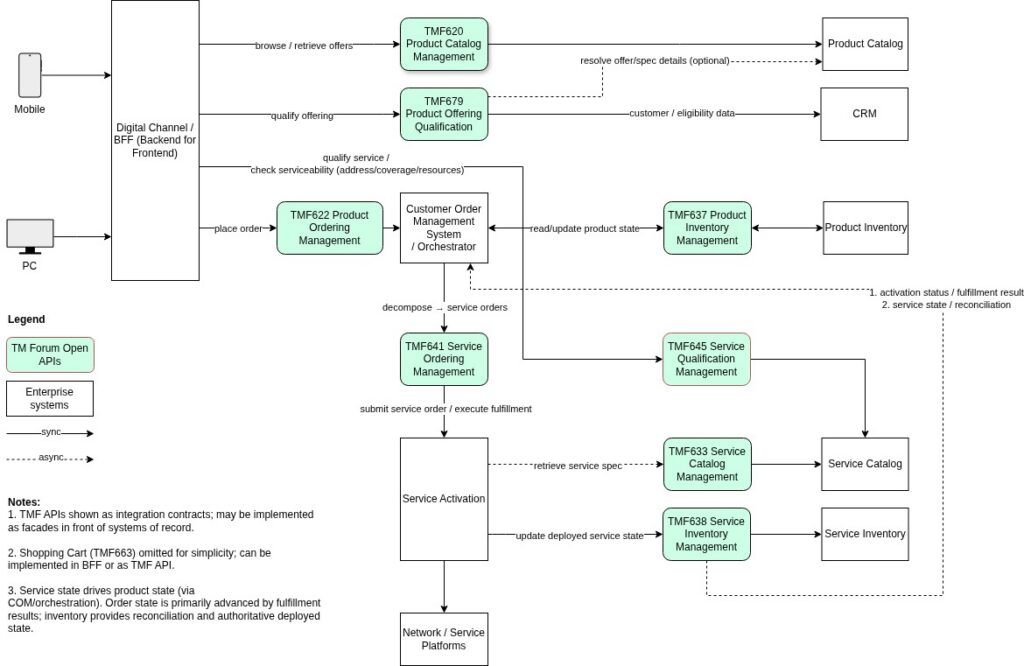
    To understand how these TM Forum Open APIs work together in a pragmatic integration architecture, it is useful to examine the complete lifecycle from customer interaction to operational service state.

    Rather than presenting TMF APIs as isolated endpoints, this architecture shows how they form a set of integration contracts between clearly separated domains: digital engagement, commercial management, order orchestration, and service fulfillment.

    The goal is not to prescribe a rigid framework, but to illustrate how standardized APIs can be combined into a coherent flow while preserving domain autonomy and minimizing coupling between systems.

    Several important design choices shape this architecture:

    • Digital channels interact only with stable TMF contracts rather than internal system implementations.
    • Qualification is separated into commercial validation (product offering qualification) and technical feasibility (service qualification), preventing late-stage failures during fulfillment.
    • Product ordering defines the boundary between commercial intent and operational execution.
    • A domain-owned order management system performs orchestration, avoiding centralized integration bottlenecks.
    • Operational reality is reflected through service and product inventories, enabling lifecycle tracking and reconciliation.

    The diagram below presents a high-level view of this lifecycle, emphasizing architectural responsibilities rather than implementation details.

    Pragmatic Integration Patterns Using TMF620, TMF679, TMF622, TMF637, TMF641, TMF633, TMF645 and TMF638:
- TMF620 Product Catalog Management
- TMF679 Product Offering Qualification
- TMF622 Product Ordering Management
- TMF637 Product Inventory Management
- TMF641 Service Ordering Management
- TMF633 Service Catalog Management
- TMF645 Service Qualification Management
- TMF638 Service Inventory Management

    The lifecycle begins in a Digital Channel / BFF (Backend-for-Frontend). The BFF performs synchronous interactions with commerce-facing APIs:

    • TMF620 Product Catalog is used to browse and retrieve commercial offerings.
    • TMF679 Product Offering Qualification validates eligibility and configuration constraints for the selected offering. In some implementations, qualification may require resolving offer/spec details from the catalog — this is treated as an optional supporting lookup, not a mandatory dependency.
    • TMF645 Service Qualification checks serviceability (address / coverage / resource constraints). This keeps “can we technically deliver this?” separate from “is this product commercially valid?”, reducing hidden coupling and late-order failures.

    Once the customer confirms the purchase, the channel submits the request via TMF622 Product Ordering. This API acts as a key architectural boundary: it captures commercial intent using a standardized contract, while shielding downstream systems from channel-specific variations.

    Behind TMF622 sits the Customer Order Management System / Orchestrator (COM). The COM owns the order lifecycle and orchestration logic and is responsible for decomposing a product order into service-level actions. The COM then triggers fulfillment through TMF641 Service Ordering.

    Service activation executes the service order using underlying network/service platforms. During execution, the activation domain may retrieve service specifications via TMF633 Service Catalog, and it updates operational reality via TMF638 Service Inventory, which represents the authoritative record of deployed service state.

    A critical part of the lifecycle is feedback and reconciliation. Fulfillment results and service state updates flow back asynchronously to the COM to advance and complete order state:

    • activation status / fulfillment result (primary driver of order progression)
    • service state / reconciliation (authoritative deployed state used for alignment and correction)

    The COM then updates TMF637 Product Inventory, keeping responsibilities separated:
    service inventory reflects deployed technical reality, while product inventory reflects customer-facing product/subscription state.

    Note: Shopping Cart (TMF663) is omitted for simplicity in this diagram. It can be implemented inside the BFF (internal cart) or exposed as a separate TMF API depending on the channel strategy.

    What’s next

    The purpose of this publication is to establish the architecture and integration patterns without drowning in specification-level detail. In the next publications, I will describe the detailed flows and state transitions per step — including practical examples of request/response sequences, event-driven feedback, and data model mappings (qualification inputs, order decomposition outputs, inventory updates, and reconciliation logic).

  • Integration architect skills in 2025-2026

    Integration architect skills in 2025-2026

    1. CORE ARCHITECTURE

    API architecture

    • REST design
    • API-first approach
    • versioning strategies
    • idempotency
    • error handling patterns
    • contract-driven development
    …more

    API architecture remains one of the core foundations of modern system integration. In 2025–2026, APIs are no longer simply technical interfaces — they define how systems evolve, how teams collaborate, and how organizations expose capabilities internally and externally. A well-designed API becomes a stable boundary between systems, allowing change without creating unnecessary coupling. For integration architects, API design is less about syntax and more about creating clear contracts that support long-term maintainability.

    REST design

    REST design continues to be the dominant paradigm for many business integrations because of its simplicity and broad adoption. However, mature REST design goes beyond basic CRUD endpoints. Integration architects must think in terms of resource modeling, clear naming conventions, stateless interactions, predictable response structures, and proper use of HTTP semantics. Good REST design reduces ambiguity and makes APIs intuitive for both developers and automated systems. Consistency across APIs is often more valuable than theoretical purity.

    API-first approach

    An API-first approach means designing interfaces before implementing underlying services or integrations. This encourages clarity of requirements, improves collaboration between teams, and allows parallel development. In modern integration environments, API-first practices help organizations avoid tightly coupled solutions by establishing clear interaction models early. Documentation, contract definition, and interface review become part of the design process rather than an afterthought.

    Versioning strategies

    Change is inevitable, and versioning strategies are essential for managing evolution without breaking existing consumers. Integration architects must decide when to introduce new versions, how to communicate deprecation, and how long to support older interfaces. Versioning is not just a technical detail — it is a governance decision that affects operational stability and user trust. Pragmatic approaches often include backward-compatible changes where possible and clear lifecycle management for APIs.

    Idempotency

    Idempotency is a critical concept for reliable integrations, especially in distributed environments where retries and network failures are common. Designing endpoints so that repeated requests produce consistent results helps prevent data corruption and unexpected side effects. Integration architects should consider idempotency in operations like payments, order processing, and state transitions, where accidental duplication can have serious consequences. Proper use of identifiers, tokens, or request keys helps maintain safe retry behavior.

    Error handling patterns

    Clear and consistent error handling is essential for operability. APIs should communicate failures in predictable ways, using structured error responses that allow clients to understand what went wrong and how to react. This includes meaningful status codes, machine-readable error messages, and clear separation between validation errors, business rule violations, and system failures. Good error design improves debugging, monitoring, and overall reliability of integration workflows.

    Contract-driven development

    Contract-driven development focuses on defining and maintaining explicit API contracts that both providers and consumers rely on. Tools such as OpenAPI specifications help ensure shared understanding between teams and reduce ambiguity during implementation. By treating the contract as a primary artifact, integration architects can enable testing, automation, and governance around interface changes. This approach strengthens collaboration and helps prevent breaking changes from propagating across complex integration landscapes.

    Sync vs Async integration

    You must know when to use:

    • REST sync
    • async messaging
    • event-driven
    • latency vs consistency trade-offs
    …more

    Understanding when to use synchronous or asynchronous integration patterns is one of the most important skills for an integration architect. Modern system landscapes often combine multiple communication models, and choosing the wrong one can lead to unnecessary complexity, performance bottlenecks, or fragile dependencies between systems. Rather than following trends, architects must evaluate business requirements, operational constraints, and system characteristics to determine the appropriate approach.

    REST synchronous integration

    Synchronous integrations, typically implemented through REST APIs, are well suited for scenarios where immediate responses are required and workflows depend on direct feedback. Examples include user-facing operations, validation checks, or transactional processes where a client needs a result before continuing. The advantages of synchronous communication include simplicity, clear request-response semantics, and easier reasoning about flow execution. However, synchronous systems create tighter coupling and can introduce cascading failures if downstream services become slow or unavailable.

    Asynchronous messaging

    Asynchronous messaging introduces decoupling between systems by allowing producers and consumers to communicate through message brokers or queues. This pattern is useful when workloads must be processed independently of immediate user interaction or when reliability and resilience are more important than instant responses. Messaging allows systems to handle spikes in load, recover from temporary failures through retries, and evolve independently. Integration architects must consider delivery guarantees, retry strategies, and message design to ensure predictable behavior.

    Event-driven integration

    Event-driven architectures extend asynchronous messaging by focusing on the publication of events that represent state changes within a system. Instead of directly requesting actions, systems react to events emitted by others. This approach improves scalability and flexibility, especially in distributed environments, but also introduces complexity around event ordering, data consistency, and monitoring. Architects must ensure that event-driven designs are introduced for real decoupling needs rather than as a default architectural choice.

    Latency vs consistency trade-offs

    One of the central decisions in integration architecture is balancing latency and consistency. Synchronous integrations typically provide immediate consistency but may suffer from higher latency and tighter dependencies. Asynchronous and event-driven models often improve responsiveness and resilience but introduce eventual consistency, requiring careful design of data synchronization and error recovery mechanisms. Understanding these trade-offs allows architects to align integration patterns with business priorities, such as user experience, reliability, or scalability.

    Combining patterns pragmatically

    In practice, most integration landscapes use a hybrid approach combining synchronous APIs with asynchronous messaging and event-driven workflows. Integration architects should avoid rigid adherence to a single paradigm and instead focus on selecting the simplest model that satisfies requirements. A pragmatic architecture often begins with synchronous integration for clarity and introduces asynchronous mechanisms where operational needs — such as resilience, scalability, or decoupling — justify the additional complexity.

    Integration patterns

    • API facade
    • anti-corruption layer
    • orchestration vs choreography
    • canonical model vs mapping
    • pub/sub vs queue
    …more

    Integration patterns provide a shared architectural language that helps integration architects design systems in a structured and predictable way. Rather than inventing new solutions for every project, experienced architects rely on proven patterns to address recurring challenges such as coupling, system evolution, data transformation, and communication coordination. Understanding when and why to apply these patterns is often more important than mastering any specific technology.

    API facade

    The API facade pattern introduces a simplified interface that sits in front of one or multiple underlying services or systems. Its primary purpose is to hide internal complexity and present a stable, consumer-friendly contract. This is especially useful when integrating legacy systems or multiple backend services that expose inconsistent interfaces. An API facade can aggregate responses, normalize data structures, enforce security policies, or provide version stability while internal systems evolve. For integration architects, this pattern helps decouple external consumers from internal implementation details.

    Anti-corruption layer

    An anti-corruption layer (ACL) protects one domain model from being tightly coupled to another, especially when integrating modern systems with legacy platforms. Instead of allowing external data structures or business logic to leak into internal systems, the ACL translates between models and enforces boundaries. This reduces the risk of long-term architectural degradation and helps maintain clean domain separation. Integration architects often apply this pattern when introducing new systems into existing environments, allowing gradual migration without forcing immediate changes across the entire landscape.

    Orchestration vs choreography

    Orchestration and choreography represent two different ways of coordinating interactions between services. Orchestration relies on a central component that controls the workflow and manages execution steps, making it easier to understand and monitor complex processes. Choreography, on the other hand, distributes coordination across multiple services that react to events independently. While choreography can improve scalability and decoupling, it may also increase complexity and reduce visibility into overall process flow. Integration architects must evaluate the domain complexity, operational requirements, and team maturity when choosing between these approaches.

    Canonical model vs mapping

    When multiple systems exchange data, architects must decide whether to introduce a canonical data model or rely on direct mappings between systems. A canonical model establishes a shared representation of core business entities, which can simplify integration in large environments but requires governance and discipline. Direct mapping strategies may be simpler for smaller integrations but can become difficult to maintain as the number of connections grows. The right choice depends on scale, organizational structure, and expected system evolution.

    Pub/Sub vs queue

    Messaging patterns also require architectural decisions between publish/subscribe (pub/sub) and queue-based communication. Queue patterns are typically used for task processing where a message is handled by a single consumer, ensuring controlled execution and workload distribution. Pub/sub patterns broadcast events to multiple subscribers, enabling reactive and loosely coupled system behavior. Integration architects must consider factors such as ordering, scalability, delivery guarantees, and consumer independence when selecting between these models. Often, both patterns coexist within the same integration architecture, each serving different purposes.

    Identity basics

    • OAuth2 flows
    • OpenID Connect
    • service-to-service auth
    • API security patterns
    …more

    Identity and access management have become essential components of modern integration architecture. As systems grow more distributed and APIs are exposed across organizational boundaries, security can no longer be treated as an afterthought. Integration architects must understand identity fundamentals well enough to design secure communication patterns, enforce trust boundaries, and prevent unauthorized access without introducing unnecessary complexity.

    OAuth2 flows

    OAuth2 has become the standard framework for delegated authorization in API-driven environments. Rather than sharing credentials directly between systems, OAuth2 allows controlled access through tokens issued by an authorization server. Integration architects do not need to implement OAuth2 internals, but they must understand the common flows — such as authorization code, client credentials, and device flows — and know when each is appropriate. Choosing the correct flow affects user experience, security posture, and operational complexity.

    OpenID Connect

    OpenID Connect builds on OAuth2 by adding authentication capabilities, allowing systems to verify user identity in a standardized way. In integration scenarios, OpenID Connect often enables single sign-on (SSO), centralized identity providers, and secure user context propagation across services. Architects should understand concepts such as ID tokens, identity claims, and federation between identity providers, ensuring that authentication responsibilities remain centralized rather than duplicated across multiple systems.

    Service-to-service authentication

    As architectures evolve toward distributed systems and microservices, service-to-service authentication becomes increasingly important. Machine-to-machine communication typically relies on token-based authentication using client credentials or mutual TLS. Integration architects must ensure that services authenticate each other securely while maintaining automation-friendly workflows. Proper token lifecycle management, secure storage of secrets, and clearly defined trust relationships are critical to avoiding vulnerabilities.

    API security patterns

    Beyond identity protocols, API security involves a broader set of architectural considerations. These include enforcing least-privilege access, validating input data, protecting against abuse through rate limiting, and using API gateways or proxies to centralize policy enforcement. Architects should also consider zero-trust principles, where every request is verified regardless of network location. The goal is not to create overly complex security mechanisms but to establish consistent, maintainable patterns that reduce risk while supporting scalability.

    Security as part of architecture

    Modern integration architecture treats identity and security as integral design elements rather than implementation details. Early decisions about authentication methods, token propagation, and access control models influence system maintainability and future extensibility. By incorporating identity considerations from the beginning, integration architects can reduce friction between teams, simplify compliance requirements, and ensure that integrations remain secure as systems evolve.

    2. MODERN ARCHITECTURE STACK

    Reverse proxy / API gateway / API management

    Understand differencies:

    • reverse proxy — traffic routing
    • API gateway — policy enforcement + aggregation
    • API management — governance
    …more

    Modern integration architectures frequently rely on intermediary layers that sit between clients and backend services. Reverse proxies, API gateways, and API management platforms are often mentioned together, but they serve different architectural purposes. A senior integration architect must understand not only what each component does, but also when introducing them adds real value — and when it simply increases complexity without clear benefit.

    Reverse proxy — traffic routing and edge control

    A reverse proxy primarily acts as an entry point that forwards incoming requests to backend services. Its responsibilities typically include traffic routing, load balancing, TLS termination, caching, and basic security controls. Reverse proxies help simplify infrastructure by hiding internal service structures and presenting a unified external endpoint. For many small or medium integrations, a well-configured reverse proxy can provide sufficient functionality without introducing heavier architectural layers. Understanding this simplicity is important, because not every integration requires a full API gateway solution.

    API gateway — policy enforcement and aggregation

    An API gateway builds on reverse proxy capabilities by adding application-level functionality. Beyond routing traffic, API gateways enforce authentication and authorization policies, apply rate limiting, manage request transformations, and aggregate responses from multiple services. They can also centralize cross-cutting concerns such as logging, monitoring, and request validation. Integration architects use API gateways when there is a need for consistent policy enforcement across multiple APIs or when external consumers require a unified interface that hides internal service complexity.

    API management — governance and lifecycle control

    API management platforms operate at a broader organizational level. While they may include gateway functionality, their main focus is governance: managing API lifecycle, documentation, versioning, access control, analytics, and developer onboarding. API management introduces structure around how APIs are published, consumed, and evolved over time. This becomes particularly important in enterprise environments or multi-team organizations where APIs are treated as products and require formal governance models.

    Choosing the right layer

    A key architectural skill is recognizing that these layers are not interchangeable. Reverse proxies address infrastructure-level needs, API gateways address runtime policy and integration concerns, and API management addresses organizational governance. Introducing all three without clear requirements can lead to unnecessary operational overhead. Integration architects must evaluate scale, security requirements, team structure, and long-term API strategy before selecting the appropriate approach.

    Pragmatic adoption

    In many real-world projects, architectures evolve incrementally. A system may begin with a reverse proxy for simplicity, introduce gateway features as APIs grow, and adopt API management later when governance needs arise. This pragmatic progression allows organizations to balance flexibility with operational maturity. The goal is not to deploy the most advanced tooling but to introduce the right level of control at the right time, ensuring that integrations remain manageable and aligned with business goals.

    Event platforms

    You should understand:

    • broker vs event streaming
    • ordering vs scalability
    • delivery guarantees
    • when RabbitMQ simpler than Kafka
    …more

    Event platforms play an increasingly important role in modern integration architecture, especially as organizations move toward distributed systems and asynchronous communication. However, adopting event-driven approaches requires careful architectural thinking rather than simply choosing a popular technology. Integration architects must understand the conceptual differences between messaging models, evaluate trade-offs, and select the simplest solution that meets the operational and business requirements.

    Broker vs event streaming

    Traditional message brokers and event streaming platforms solve different problems, even though they are often discussed together. Message brokers, such as RabbitMQ, focus on reliable delivery of tasks or messages between producers and consumers. They are typically well suited for workflow orchestration, background processing, and decoupling services through queues. Event streaming platforms, such as Kafka, emphasize durable event logs and high-throughput streaming, allowing multiple consumers to process historical and real-time data independently. Integration architects must recognize whether the use case is task-oriented communication or continuous event processing before selecting an approach.

    Ordering vs scalability

    One of the key trade-offs in event platforms is balancing message ordering with scalability. Strict ordering guarantees can simplify processing logic but may limit throughput and parallelization. Highly scalable systems often distribute events across partitions, which improves performance but introduces complexity in maintaining order. Architects need to evaluate whether business processes truly require global ordering or whether localized ordering within partitions is sufficient. Understanding this trade-off helps avoid overengineering solutions that introduce unnecessary constraints.

    Delivery guarantees

    Event platforms provide different delivery semantics, such as at-most-once, at-least-once, or exactly-once processing. Each comes with operational implications and complexity trade-offs. For example, at-least-once delivery is common and generally easier to implement but requires idempotent consumers to avoid duplicate processing. Exactly-once semantics can reduce duplication risks but may introduce additional complexity and performance overhead. Integration architects must align delivery guarantees with real business needs rather than defaulting to the most complex option.

    When RabbitMQ is simpler than Kafka

    A common architectural mistake is adopting highly scalable event streaming platforms when a simpler message broker would be more appropriate. RabbitMQ and similar brokers are often easier to operate, require less infrastructure expertise, and provide sufficient capabilities for many integration scenarios such as asynchronous workflows, background processing, or service decoupling. Kafka becomes valuable when handling high-throughput data streams, long-lived event histories, or complex data pipelines. Senior integration architects recognize that choosing the simplest viable solution often leads to better maintainability and lower operational risk.

    Pragmatic event-driven design

    Event-driven architecture should be introduced intentionally and incrementally. Not every integration benefits from event streaming, and overusing event patterns can make systems harder to understand and operate. A pragmatic approach starts with clear use cases — such as decoupling, scalability, or resilience — and evaluates whether asynchronous messaging or event streaming genuinely improves the architecture. By focusing on outcomes rather than tools, integration architects can design systems that are both robust and maintainable.

    Microservices reality

    • bounded contexts
    • data ownership
    • distributed failure modes
    • why not everything should be microservices
    …more

    Microservices have become a widely adopted architectural approach, but real-world experience has shown that they introduce both opportunities and significant challenges. For integration architects, understanding the practical realities of microservices is more important than following trends. Successful architectures focus on clear system boundaries, operational simplicity, and organizational alignment rather than blindly decomposing systems into smaller services.

    Bounded contexts

    One of the most important principles behind microservices is the concept of bounded contexts. Services should be defined around clear business domains rather than technical layers or arbitrary functional splits. A bounded context establishes ownership over specific business capabilities and allows teams to evolve services independently without creating tight coupling. Integration architects must ensure that service boundaries reflect domain logic and organizational structure, as poorly defined boundaries often lead to excessive inter-service communication and increased complexity.

    Data ownership

    In a microservices architecture, each service typically owns its data and controls access to it through defined APIs or events. This principle helps avoid shared databases and hidden dependencies, enabling services to evolve independently. However, strict data ownership introduces new challenges such as data duplication, synchronization strategies, and eventual consistency. Integration architects must carefully design how data flows between services, ensuring that responsibilities remain clear while minimizing unnecessary data coupling.

    Distributed failure modes

    Unlike monolithic systems, microservices operate in distributed environments where network failures, latency issues, and partial outages are normal conditions rather than exceptions. Integration architects must anticipate these failure modes and design resilience into the system. This includes implementing timeouts, retries, circuit breakers, and fallback strategies, as well as ensuring that monitoring and observability provide visibility into cross-service interactions. Understanding distributed failure patterns is essential for preventing cascading failures that can impact entire platforms.

    Why not everything should be microservices

    Despite their popularity, microservices are not a universal solution. They introduce operational overhead, increase system complexity, and require mature deployment, monitoring, and organizational practices. For smaller systems or straightforward business domains, simpler architectures — such as modular monoliths or well-structured APIs — may provide better long-term maintainability. Senior integration architects understand that the goal is not to adopt microservices by default but to choose the architectural style that best fits the scale, team structure, and business needs.

    Pragmatic architectural thinking

    The most effective integration strategies treat microservices as one tool among many rather than as an architectural ideology. A pragmatic approach evaluates whether service decomposition genuinely improves scalability, team autonomy, or system evolution. Often, systems evolve gradually, starting with simpler architectures and introducing microservices where clear boundaries and operational maturity exist. This incremental mindset helps organizations avoid unnecessary complexity while still benefiting from distributed architectures when they provide real value.

    Cloud integration patterns

    • serverless integration
    • managed messaging
    • identity integration
    • cloud storage events
    …more

    Cloud platforms have fundamentally changed how integrations are designed and operated. Instead of building and maintaining infrastructure-heavy integration layers, organizations increasingly rely on managed services that reduce operational overhead while improving scalability and resilience. For integration architects, the focus is not simply on using cloud technologies, but on understanding patterns that allow systems to evolve flexibly while maintaining clarity and control.

    Serverless integration

    Serverless architectures enable event-driven or API-based integrations without requiring dedicated infrastructure management. Functions triggered by HTTP requests, events, or scheduled processes allow teams to implement lightweight integration logic that scales automatically based on demand. Serverless integration can be especially useful for data transformation, workflow automation, or connecting external APIs. However, integration architects must also consider aspects such as execution limits, cold-start latency, and observability challenges to ensure that serverless solutions remain reliable in production environments.

    Managed messaging

    Cloud providers offer managed messaging services that simplify asynchronous communication between systems. These services provide built-in scalability, delivery guarantees, and operational monitoring without requiring teams to operate their own messaging infrastructure. Managed queues, topics, and event buses allow integration architects to decouple services while reducing maintenance complexity. The architectural challenge is deciding when managed messaging provides sufficient flexibility and when more specialized event platforms are necessary for advanced use cases.

    Identity integration

    Identity integration is a key component of cloud-based architectures. Cloud identity services allow centralized authentication, authorization, and user management across multiple applications and APIs. Integration architects must understand how identity providers interact with APIs through tokens, roles, and access policies, enabling secure service-to-service communication and user authentication flows. Proper identity integration reduces duplication of security logic across systems and helps organizations implement consistent access control models.

    Cloud storage events

    Modern cloud storage platforms often support event-driven triggers when files are created, modified, or deleted. These storage events can initiate workflows such as data processing pipelines, document validation, or automated synchronization between systems. By leveraging storage events, integration architects can design reactive architectures that eliminate manual polling and improve efficiency. However, careful design is required to handle retries, duplicate events, and consistency considerations when building workflows around storage triggers.

    Designing cloud-native integrations

    Cloud integration patterns emphasize composability — combining small, managed services into flexible workflows rather than building monolithic integration layers. Architects must balance the advantages of managed services with concerns about portability, vendor-specific features, and long-term maintainability. A pragmatic cloud-native approach focuses on using platform capabilities where they provide clear benefits while maintaining architectural clarity and avoiding unnecessary complexity.

    3. OBSERVABILITY & OPERABILITY

    Integration architect is thinking about operations:

    • structured logging
    • metrics vs logs vs traces
    • failure visibility
    • retry strategies
    • dead-letter queues
    …more

    A key shift in modern integration architecture is the recognition that building integrations is only part of the work — operating them reliably over time is equally important. Integration architects must design systems with operational realities in mind from the beginning. Observability and operability are not optional enhancements but core architectural concerns that determine how easily issues can be detected, diagnosed, and resolved in distributed environments.

    Structured logging

    Structured logging provides machine-readable logs that allow systems to be monitored and analyzed efficiently. Instead of unstructured text messages, structured logs include consistent fields such as timestamps, request identifiers, correlation IDs, and contextual metadata. This enables better filtering, searching, and aggregation across multiple services. Integration architects should encourage consistent logging standards across systems to simplify debugging and improve operational visibility, especially when workflows span multiple components.

    Metrics vs logs vs traces

    Understanding the differences between metrics, logs, and traces is essential for effective observability. Metrics provide high-level insights into system health and performance trends, such as latency or error rates. Logs capture detailed events and contextual information that help explain what happened during execution. Distributed traces connect multiple service calls into a single flow, showing how requests move through the system. Integration architects must ensure that these signals complement each other, providing both overview monitoring and deep diagnostic capabilities.

    Failure visibility

    In distributed integration environments, failures are inevitable. The goal is not to eliminate failures entirely but to make them visible and understandable. Clear error reporting, alerting mechanisms, and monitoring dashboards help teams identify issues before they escalate into larger incidents. Integration architects should design systems that expose meaningful operational signals rather than hiding errors behind silent retries or unclear responses. Visibility into failures enables faster response times and improves system resilience.

    Retry strategies

    Retries are a common mechanism for handling transient failures such as network issues or temporary service outages. However, poorly designed retry logic can create cascading problems, including duplicated operations or system overload. Architects must define retry policies carefully, considering exponential backoff, maximum retry limits, and idempotency requirements. Integrations should distinguish between temporary errors that can be retried safely and permanent failures that require alternative handling.

    Dead-letter queues

    Dead-letter queues (DLQs) provide a controlled mechanism for handling messages that cannot be processed successfully after retries. Instead of losing data or endlessly retrying failed messages, DLQs isolate problematic cases for later analysis and manual intervention. This approach improves system reliability and prevents operational bottlenecks. Integration architects should design workflows that include clear processes for monitoring and resolving dead-letter messages, ensuring that operational teams can respond effectively.

    Operational mindset

    Ultimately, observability and operability reflect a broader architectural mindset: integrations are living systems that must be monitored, maintained, and evolved over time. By incorporating operational considerations into design decisions — from logging standards to error handling strategies — integration architects enable organizations to operate integrations confidently and sustainably in complex environments.

    4. DELIVERY MODEL

    • fixed-scope integration vs platform build
    • how to reduce integration complexity
    • incremental integration strategy
    • avoiding overengineering
    …more

    Integration architecture is not only about technical design — it also involves choosing the right delivery approach. The way integrations are planned, scoped, and implemented directly influences cost, timelines, maintainability, and long-term success. A senior integration architect must understand how to balance business expectations with technical reality, selecting delivery models that provide value without creating unnecessary complexity or long-term risk.

    Fixed-scope integration vs platform build

    One of the most important decisions is distinguishing between focused integrations and building a broader integration platform. Fixed-scope integrations typically involve connecting a limited number of systems to solve a clearly defined business problem. These projects benefit from well-defined scope, predictable timelines, and pragmatic architecture. In contrast, platform-building initiatives aim to create reusable infrastructure or standardized integration layers across an organization. While platforms can offer long-term benefits, they require higher investment, governance, and organizational maturity. Integration architects must carefully evaluate whether a problem truly requires a platform or whether a simpler targeted solution is more appropriate.

    Reducing integration complexity

    Complexity often emerges unintentionally when systems are connected without clear architectural boundaries. A key responsibility of the integration architect is to actively reduce complexity rather than adding layers of abstraction by default. This includes minimizing unnecessary intermediaries, avoiding excessive transformations, and selecting integration patterns that remain understandable over time. Simplicity improves maintainability, accelerates onboarding for new team members, and reduces operational risk.

    Incremental integration strategy

    Large integration initiatives are rarely successful when delivered as monolithic projects. Instead, incremental strategies allow organizations to deliver value step by step, validating assumptions and adjusting architecture as requirements evolve. Integration architects should encourage iterative delivery, starting with minimal viable integrations and gradually expanding capabilities. This approach reduces risk, enables faster feedback cycles, and prevents organizations from overcommitting to architectural decisions before they are fully validated.

    Avoiding overengineering

    A common challenge in integration projects is the temptation to introduce advanced technologies or complex patterns prematurely. Overengineering can result from adopting trends without clear justification or attempting to anticipate every possible future requirement. Senior integration architects prioritize pragmatic solutions that solve current problems while remaining adaptable to change. Introducing complexity only when it delivers measurable value helps maintain clarity and ensures that systems remain manageable for both development and operations teams.

    Aligning architecture with business outcomes

    Ultimately, the delivery model should align technical decisions with business objectives. Integration architects must consider factors such as team capabilities, operational maturity, budget constraints, and long-term ownership. By choosing delivery strategies that emphasize clarity, incremental progress, and practical outcomes, architects help organizations achieve reliable integrations without unnecessary overhead or prolonged project timelines.

    5. ENTERPRISE THINKING

    High-level understanding:

    • API governance
    • version lifecycle
    • domain boundaries
    • data contracts
    …more

    Enterprise integration architecture requires a broader perspective than individual system connections or isolated projects. As organizations grow, integrations must support multiple teams, evolving business processes, and long-term system evolution. Enterprise thinking involves understanding how architectural decisions scale across domains, how standards are maintained over time, and how systems remain manageable even as complexity increases. Integration architects operating at this level focus on creating clarity, consistency, and governance without introducing unnecessary bureaucracy.

    API governance

    API governance establishes guidelines and practices that ensure consistency and quality across an organization’s APIs. This includes naming conventions, security policies, documentation standards, lifecycle management, and review processes. Effective governance does not mean rigid control but rather providing guardrails that help teams build interoperable and maintainable interfaces. Integration architects must balance flexibility and standardization, enabling teams to innovate while preventing fragmentation or incompatible implementations that complicate long-term integration.

    Version lifecycle

    Managing API evolution is a critical enterprise concern. Over time, APIs change as business requirements evolve, new capabilities are introduced, or technical improvements are implemented. A clear version lifecycle defines how APIs are introduced, updated, deprecated, and eventually retired. Integration architects must design strategies that allow change without breaking existing consumers, such as backward compatibility, phased deprecation, and clear communication with stakeholders. Well-managed version lifecycles reduce operational disruption and build trust with internal and external API consumers.

    Domain boundaries

    Enterprise architectures often involve multiple domains representing different business capabilities. Defining clear domain boundaries helps reduce coupling between teams and systems by establishing ownership and responsibility for specific areas. Integration architects use domain-driven thinking to prevent uncontrolled data sharing or tightly intertwined workflows. Clear boundaries enable independent evolution of systems while maintaining consistent integration through well-defined interfaces.

    Data contracts

    Data contracts define the structure, semantics, and expectations of information exchanged between systems. In enterprise environments, shared understanding of data is essential to avoid misinterpretation and integration errors. Contracts help ensure that producers and consumers align on formats, validation rules, and lifecycle expectations. Integration architects promote the use of explicit data contracts to support automation, testing, and governance, enabling organizations to evolve systems without introducing hidden dependencies.

    Long-term architectural perspective

    Enterprise thinking ultimately emphasizes sustainability. Integration architects must consider how decisions made today will impact future system evolution, organizational scaling, and operational stability. Rather than optimizing for short-term solutions alone, enterprise architecture aims to create structures that remain adaptable over time. By applying governance thoughtfully, respecting domain boundaries, and managing API and data lifecycles carefully, integration architects help organizations maintain control over complex integration landscapes.

    OVERKILL — where you should not deep dive

    Not so important to know as subject matter expert in details:

    • being deep expert in Kubernetes internals
    • write operators
    • deep service mesh networking
    • low-level Kafka cluster tuning
    • multi-cloud expert

    This is a platform engineer territory.

    …more

    One of the most important skills for a senior integration architect is knowing not only what to learn, but also what not to specialize in too deeply. Modern technology landscapes are vast, and attempting to become a deep expert in every infrastructure or platform detail is neither realistic nor necessary. Integration architecture focuses primarily on designing interactions between systems, defining boundaries, and making pragmatic decisions that reduce complexity. Understanding where to draw the line between architectural knowledge and platform engineering expertise is essential for maintaining focus and effectiveness.

    Not every technical area requires deep specialization

    Integration architects benefit from broad technical awareness across infrastructure, cloud platforms, and distributed systems. However, deep expertise in low-level implementation details is often the responsibility of specialized roles such as platform engineers, DevOps engineers, or site reliability engineers. The architect’s role is to understand capabilities, limitations, and trade-offs at a conceptual level rather than managing operational internals or optimizing infrastructure configurations.

    Kubernetes internals and operator development

    Kubernetes has become a common deployment platform, and integration architects should understand its high-level concepts — such as containers, scaling, service discovery, and deployment patterns. However, deep knowledge of Kubernetes internals, custom resource definitions, or writing operators is typically unnecessary unless the role directly involves platform engineering. Architects should focus on how integrations behave within containerized environments rather than mastering cluster-level mechanics.

    Deep service mesh networking

    Service meshes introduce advanced capabilities such as traffic management, resilience policies, and observability across microservices. While architects should understand the purpose and implications of service mesh adoption, deep expertise in networking internals, sidecar configuration, or low-level performance tuning is generally beyond the scope of integration architecture. The primary concern is evaluating whether a service mesh solves real architectural problems, not becoming a specialist in its internal mechanics.

    Low-level Kafka cluster tuning

    Event streaming platforms like Kafka can require significant operational expertise, including cluster management, partition balancing, and performance optimization. Integration architects should understand event-driven design patterns and messaging trade-offs but do not need to specialize in infrastructure-level tuning. These responsibilities are better handled by platform teams responsible for maintaining reliable infrastructure.

    Multi-cloud expertise as infrastructure specialization

    While architects may design integrations that span multiple cloud providers, becoming a deep multi-cloud infrastructure expert is rarely necessary. Integration architects should focus on cloud integration patterns, identity integration, and service capabilities rather than mastering every provider’s low-level services or operational tooling. Broad understanding enables informed architectural decisions without diverting attention away from integration strategy.

    Staying focused on architectural value

    Avoiding over-specialization allows integration architects to concentrate on their primary value: making clear architectural decisions that simplify system interaction and support long-term evolution. By maintaining high-level awareness without diving too deeply into platform engineering domains, architects can collaborate effectively with specialized teams while preserving a holistic view of the integration landscape.

    Mental model of integration architect

    You are not a tool specialist, but a decision maker who reduces complexity.

    …more

    The core mindset of a modern integration architect is fundamentally different from that of a tool specialist or technology evangelist. While tools and platforms are important, they are not the primary focus. The real value of an integration architect lies in making informed decisions that reduce complexity, improve clarity, and enable systems to evolve sustainably over time. In 2025–2026, successful integration work is less about mastering specific products and more about understanding patterns, trade-offs, and organizational realities.

    From tool selection to decision-making

    Many technical roles emphasize expertise in particular frameworks or platforms. Integration architecture, however, requires a broader perspective. Tools change quickly, but architectural principles remain relatively stable. The architect’s responsibility is to evaluate whether a specific technology genuinely solves a problem or simply adds another layer of abstraction. This means asking questions about long-term maintainability, operational impact, team capabilities, and business outcomes rather than focusing solely on technical features.

    Reducing complexity instead of adding it

    Integration projects often become complicated because multiple systems, teams, and requirements intersect. Without careful design, integrations can accumulate unnecessary layers, inconsistent data models, and fragile dependencies. A key skill of an integration architect is recognizing when complexity is unavoidable and when it is self-inflicted. By simplifying interfaces, choosing clear patterns, and avoiding premature optimization, architects help organizations maintain systems that remain understandable and maintainable over time.

    Thinking in trade-offs

    Architectural decisions rarely have perfect solutions. Every choice introduces trade-offs between flexibility, performance, cost, scalability, and operational effort. The integration architect’s mental model focuses on understanding these trade-offs and selecting options that align with the organization’s priorities. For example, choosing synchronous APIs may simplify implementation but reduce resilience, while event-driven architectures increase flexibility but add operational complexity. The role involves balancing these considerations rather than pursuing idealized designs.

    Aligning technology with business context

    Integration architecture exists at the intersection of technology and business needs. Decisions about APIs, messaging, or system boundaries should reflect organizational structure, delivery speed, and operational maturity. A solution that works well in a large enterprise environment may be unnecessarily complex for a smaller team. By aligning architecture with context, integration architects ensure that systems remain practical and sustainable rather than overly ambitious or under-engineered.

    Collaboration and shared understanding

    Reducing complexity also involves improving communication between teams. Integration architects help establish shared language through patterns, contracts, and consistent design principles. This reduces misunderstandings and enables teams to work independently while maintaining interoperability. The architect’s role is not only technical but also facilitative, helping teams align around clear integration strategies.

    Architecture as continuous evolution

    Finally, the mental model of an integration architect recognizes that architecture is not a one-time decision but an ongoing process. Systems evolve, requirements change, and new technologies emerge. By focusing on simplicity, adaptability, and clear boundaries, integration architects create environments where change can occur without constant rework. The ultimate goal is not to build the most advanced system, but to create one that remains manageable and adaptable as the organization grows.