Almost no company today operates without a well-thought-out integration layer. Whether it’s CRM, ERP, e-commerce, billing, or partner systems — once more than a handful of systems need to talk to each other, one question becomes unavoidable: which system integration or API management software should we build on?
Tools like Gravitee, Kong, Tyk, WSO2, or Apache Camel all promise the same thing: centralized control, security, scalability. The reality often looks different — projects that stall on the wrong licensing model, underestimated complexity, or a quiet vendor lock-in that only becomes visible years later.
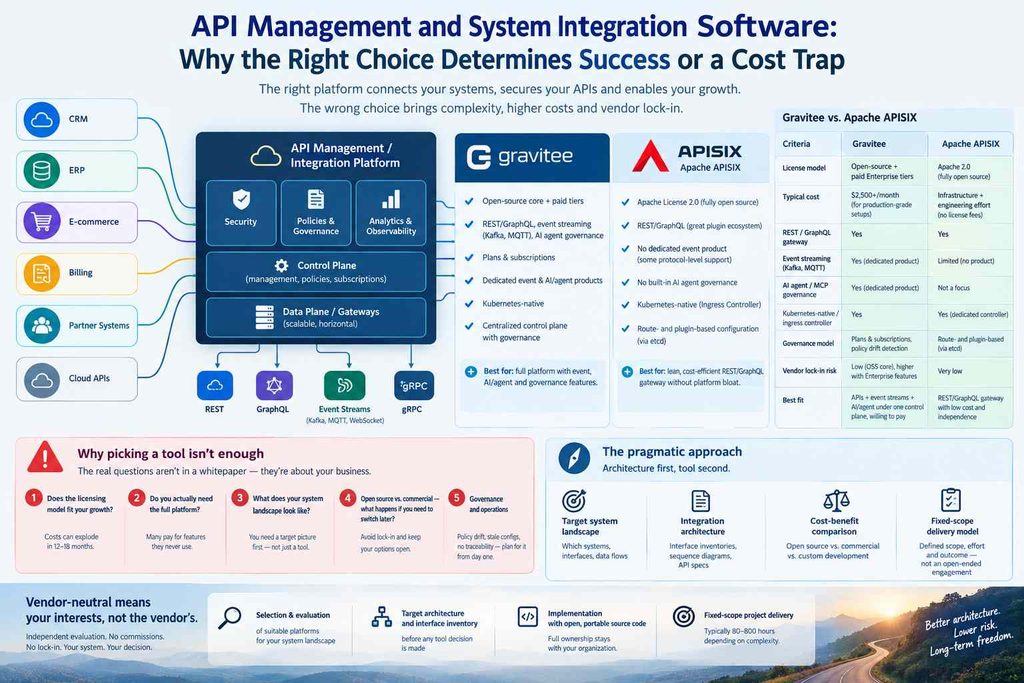
What platforms like Gravitee actually deliver
Gravitee is a good example of how modern integration platforms are typically structured:
- Separate control plane and data plane: Policies, API definitions, and governance are managed centrally, while one or more gateways handle the actual traffic — scaling horizontally and independently from the management layer.
- Plans and subscriptions as a governance model: A „plan“ defines what authentication is required, what throttling applies, and what consumers are entitled to; a „subscription“ links a consuming application to that plan. This creates traceability between identity, entitlement, and runtime behavior.
- Event-native support: Alongside classic REST and GraphQL APIs, event streams over Kafka, MQTT, and WebSocket are increasingly managed through the same platform — relevant as soon as event-driven architectures come into play.
- Observability: Latency, error rates, top consumers, and policy-level outcomes (e.g. authentication failures vs. quota rejections) matter once the gateway becomes a shared critical path for many services.
- Open-source core with commercial tiers: Gravitee is available as an open-source API gateway, with paid tiers for enterprise features, support, and multiple production gateways.
That sounds like a blueprint for any integration strategy. But this is exactly where the real work begins — and where many companies make costly decisions without independent guidance.
Why picking a tool isn’t enough
A whitepaper comparison or an analyst rating won’t answer the questions that actually matter for your business:
- Does the licensing model fit your growth? Enterprise API management is often priced by gateway count or traffic volume. Without solid capacity planning, cost explosions tend to surface only 12–18 months in.
- Do you actually need the full platform? Many organizations buy an enterprise package but use only a fraction of its features — a pattern that shows up repeatedly in independent user reviews: high satisfaction with core functionality, but unused add-ons still being paid for.
- What does your existing system landscape look like? An API gateway doesn’t replace an integration architecture. You need a target picture first: which systems (CRM, ERP, billing, partner systems, cloud APIs) get connected, in what order, with what data flows?
- Open source vs. commercial — and what happens if you need to switch later? A platform that fits today may be too expensive, too rigid, or technologically outdated in three years. Without portable, documented source code and open standards, you end up stuck.
- Governance and operations: Policy drift, stale or overridden configurations, and a lack of traceability are the norm rather than the exception in grown API landscapes — this needs to be planned for from day one, not patched in retrospect.
When you don’t need the full platform: Apache APISIX as a leaner alternative
Not every organization needs event-stream management or AI agent governance bundled into their API gateway. If your integration need is primarily REST (and gRPC/WebSocket) traffic — routing, authentication, rate limiting, observability, Kubernetes ingress — a leaner, fully open-source gateway can deliver the same day-to-day value without the layered licensing model.
Apache APISIX is a strong candidate here. It’s a top-level Apache Software Foundation project, released under the Apache License 2.0 — meaning the entire gateway, including dynamic routing, load balancing, canary releases, circuit breaking, authentication, rate limiting, and observability plugins, is open source with no feature paywall for the core gateway. It’s built on OpenResty/Nginx and etcd, runs from bare metal to Kubernetes (including as a native ingress controller), and is widely used for both north-south (client-to-service) and east-west (service-to-service) traffic.
The trade-off is real, and worth naming honestly: APISIX doesn’t ship a dedicated event gateway (Kafka/MQTT broker productization the way Gravitee offers it) or an AI agent/MCP governance layer. If your roadmap includes event-stream productization or LLM/agent traffic governance as first-class requirements, that gap matters and should factor into the decision. But if today’s actual need is „get REST APIs under control, securely, cheaply, without vendor lock-in,“ APISIX often gets you there with a smaller footprint and a smaller invoice — while leaving the door open to add specialized tooling later, on its own terms, without ripping out the gateway layer.
Gravitee vs. Apache APISIX: comparison matrix
| Criteria | Gravitee | Apache APISIX |
| License model | Open-source core + paid Enterprise tiers (Planet/Galaxy/Universe) | Apache License 2.0 — fully open source, no paywalled core gateway |
| Typical cost | Free OSS tier; commercial plans from roughly $2,500/month upward for production-grade multi-gateway setups | Free to self-host; costs are infrastructure and engineering effort, not license fees |
| REST / GraphQL gateway | Yes, full lifecycle management | Yes, full lifecycle management with a large plugin ecosystem |
| Event streaming (Kafka, MQTT) | Yes — dedicated Event Management product line | Not a dedicated product; some protocol-level support exists, but no event productization layer |
| AI agent / MCP governance | Yes — dedicated AI Agent Management product line | Not a built-in focus area |
| Kubernetes-native / ingress controller | Supported | Supported, including a dedicated APISIX Ingress Controller |
| Governance model | Plans & subscriptions, policy drift detection, centralized control plane | Route- and plugin-based configuration via etcd; governance largely built by the implementer |
| Vendor lock-in risk | Low for OSS core; increases as Enterprise-only features get adopted | Very low — single open-source license, no tiered feature gating |
| Best fit | Organizations that need APIs, event streams, and AI/agent traffic governed under one control plane, and are willing to pay for it | Organizations whose core need is a fast, reliable, cost-efficient REST/GraphQL gateway without additional platform scope |
The matrix isn’t a verdict — it’s a starting point. Which side of it makes sense depends entirely on your actual traffic types, your governance requirements, and your appetite for ongoing license cost versus in-house operational effort.
The pragmatic approach: architecture first, tool second
The most common cause of failed integration projects isn’t the chosen software — it’s the missing architectural decision before the tool selection. Before answering „Gravitee, Apache APISIX, Kong, or a custom build with Apache Camel?“, you need:
- A clear target system landscape: which systems, which interfaces, which data flows
- A documented integration architecture: interface inventories, sequence diagrams, API specifications
- An honest cost-benefit comparison between open-source solutions, commercial platforms, and custom development
- A fixed-scope delivery model that defines scope, effort, and outcome upfront — not an open-ended consulting engagement with no end date
That’s the difference between „we installed an API gateway“ and „we have an integration landscape we understand, own, and can keep evolving ourselves.“
Vendor-neutral means your interests, not the vendor’s
As an independent solutions architect, I evaluate system integration and API management software — whether that’s Gravitee, Apache APISIX, Kong, Tyk, WSO2, MuleSoft, or a lean open-source solution — purely based on what makes sense for your system landscape, your budget, and your long-term independence. No sales commission, no incentive to push higher license costs, no lock-in to a single vendor.
Typical services in this area:
- Selection and evaluation of suitable integration and API management platforms for your specific system landscape
- Target architecture and interface inventory before any tool decision is made
- Implementation with open, portable source code — full ownership stays with your organization
- Fixed-scope project delivery, typically 80–800 hours of effort depending on integration complexity
Next step
If you’re facing a decision about which system integration or API management software is right for your business — or whether an existing solution still fits your needs — it’s worth having a no-obligation conversation before committing to a licensing decision that’s hard to walk back.