DON’T WRITE YOUR STRATEGIC GOALS DAILY! Instead, 1. Define your goals yearly → 2. Review every 3 months → 3. Read from time to time to remind yourself → 4. Execute consistently.
Pure motivational approach is too chaotic.
Pure annual plan is too static and cold.
Execution is more important than the goal setting.
This approach brings:
Stability
Direction clarity
Reduced cognitive load
Long-term consistency
Less emotional fluctuation
Strategy to Execution
Goal seeting
Define 5–8 key goals yearly
Break into quarterly checkpoints
Adjust based on reality
Weekly alignment
Once a week (15–20 min) select:
Top 3 goals right now from your annual goals list
Why they matter?
Next concrete steps
Daily – micro-focus
Set 3–5 Actions today to achieve your Top 3 Goals from weekly alignment.
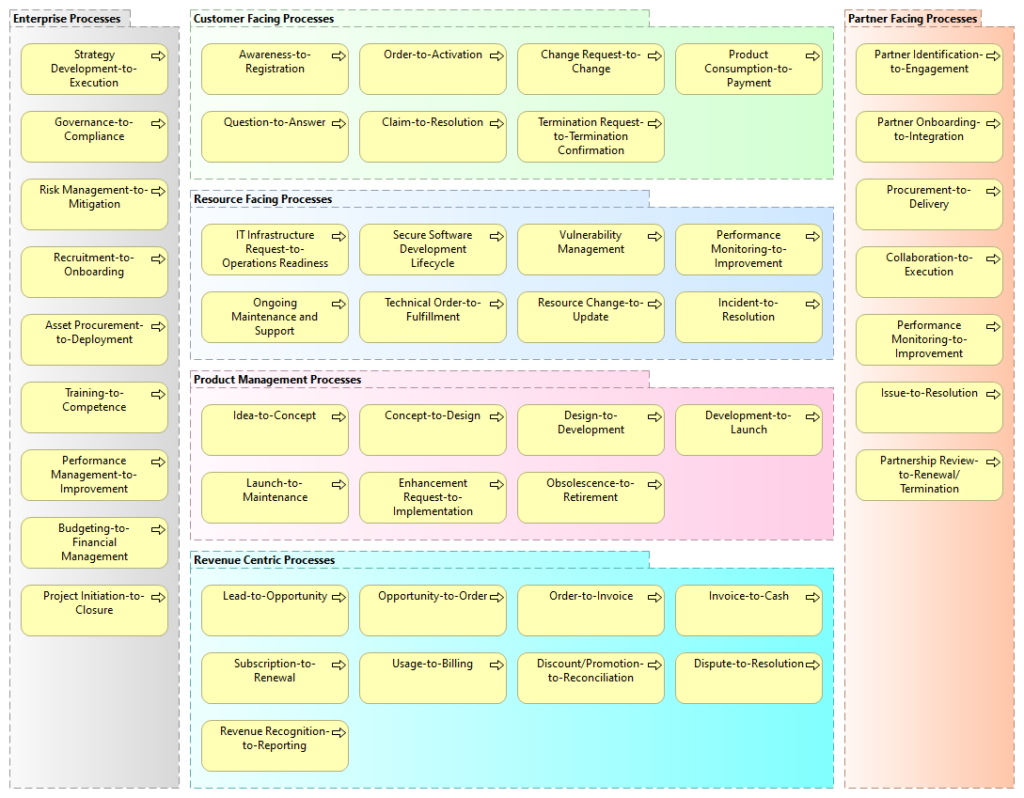
A practical map of 35+ processes across six business domains — for anyone building, refining, or simply trying to understand how work really flows through an enterprise.
6 domains35+ processes~25 min read
In today’s dynamic and competitive business environment, enterprises must constantly strive for efficiency, agility, and customer satisfaction. One of the most effective ways to achieve these goals is by building a clear, comprehensive end-to-end process catalog — a single source of truth that maps how work actually flows across an organization, from a customer’s first interaction to final invoice, and from a new hire’s first day to a retired product’s last update.
This guide walks through a complete, ready-to-use end-to-end process catalog covering six core business domains and more than 35 individual processes. Whether you’re building your first process map or refining an existing one, you can use this as a practical template or a benchmark for your own organization.
What Is an End-to-End Process Catalog?
An end-to-end process catalog is a structured inventory of the major workflows that span an organization from start to finish — crossing departments, systems, and teams rather than stopping at a single function’s boundary. Instead of looking at „what does the sales team do“ or „what does IT do“ in isolation, an end-to-end view follows a process all the way through, such as how a customer’s order eventually becomes an invoice, a payment, and recognized revenue.
This guide presents a template that can be adapted by any enterprise, including:
An end-to-end process map diagram
Process descriptions organized by domain
Goals, steps, examples, and best practices for each process
The processes are grouped into six domains:
#
Domain
01
Customer Facing Processes
02
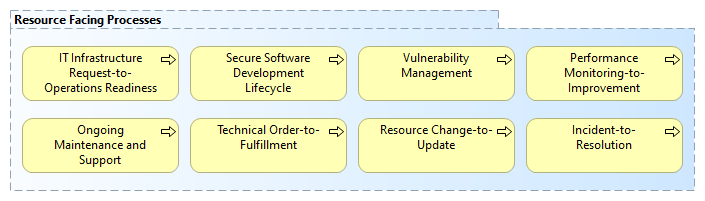
Resource Facing Processes
03
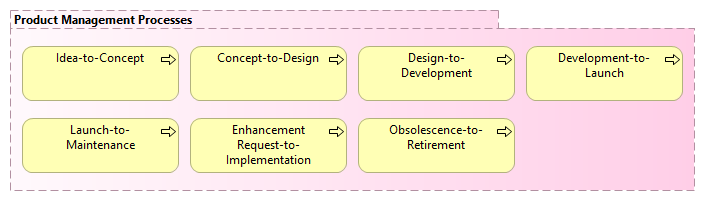
Product Management Processes
04
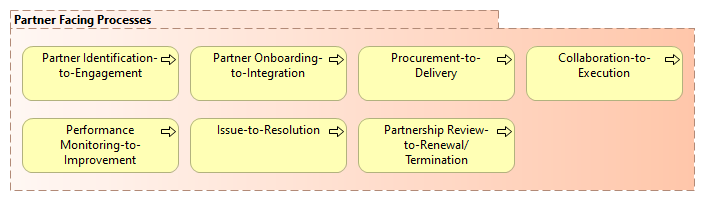
Partner Facing Processes
05
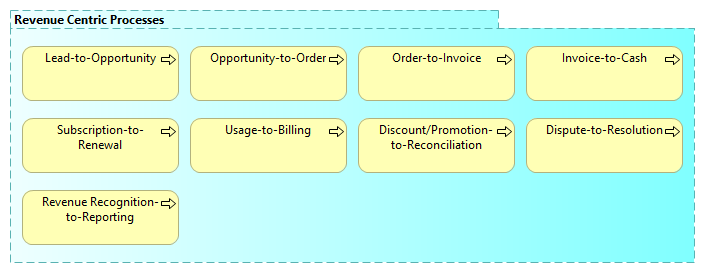
Revenue Centric Processes
06
Enterprise Processes
Each domain is explored in detail below, with every process broken down by goal, typical steps, a real-world example, and best practices you can apply right away.
Why Build an End-to-End Process Catalog?
Before diving into the catalog itself, it’s worth understanding why this exercise matters. Here are the core motivations for maintaining a catalog of end-to-end processes:
1. Improved Coordination and Collaboration
In complex enterprises, different departments and teams often work in silos, which leads to miscommunication and inefficiency. A process catalog fosters better coordination by providing a unified framework that shows how processes interconnect and depend on one another — helping teams understand their role within the bigger picture.
2. Enhanced Customer Experience
Customer-facing processes are critical to delivering exceptional service. Cataloging these processes helps ensure every customer interaction is seamless and consistent. By understanding the entire customer journey — from first contact to post-sale support — businesses can identify and fix pain points, improving the overall experience.
3. Agility and Adaptability
In a fast-changing market, the ability to quickly adapt is crucial. A documented process catalog gives an organization the flexibility to reconfigure how it operates, whether that means responding to new regulations, adopting new technology, or launching new products faster.
4. Strategic Alignment
Aligning business processes with strategic objectives is essential for long-term success. A process catalog ensures every activity supports the organization’s mission and goals, and makes it easier to review and update processes as priorities shift.
5. Knowledge Management and Continuity
Documenting processes preserves institutional knowledge and ensures continuity — especially valuable during employee turnover. A well-maintained catalog becomes a living knowledge base that supports onboarding, training, and long-term consistency.
01
Customer Facing Processes
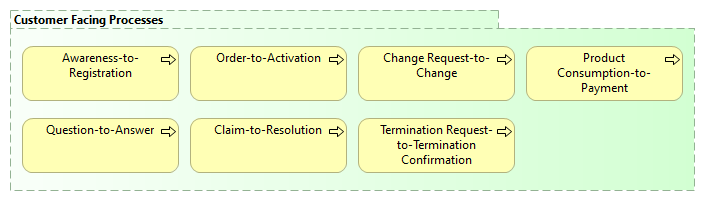
The Customer Facing domain captures the complete end-to-end processes involved in managing customer interactions, from initial interest and registration to termination requests. Each process is designed to deliver a smooth, efficient experience for the customer while maintaining operational accuracy for the business. Customer-facing processes frequently trigger resource-facing processes behind the scenes, such as technical implementation tasks.
Awareness-to-Registration
Goal: Convert potential customer interest into a desire to use the company’s products or services, capturing leads and encouraging registration (including free sign-ups and, optionally, orders).
Steps: Targeted advertising → Content marketing → Product demonstrations/webinars → Customer testimonials → Engaging follow-up communications → Marketing campaigns → Lead generation → Website/social media visits → Registration form completion → Confirmation of registration → Feedback collection
Example: A software company running a webinar series to generate leads and drive registrations for a free trial.
Best Practices:
Ensure all customer touchpoints are tracked.
Follow up with personalized communications post-registration.
Order-to-Activation
Goal: Facilitate the process from placing an order to activating the purchased product or service.
Example: An internet service provider monitoring data usage and billing customers accordingly each month.
Best Practices:
Implement accurate and real-time usage monitoring systems.
Ensure seamless collection of usage data.
Automate invoice generation to reflect actual usage.
Deliver invoices promptly and through preferred customer channels.
Offer multiple payment processing options.
Confirm payments quickly and update customer accounts accordingly.
Termination Request-to-Termination Confirmation
Goal: Process customer requests for terminating products or services and confirm the termination.
Steps: Termination request submission → Request validation → Feedback collection → Termination processing → Final bill generation → Confirmation of termination
Example: A subscription-based streaming service processing customer requests to cancel their subscription and providing confirmation along with a final bill.
Best Practices:
Provide an easy and accessible termination request process.
Validate requests promptly to prevent unauthorized terminations.
Collect feedback to understand reasons for termination and improve services.
Process terminations efficiently to ensure a smooth customer experience.
Generate and deliver the final bill accurately.
Send timely confirmation of termination and any relevant information.
02
Resource Facing Processes
The Resource Facing domain includes end-to-end processes for managing internal resources. These processes support the overall operational effectiveness of the enterprise, ensuring necessary resources are available and optimally utilized to meet business needs. Linking these processes to customer-facing flows keeps internal and external operations aligned.
IT Infrastructure Request-to-Operations Readiness
Goal: Set up and maintain IT infrastructure to support business operations.
Steps: Requirements analysis → Infrastructure design → Procurement → Installation and setup → Configuration → Handover to operations
Example: An IT department setting up a new server for a company’s expanding data storage needs.
Best Practices:
Conduct thorough requirements analysis.
Design for scalability and security.
Streamline procurement processes.
Follow best practices for installation and setup.
Optimize configuration for performance.
Provide comprehensive documentation and training during handover.
Secure Software Development Lifecycle
Goal: Ensure that software development processes incorporate security best practices from inception to deployment.
Goal: Monitor resource performance and implement improvements.
Steps: Define KPIs → Data collection → Performance analysis → Identify improvement areas → Implement changes → Monitor impact
Example: An IT team monitoring server performance metrics and optimizing configurations to improve speed and reliability.
Best Practices:
Clearly define key performance indicators (KPIs) aligned with business goals.
Collect performance data consistently and accurately.
Analyze performance data to identify trends and areas for improvement.
Prioritize and implement necessary changes.
Continuously monitor the impact of changes to ensure effectiveness.
Regularly review and update KPIs and strategies based on performance insights.
03
Product Management Processes
The Product Management domain covers the entire lifecycle of a product, from initial idea generation to eventual retirement. These end-to-end processes ensure a structured approach to developing, launching, maintaining, and phasing out products — supporting product quality, customer satisfaction, and continuous improvement while staying aligned with overall business goals.
Idea-to-Concept
Goal: Transform initial product ideas into viable concepts.
Steps: Idea generation → Market research → Feasibility analysis → Concept development → Initial validation → Concept approval
Example: A tech company brainstorming and developing a new app concept based on user feedback and market trends.
Best Practices:
Encourage diverse idea generation from multiple sources.
Conduct thorough market research to understand demand and competition.
Perform feasibility analysis to assess technical, financial, and operational viability.
Develop detailed concepts that outline key features and benefits.
Validate concepts with initial testing or prototypes.
Secure approval from key stakeholders to proceed to the next stage.
Concept-to-Design
Goal: Develop detailed designs from approved concepts.
Example: A software company providing continuous updates and support for a newly launched app to ensure it remains competitive and functional.
Best Practices:
Set up robust customer support to handle inquiries and issues.
Continuously monitor the product’s performance and user feedback.
Promptly fix any bugs or issues that arise.
Implement regular updates to improve security and functionality.
Enhance features based on user needs and market trends.
Establish a feedback loop to gather and act on customer insights.
Enhancement Request-to-Implementation
Goal: Manage and implement product enhancement requests.
Steps: Enhancement request submission → Prioritization → Design and development → Testing → Release → Customer notification
Example: A software company adding new features to an existing application based on user requests.
Best Practices:
Provide an easy-to-use submission process for enhancement requests.
Prioritize requests based on customer impact and strategic value.
Follow rigorous design and development processes to ensure quality.
Conduct thorough testing to verify the enhancement works as intended.
Release enhancements in a controlled manner to ensure stability.
Notify customers about new features and enhancements to maintain engagement and satisfaction.
Obsolescence-to-Retirement
Goal: Manage the end-of-life process for products.
Steps: Obsolescence planning → Customer communication → Support phase-out → Data migration → Product retirement → Post-retirement support
Example: A tech company retiring an outdated software version and migrating users to a newer version.
Best Practices:
Plan obsolescence to ensure a smooth transition for users.
Communicate clearly and early with customers about the product’s end-of-life timeline.
Gradually phase out support to give customers time to adapt.
Ensure seamless data migration to new systems or products.
Retire the product efficiently and securely.
Provide post-retirement support to assist customers with the transition and address any lingering issues.
04
Partner Facing Processes
The Partner Facing domain encompasses the entire lifecycle of partner relationships, from initial identification and engagement to ongoing collaboration, performance monitoring, and eventual renewal or termination. Maintaining strong, productive relationships with partners helps businesses enhance their capabilities, expand their reach, and achieve strategic goals more effectively.
Partner Identification-to-Engagement
Goal: Identify and engage potential partners to collaborate with the business.
Example: An e-commerce company monitoring the performance of its logistics partner to ensure timely deliveries.
Best Practices:
Define clear and relevant performance metrics aligned with business goals.
Collect performance data consistently and accurately.
Analyze performance data to identify trends and areas for improvement.
Gather feedback from stakeholders to gain insights into performance issues.
Develop a detailed improvement plan addressing identified issues.
Implement improvements in collaboration with the partner.
Re-evaluate performance after changes are made to ensure effectiveness.
Issue-to-Resolution (Partner Facing)
Goal: Address and resolve any issues arising in the partnership.
Steps: Issue reporting → Prioritization → Investigation → Resolution plan → Implementation → Partner communication → Follow-up
Example: A software company resolving a compatibility issue with a third-party API used by a partner.
Best Practices:
Implement a straightforward issue reporting system.
Prioritize issues based on impact and urgency.
Conduct thorough investigations to understand the root cause.
Develop a clear and actionable resolution plan.
Implement solutions efficiently to minimize disruptions.
Maintain open communication with the partner throughout the process.
Follow up to ensure the issue is fully resolved and to prevent recurrence.
Partnership Review-to-Renewal/Termination
Goal: Periodically review partnerships to decide on renewal or termination.
Steps: Performance review → Strategic alignment assessment → Renewal/termination decision → Renewal negotiation/termination process → Transition planning → Execution → Update systems of records
Example: A retail company reviewing its partnership with a logistics provider to decide whether to renew the contract.
Best Practices:
Conduct regular and thorough performance reviews of the partnership.
Assess the strategic alignment of the partnership with long-term business goals.
Make informed decisions on renewal or termination based on performance and alignment.
Negotiate terms for renewal or manage the termination process smoothly.
Plan transitions carefully to minimize disruptions.
Execute the renewal or termination plan efficiently.
Ensure all systems of records are updated to reflect the current partnership status.
05
Revenue Centric Processes
The Revenue domain encompasses the entire lifecycle of financial transactions related to sales and billing — from lead generation and conversion to invoicing, payment collection, and financial reporting. Maintaining accurate, transparent revenue processes improves cash flow, enhances customer satisfaction, and ensures compliance with financial regulations.
It’s important to distinguish customer-facing/partner-facing processes from revenue-centric processes, since they represent different perspectives within the organization. Customer-facing and partner-facing processes focus on the interactions and experience of the customer or partner, while revenue-centric processes emphasize the financial transactions and revenue-generation side of the business. Both are crucial and interrelated, but serve distinct purposes:
Customer-Facing Processes manage all interactions with the customer, from initial contact to ongoing support, aiming for a seamless and satisfying experience. Examples: Awareness-to-Registration, Order-to-Activation, Claim-to-Resolution.
Revenue-Centric Processes focus on managing the financial transactions associated with sales and services, ensuring the business efficiently generates and collects revenue. Examples: Lead-to-Opportunity, Order-to-Invoice, Invoice-to-Cash.
Customer-facing processes often trigger revenue-centric processes — for instance, Order-to-Activation in the customer-facing domain initiates Order-to-Invoice in the revenue-centric domain.
Lead-to-Opportunity
Goal: Convert potential customer leads into sales opportunities.
Example: A software company recognizing subscription revenue monthly and preparing quarterly financial reports for stakeholders.
Best Practices:
Implement robust revenue recognition policies that comply with accounting standards.
Update financial records promptly to reflect recognized revenue.
Perform periodic closing procedures to ensure accurate financial statements.
Conduct thorough financial analysis to interpret revenue data and trends.
Generate detailed and accurate financial reports.
Review reports with stakeholders to provide transparency and inform decision-making.
06
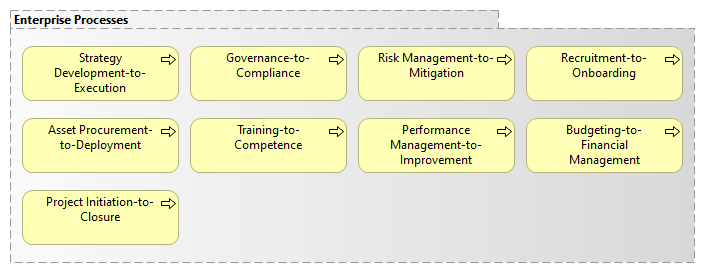
Enterprise Processes
The Enterprise domain includes end-to-end processes that support the overall strategic, governance, risk management, and operational needs of the organization. These processes ensure the enterprise operates efficiently, adheres to regulations, manages risks effectively, and continuously improves its performance.
Strategy Development-to-Execution
Goal: Develop and execute the organization’s strategic goals and objectives.
Steps: Market analysis → Strategy formulation → Goal setting → Action plan development → Resource allocation → Implementation → Monitoring and evaluation
Example: A tech company analyzing market trends to formulate a strategy for entering a new market segment, setting specific goals, and implementing the strategy with regular progress evaluations.
Best Practices:
Conduct comprehensive market analysis to understand trends, opportunities, and threats.
Formulate a clear and actionable strategy aligned with the organization’s vision and mission.
Set specific, measurable, achievable, relevant, and time-bound (SMART) goals.
Develop a detailed action plan outlining steps, timelines, and responsibilities.
Allocate resources efficiently to support the execution of the strategy.
Implement the strategy systematically and ensure all team members are aligned.
Monitor progress regularly and evaluate outcomes to make necessary adjustments and ensure strategic objectives are met.
Governance-to-Compliance
Goal: Establish governance frameworks and ensure compliance with regulations and internal policies.
Example: A financial institution developing policies to comply with new regulatory requirements, conducting regular audits, and taking corrective actions to address any issues found.
Best Practices:
Develop comprehensive policies that align with regulatory requirements and internal standards.
Regularly assess compliance with relevant regulations to identify any gaps.
Implement robust risk management practices to mitigate potential compliance risks.
Conduct periodic internal audits to ensure adherence to policies and regulations.
Report compliance status and findings to stakeholders transparently.
Take prompt corrective actions to address any compliance issues identified.
Foster a culture of continuous improvement to enhance governance and compliance practices over time.
Risk Management-to-Mitigation
Goal: Identify, assess, and mitigate risks to the organization.
Example: A healthcare organization identifying and mitigating risks associated with patient data security.
Best Practices:
Implement a structured process for identifying potential risks across the organization.
Assess the impact and likelihood of identified risks to understand their significance.
Prioritize risks based on their potential impact on the organization.
Develop detailed mitigation plans to address high-priority risks.
Implement mitigation strategies effectively to reduce or eliminate risks.
Monitor the effectiveness of mitigation efforts continuously.
Regularly review and update risk management plans to reflect new risks and changes in the environment.
Recruitment-to-Onboarding
Goal: Attract, recruit, and effectively onboard new employees.
Steps: Job posting → Application collection → Candidate screening → Interviews → Job offer → Acceptance → Onboarding process → Training and orientation
Example: A tech company recruiting software engineers and providing comprehensive onboarding and training to ensure they are quickly integrated into the team.
Best Practices:
Create clear and attractive job postings that accurately reflect the role and company culture.
Collect and manage applications efficiently using an applicant tracking system.
Screen candidates thoroughly to ensure they meet the required qualifications and fit the company culture.
Conduct structured interviews to evaluate candidates‘ skills and potential.
Make timely and competitive job offers to selected candidates.
Ensure a smooth acceptance process with clear communication and support.
Develop a comprehensive onboarding process that includes all necessary administrative tasks.
Provide thorough training and orientation to help new employees acclimate and become productive quickly.
Asset Procurement-to-Deployment
Goal: Procure and deploy necessary assets for business operations.
Example: A retail company procuring new point-of-sale systems and deploying them across multiple store locations.
Best Practices:
Conduct a thorough needs assessment to determine the exact requirements for assets.
Select vendors based on reliability, cost, and quality.
Generate and manage purchase orders efficiently.
Ensure timely delivery of assets and verify shipment contents.
Perform quality checks to ensure assets meet specifications and standards.
Deploy assets promptly to minimize downtime and maximize operational efficiency.
Update inventory records accurately to reflect new assets and their locations.
Training-to-Competence
Goal: Train employees to develop competencies needed for their roles.
Steps: Training needs analysis → Curriculum development → Training delivery → Assessment → Feedback → Continuous improvement
Example: A financial services firm developing a training program for new hires to ensure they are competent in regulatory compliance and customer service.
Best Practices:
Conduct a detailed training needs analysis to identify skill gaps and requirements.
Develop a comprehensive curriculum tailored to the identified needs.
Deliver training using effective and engaging methods, such as interactive workshops and e-learning modules.
Assess trainees‘ understanding and competency through tests and practical evaluations.
Collect feedback from trainees to gauge the effectiveness of the training program.
Continuously improve the training program based on feedback and changing requirements to ensure ongoing relevance and effectiveness.
Performance Management-to-Improvement
Goal: Monitor and improve organizational and employee performance.
What is the difference between a process and an end-to-end process?
A process is typically a single, contained activity within one function or department. An end-to-end process crosses multiple departments, systems, and teams to deliver a complete outcome — for example, going from a customer „order“ all the way through to „activation,“ which may touch sales, billing, IT, and customer support.
How many process domains should an end-to-end catalog have?
This template uses six domains — Customer Facing, Resource Facing, Product Management, Partner Facing, Revenue Centric, and Enterprise — but the right number depends on your organization’s structure and complexity. Six domains works well as a starting framework that most enterprises can adapt.
Who should own an end-to-end process catalog?
Ownership is often shared between Enterprise/Business Architecture, Process Excellence, or Operations teams, with individual process owners assigned within each domain (e.g., a Sales leader owning Lead-to-Opportunity, an IT leader owning Incident-to-Resolution).
Can this template be used for any industry?
Yes. The structure is industry-agnostic. The specific steps, tools, and examples will vary by sector, but the underlying domains and process names apply broadly across SaaS, telecom, manufacturing, financial services, and more.
Putting the Catalog to Work
An end-to-end process catalog is most valuable when it’s treated as a living document rather than a one-time exercise. Start by mapping your highest-impact processes — often those in the Customer Facing and Revenue Centric domains — then expand outward into Resource Facing, Product Management, Partner Facing, and Enterprise processes as your organization matures its process management practice.
Use this template as a starting point: adapt the domains, rename processes to match your organization’s terminology, and add the specific tools, systems, and KPIs relevant to your business. The goal isn’t a perfect, exhaustive diagram — it’s a shared, evolving reference that helps every team understand how their work connects to the bigger picture.
На восприятие влияют не только аргументы, но и способ их подачи.
Интонация
Темп речи
Паузы
Мимика
Жесты
Уверенность
Часто важнее не что сказано, а как именно это сказано.
💡 Главная идея книги
Эффективная коммуникация — это способность управлять вниманием, удерживать инициативу и направлять разговор к нужному результату, сохраняя ясность, уверенность и контроль над ситуацией.
Welche Technologie passt zu welchem Geschäftsprozess – und wie treffen Sie die richtige Entscheidung?
📅 Juni 2026 · ⏱ 6 Min. Lesezeit · 🏷 Automatisierung · KI · Entscheidungshilfe
Automatisierung als Wettbewerbsvorteil
Der Druck auf Unternehmen, effizienter zu arbeiten, steigt – gleichzeitig wachsen die Möglichkeiten, repetitive Arbeit zu automatisieren. Zwei Technologien stehen dabei derzeit im Mittelpunkt: klassische Chatbots und KI-Agenten.
Ob Kundensupport, interne Helpdesks, Vertriebsunterstützung oder komplexe Datenprozesse – digitale Assistenten übernehmen heute Aufgaben, die früher ausschließlich menschliche Mitarbeiter erledigten. Für Unternehmen im DACH-Raum stellt sich dabei eine entscheidende Frage: Welche Technologie löst mein konkretes Problem am besten?
Die Antwort ist nicht immer offensichtlich. Ein klassischer Chatbot und ein KI-Agent sehen von außen ähnlich aus – beide beantworten Fragen, beide kommunizieren in natürlicher Sprache. Doch unter der Haube unterscheiden sie sich grundlegend in Intelligenz, Flexibilität und Einsatzbereich.
💡
Kurz vorab: Die „richtige“ Technologie hängt nicht vom Budget ab, sondern vom Anwendungsfall. Dieser Artikel hilft Ihnen, den passenden Weg zu finden – mit klaren Definitionen, Praxisbeispielen und einer Entscheidungsmatrix.
Was ist was? Definitionen und Kernunterschied
Klassischer Chatbot
Regelbasierter Dialog-Assistent
Ein Chatbot folgt vordefinierten Gesprächsabläufen (Flows) oder nutzt NLP, um Nutzereingaben zu klassifizieren und passende Antworten auszuliefern. Er arbeitet innerhalb eines festen Regelwerks und eskaliert bei unbekannten Anfragen an einen Menschen.
KI-Agent
Autonomes, handelndes System
Ein KI-Agent analysiert Ziele, plant eigenständig Schritte, ruft externe Tools und APIs auf und trifft Entscheidungen – ohne jeden Schritt vorab im Code abzubilden. Er lernt aus dem Kontext und passt sein Vorgehen dynamisch an.
Der wesentliche Unterschied liegt in der Entscheidungslogik: Ein Chatbot wählt aus vorbereiteten Optionen. Ein KI-Agent denkt sein Vorgehen im Moment der Anfrage. Das klingt nach einem graduellen Unterschied – hat aber enorme Auswirkungen auf Aufbau, Wartung und Einsatzbereich.
Merkmal
Klassischer Chatbot
KI-Agent
Entscheidungslogik
Regelbasiert / NLP-Klassifikation
LLM-gestützt, situativ
Tool-Nutzung
Begrenzt, vorher definiert
Dynamisch, beliebige APIs
Anpassung an neue Fragen
Erfordert manuelles Update
Automatisch durch Kontext
Gedächtnis / Kontext
Innerhalb einer Session
Sitzungsübergreifend möglich
Implementierungsaufwand
Gering bis mittel
Mittel bis hoch
Transparenz / Kontrolle
Sehr hoch
Bedingt (Monitoring nötig)
Betriebskosten
Niedrig
Höher (LLM-Token, Infra)
Wann ein klassischer Chatbot die richtige Wahl ist
Chatbots glänzen überall dort, wo Prozesse strukturiert und vorhersehbar sind. Wenn Sie genau wissen, welche Fragen Nutzer stellen werden, und klare Antworten darauf haben, ist ein Chatbot die effizienteste Lösung: günstig im Betrieb, zuverlässig in der Ausgabe, leicht wartbar.
❓
FAQ & Kundensupport-Automatisierung Wiederkehrende Fragen zu Öffnungszeiten, Preisen, Produkten oder Lieferzeiten – der Chatbot liefert konsistente Antworten rund um die Uhr, ohne Wartezeit.
📋
Lead-Qualifizierung & Ersterfassung Interessenten werden strukturiert durch eine Reihe von Fragen geführt. Das System erfasst Kontaktdaten, Budget und Bedarf – und übergibt qualifizierte Leads an den Vertrieb.
📅
Terminbuchung & Reservierungen Geführte Buchungsprozesse (z. B. Arztpraxis, Dienstleister, Gastronomie) mit Kalenderintegration laufen vollautomatisch und entlasten das Frontoffice spürbar.
🏢
Interner Helpdesk / IT-Support (Tier 1) Password-Resets, Onboarding-Checklisten, Gerätebestellungen – standardisierte Abläufe, die Mitarbeitende bisher per E-Mail oder Ticketformular angestoßen haben.
📦
Bestell- und Statusabfragen Integration in CRM oder Shop-System: Kunden erhalten Lieferstatus, Rechnungskopien oder können einfache Stornierungen auslösen – ohne Agentenkontakt.
🌍
Mehrsprachiger Kundenservice Chatbots können parallel in Deutsch, Englisch, Französisch und weiteren Sprachen antworten – ohne Mehraufwand im Team.
Faustregel: Können Sie den Großteil der erwarteten Anfragen in einem FAQ-Dokument mit 30–50 Einträgen abbilden? Dann ist ein Chatbot wahrscheinlich die wirtschaftlichste Lösung.
Wann ein KI-Agent die richtige Wahl ist
KI-Agenten sind sinnvoll, wenn Prozesse variabel, mehrstufig oder stark kontextabhängig sind – also überall dort, wo ein Chatbot-Flow zu schnell an seine Grenzen stößt. Der Agent kombiniert mehrere Datenquellen, hält Ziele im Blick und handelt selbstständig.
🔍
Komplexe Kundenanfragen mit Systemzugriff Der Agent ruft Kundendaten aus dem CRM ab, prüft Vertragsstatus und Produktkonfiguration, und gibt eine individuell zugeschnittene Antwort – in einem einzigen Gespräch.
⚙️
Mehrstufige Geschäftsprozesse Automatisierung von Abläufen, die mehrere Systeme betreffen: z. B. Angebot erstellen → CRM aktualisieren → E-Mail versenden → Kalender-Termin anlegen – alles auf einmal.
📊
Forschungs- und Rechercheaufgaben Marktrecherchen, Wettbewerbsanalysen oder Due-Diligence-Zusammenfassungen: Der Agent durchsucht strukturierte und unstrukturierte Quellen und erstellt einen kompakten Bericht.
🤝
Vertriebsunterstützung & Angebotserstellung Anhand von Kundenprofil, Gesprächshistorie und Produktkatalog generiert der Agent individualisierte Angebote oder Gesprächsleitfäden für den Vertrieb.
🔄
Intelligente Prozess-Automatisierung (IPA) Dort wo RPA-Tools (Robotic Process Automation) an UI-Änderungen scheitern, navigiert ein KI-Agent kontextbasiert – robust gegenüber wechselnden Oberflächen.
📁
Dokumentenverarbeitung & Datenextraktion Rechnungen, Verträge oder Formulare werden gelesen, klassifiziert und Schlüsseldaten in nachgelagerte Systeme übertragen – vollautomatisch, auch bei variablen Layouts.
Wichtig: KI-Agenten erfordern klare Governance – also definierte Grenzen, was der Agent tun darf, Monitoring der Entscheidungen und ggf. menschliche Freigabe bei kritischen Aktionen. Ohne diese Rahmenbedingungen entstehen unerwartete Ergebnisse.
Entscheidungsmatrix: Was passt zu Ihrem Anwendungsfall?
Die folgende Matrix fasst die wichtigsten Entscheidungsdimensionen zusammen. Bewerten Sie Ihren konkreten Use Case anhand der Kriterien – je mehr grüne Häkchen eine Spalte erhält, desto besser passt diese Technologie.
Kriterium
Klassischer Chatbot
KI-Agent
Anfragen sind größtenteils vorhersehbar
✅
〰️
Klare, einheitliche Antworten erforderlich
✅
〰️
Hohe Nachvollziehbarkeit / Compliance
✅
〰️
Schnelle Implementierung und Go-Live
✅
❌
Geringes Betriebsbudget
✅
❌
Prozess umfasst mehrere Systeme / APIs
〰️
✅
Anfragen sind stark kontextabhängig
❌
✅
Offene, unstrukturierte Anfragen möglich
❌
✅
Eigenständige Aktionen sollen ausgeführt werden
❌
✅
Prozess ändert sich häufig oder ist schwer zu spezifizieren
Hybride Ansätze sind möglich: In der Praxis setzen viele Unternehmen beide Technologien kombiniert ein – ein Chatbot übernimmt die strukturierten Standardanfragen (schnell, günstig), ein KI-Agent greift bei komplexen oder eskalierenden Fällen ein. Diese Architektur bietet das beste Kosten-Nutzen-Verhältnis.
Welche Lösung passt zu Ihrem Unternehmen?
Ob Chatbot, KI-Agent oder ein hybrider Ansatz – die richtige Entscheidung hängt von Ihren Prozessen, Ihrem Budget und Ihren Zielen ab. In einem kostenlosen Erstgespräch analysieren wir gemeinsam Ihren Use Case und zeigen Ihnen konkrete Optionen auf.
Pragmatic Patterns Using TMF645 and Its Role in the Order Capture Lifecycle
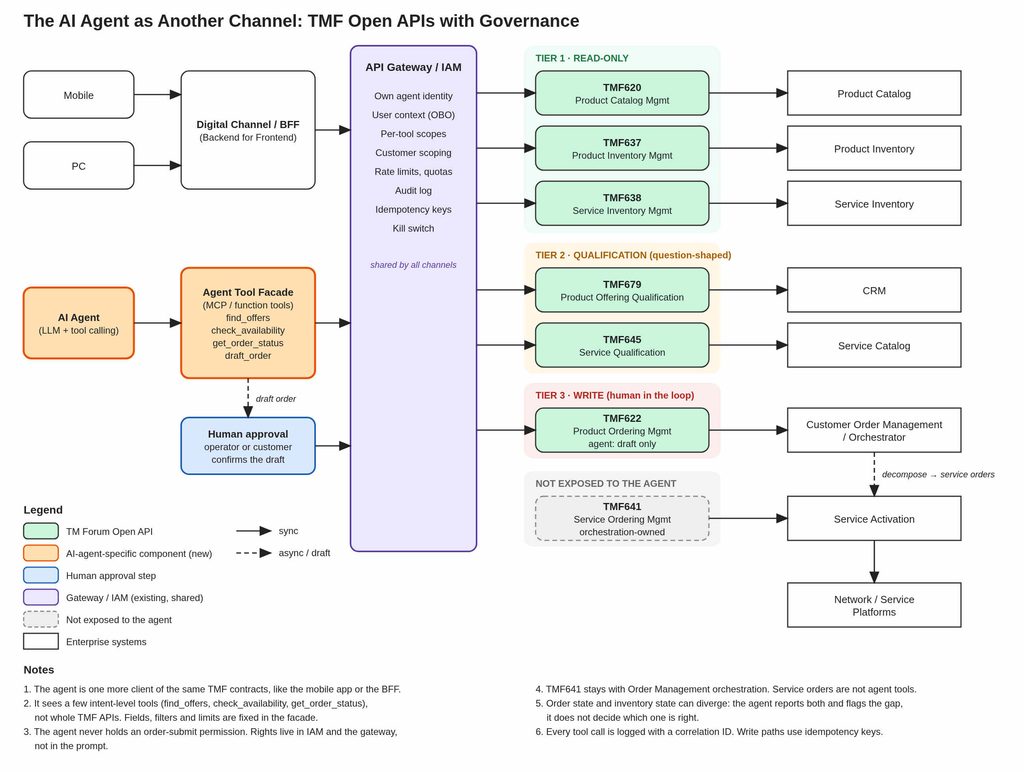
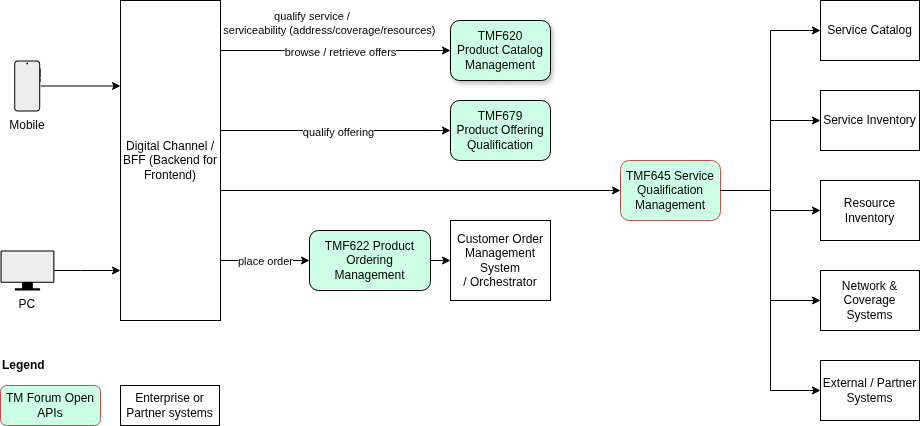
In the previous article on Customer Order Capture, TMF645 Service Qualification was identified as one of the four core APIs involved in translating customer intent into a valid ProductOrder. Alongside TMF620, TMF679, and TMF622, it occupies a specific and critical position in the architecture — the point at which commercial feasibility meets technical reality.
This article examines TMF645 Service Qualification in depth: what it does, how it fits into the broader order lifecycle, how it relates to other qualification APIs, and what practical patterns emerge when it is implemented correctly in telecom BSS/OSS architectures.
What Is Service Qualification?
Service Qualification answers a specific operational question: can this service actually be delivered to this customer at this location with these technical constraints?
The TM Forum TMF645 Service Qualification Management API provides a standardized interface for checking the technical feasibility of a service request before that request enters the order lifecycle. It sits upstream of order submission and downstream of commercial product selection, acting as a validation gate between intent and commitment.
TMF645 is not about whether a customer is eligible to purchase a product — that is the domain of TMF679 Product Offering Qualification. TMF645 is about whether the underlying infrastructure, network, or platform can actually support the requested service for that specific customer context.
Why Service Qualification Matters
Service Qualification is the difference between selling what you offer and committing to what you can deliver. Without it, the gap between commercial intent and operational execution generates late failures, costly rework, and degraded customer experience.
Where TMF645 Fits in the Order Lifecycle
The order capture lifecycle follows a structured progression from product discovery to order submission. TMF645 occupies the technical feasibility stage — after commercial qualification and before ProductOrder creation.
Stage
Primary API
Core Responsibility
Product Discovery
TMF620
Retrieve and browse available product offerings
Commercial Qualification
TMF679
Validate customer eligibility and offer compatibility
Technical Feasibility
TMF645
Verify infrastructure and network delivery capability
Order Submission
TMF622
Capture and submit the standardized ProductOrder
This sequencing is deliberate and architecturally significant. If technical feasibility is checked only during service activation — downstream in the lifecycle — orders that cannot be fulfilled will have already passed through multiple processing stages. The cost of late failure is substantially higher than the cost of early qualification.
By checking technical feasibility through TMF645 before the ProductOrder is submitted, the architecture ensures that only viable orders enter the fulfillment pipeline.
Commercial vs. Technical Qualification: A Critical Distinction
One of the most important architectural separations in the order capture domain is the distinction between commercial qualification and technical qualification. These two validation concerns are often conflated in legacy architectures, producing systems that are difficult to evolve and prone to inconsistency.
TMF679 – Product Offering Qualification
TMF645 – Service Qualification
Is this customer eligible for this offer?
Can the network or infrastructure deliver this service?
Are the selected options compatible with the product?
Is there capacity or coverage at the requested location?
Does the customer’s account support this product?
Are the required resources available and allocatable?
Commercial rules and pricing constraints
Infrastructure, topology, and platform constraints
Catalog-driven validation
Network- and inventory-driven validation
A customer may be fully eligible for a premium broadband offer (TMF679 qualified) but reside at an address outside the fiber coverage area (TMF645 not qualified). These are orthogonal checks that must remain independent to allow each domain to evolve without coupling.
Anti-Pattern: Merged Qualification
Merging commercial and technical qualification into a single validation service is a recurring anti-pattern. It couples the product catalog model to network topology, forces synchronized releases across otherwise independent domains, and makes it impossible to clearly identify why a qualification failed. Keep these concerns separate.
What TMF645 Checks
The scope of a TMF645 qualification check depends on the service type and operational context. Typical checks include:
Check Type
Description
Address and location validation
Confirms the customer’s service address is within the delivery area for the requested service
Network coverage verification
Validates that the required network technology (fiber, cable, mobile, etc.) reaches the specified location
Resource availability
Checks whether required infrastructure resources — ports, bandwidth, spectrum, or capacity — are available
Infrastructure constraints
Identifies topology-specific limitations that may affect service parameters or options
Technology-specific feasibility
For services such as VoIP, IPTV, or mobile, verifies platform availability and compatibility
Third-party or partner dependency checks
For wholesale or shared infrastructure scenarios, queries external qualification systems
The qualification result includes not just a binary qualified or not-qualified outcome, but structured detail about the constraints encountered, the alternatives available, and any parameters that must be adjusted before order submission.
TMF645 API Structure
The TMF645 API supports both synchronous and asynchronous qualification patterns, reflecting the reality that some qualification checks can be resolved immediately while others require queries to external or slow systems.
Core Resources
Resource
Purpose
ServiceQualification
The primary qualification request and result object
ServiceQualificationItem
Represents a single service within a multi-service qualification request
QualificationResult
The outcome per qualification item: qualified, notQualified, or partiallyQualified
AlternateServiceProposal
Proposed alternative configurations when the original request cannot be qualified as submitted
ServiceabilityDate
Earliest date on which the service can be delivered if not immediately available
Qualification States
A qualification request progresses through a defined lifecycle:
State
Meaning
Caller Response
acknowledged
Request received and accepted for processing
Retain qualification ID; await next state
inProgress
Qualification checks are executing
Continue monitoring via polling or event
done
Qualification completed with a result
Process result and proceed or adjust
terminatedWithError
Qualification could not be completed
Evaluate error and retry or escalate
Synchronous vs. Asynchronous Execution
TMF645 supports both execution patterns. The choice between them is not arbitrary — it should reflect the operational characteristics of the underlying qualification systems.
Synchronous Qualification
Asynchronous Qualification
Result returned in same API call response
Result delivered via event callback or polling
Appropriate when all checks are local and fast
Required when external systems or slow lookups are involved
Simpler caller implementation
More complex state management required by caller
Fragile if any downstream system is slow
Resilient to variable response times
Suitable for simple address lookups
Required for partner or wholesale qualification flows
Design Recommendation
Architectural Recommendation: Even when synchronous qualification is technically feasible, designing the caller (typically the BFF or order capture service) to handle asynchronous results makes the integration more resilient. A synchronous qualification that becomes slower over time due to infrastructure growth should not require a re-architecture of the calling layer.
Qualification in the BFF and Channel Layer
In a well-structured order capture architecture, the BFF (Backend-for-Frontend) orchestrates qualification calls on behalf of the digital channel. This keeps the frontend free from direct dependency on TMF APIs while maintaining a clean separation between engagement logic and domain validation.
The BFF is responsible for:
Aggregating product selection, customer context, and location data into a qualification request
Calling TMF679 for commercial qualification and TMF645 for technical qualification
Presenting qualification results to the frontend in a channel-appropriate format
Blocking order submission if qualification has not succeeded
Surfacing alternative proposals from TMF645 if the original request cannot be qualified
The BFF should not implement qualification logic itself. Its role is orchestration and translation — not validation. Qualification rules live behind the TMF645 interface, inside the domain that owns the qualification logic.
Anti-Pattern: Qualification in the Channel
A common mistake is implementing address validation or coverage checks inside the BFF or frontend layer. This creates duplicated logic, inconsistencies between channels, and tight coupling to infrastructure data that changes independently of digital channel releases. Qualification logic belongs behind TMF APIs.
Handling Qualification Results
The outcome of a TMF645 qualification is not always a simple pass or fail. Three result types must be handled explicitly:
1. Qualified
The service can be delivered as requested. The qualification result may include additional information — such as confirmed delivery dates, available service parameters, or resource identifiers — that should be carried forward into the ProductOrder payload.
2. Not Qualified
The service cannot be delivered as requested. The result should include structured detail on the reason for disqualification: coverage boundary, resource unavailability, platform incompatibility, or infrastructure constraint. This information should be surfaced to the customer clearly, with appropriate next steps.
In some architectures, a not-qualified result triggers a waitlist or future-date qualification flow, where the system tracks the customer’s intent and notifies them when qualification conditions change.
3. Partially Qualified or Alternative Proposed
TMF645 supports the return of alternative service proposals when the requested configuration cannot be qualified but a modified version can. Alternatives may include:
A lower bandwidth tier where the full requested speed is not available
A different access technology (e.g., FTTC instead of FTTP)
A future delivery date when current resources are temporarily exhausted
A modified service area or endpoint if the exact address has limited coverage
Alternative proposals must be presented to the customer as genuine choices, not silent fallbacks. The channel layer must handle these gracefully and allow the customer to accept, reject, or modify their selection before proceeding.
Relationship to Order Submission via TMF622
The output of a successful TMF645 qualification is not discarded — it informs the structure and content of the ProductOrder submitted through TMF622. Key qualification data that flows into the order includes:
Qualification Output
Role in TMF622 ProductOrder
Qualification ID
Carried as a correlation reference in the ProductOrder for traceability
Confirmed service parameters
Used to populate the requested characteristics of the order item
Resource identifiers
Referenced in the order to ensure the correct infrastructure is reserved
Delivery date commitment
Reflected in the requested start date of the order
Alternative proposal reference
Included if the customer accepted an alternative configuration
This linkage between qualification and order is architecturally important. It ensures that the ProductOrder reflects not just what the customer wants, but what the network has confirmed it can deliver. Orders that do not carry qualification context force downstream systems to re-check feasibility, introducing redundancy, delay, and potential inconsistency.
Design Principle
Design Principle: The qualification reference should be treated as a first-class attribute of the ProductOrder, not an optional annotation. Downstream decomposition and service activation systems rely on this reference to skip redundant feasibility checks and proceed directly to fulfillment.
Caching, Validity, and Qualification Windows
A qualification result is not indefinitely valid. Infrastructure conditions, resource availability, and coverage boundaries can change. TMF645 results should carry an explicit validity window, after which the qualification must be refreshed before order submission.
Common validity patterns include:
Pattern
Description
Time-bounded validity
Qualification result is valid for a defined period (e.g., 24–72 hours) before expiry
Event-invalidated qualification
Qualification is invalidated if specific network events occur (maintenance, topology changes)
Commitment-based holding
For high-demand resources, qualification results may optionally reserve capacity for a defined window
Re-qualification on modification
Any change to the order parameters (address, service tier, options) requires a fresh qualification
Digital channels and BFFs must enforce qualification validity. Submitting a ProductOrder against an expired qualification is a common source of late-stage failures that could have been avoided with appropriate staleness detection.
Common Anti-Patterns in Service Qualification
1. Qualification as an Afterthought
Some architectures treat service qualification as an optional pre-check rather than a required gate. Orders are accepted and submitted regardless of whether qualification has been completed, relying on activation-time failure handling to catch infeasible requests.
This pattern multiplies the cost of failure. An order that fails during activation has already consumed order management processing, inventory reservation, and orchestration capacity. An order that fails at qualification consumes only a lightweight API call.
2. Embedding Qualification Logic in Activation
When qualification logic is not exposed through a dedicated interface like TMF645, it tends to migrate into the activation domain, where it is evaluated at provisioning time. This delays failure detection, increases orchestration complexity, and mixes technical feasibility concerns with execution logic.
3. Silently Accepting Alternatives
Returning an alternative service proposal without explicit customer confirmation is a source of downstream disputes and operational confusion. If the customer ordered 1 Gbps fiber and the network can only deliver 500 Mbps FTTC, that substitution must be surfaced and confirmed — not silently applied to the order.
4. Not Propagating Qualification Context
Discarding the qualification reference after order submission disconnects the ProductOrder from its feasibility basis. Activation systems that cannot reference the qualification outcome are forced to repeat checks, introducing latency and creating opportunities for divergence between what was qualified and what is provisioned.
Integration Pattern Summary
When TMF645 is implemented correctly, it provides a clean, early validation gate that prevents infeasible orders from entering the fulfillment pipeline and ensures that downstream processing operates on committed, technically verified requests.
Responsibility
Mechanism
Rationale
Validate technical feasibility early
TMF645 Service Qualification before TMF622 order submission
Prevents late failures and reduces orchestration complexity
Separate commercial from technical validation
TMF679 for eligibility, TMF645 for feasibility — independent calls
Allows each domain to evolve independently
Surface alternatives explicitly
Return AlternateServiceProposal with qualification result
Ensures customer confirmation before substitution is applied
Propagate qualification context to orders
Carry qualification ID and confirmed parameters in ProductOrder
Enables activation to skip redundant checks
Enforce qualification validity windows
Track expiry and re-qualify if window elapses or parameters change
Prevents order submission against stale feasibility data
Keep qualification logic behind the API
Validation in the domain, not in BFF or frontend
Eliminates duplication and maintains consistency across channels
What’s Next
This article examined TMF645 Service Qualification as a standalone domain: its structure, its role in the order lifecycle, its relationship to commercial qualification via TMF679, and the practical patterns required to implement it without introducing architectural fragility.
Together with the preceding articles in this series, the full order capture lifecycle is now covered from first product discovery through technical feasibility to order submission:
Article
Primary APIs
Focus
Customer Order Capture
TMF620, TMF679, TMF645, TMF622
End-to-end order capture lifecycle overview
TMF663 Shopping Cart Management
TMF663
Pre-order cart aggregation and session management
Service Qualification (this article)
TMF645
Technical feasibility validation in depth
Customer Order Management
TMF622, TMF641, TMF637
Order decomposition and orchestration
Service Activation
TMF641, TMF633, TMF638
Technical execution and inventory management
The next publication in the series will examine TMF620 Product Catalog Management in depth — exploring how catalog design decisions shape the complexity (or simplicity) of every downstream domain, from qualification through to activation.
Closing Principle
Closing Principle: Service Qualification is not a technical detail to be deferred. It is the architectural mechanism that aligns commercial commitment with operational capability. Systems that skip this step shift the cost of infeasibility downstream, where it is harder to handle, more expensive to recover from, and more visible to the customer.
TMF Open APIs – Pragmatic Patterns Using TMF641, TMF633, and TMF638
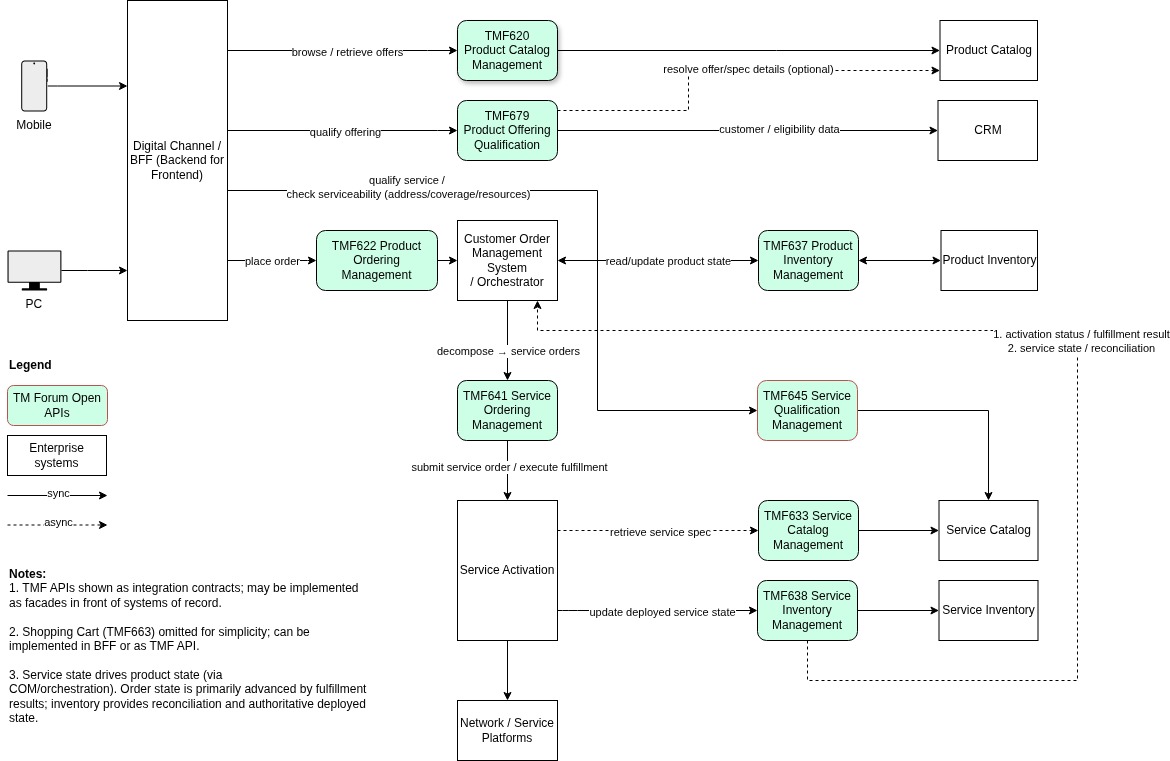
In the previous articles, we examined how customer intent is captured and standardized through TMF622 Product Ordering, and how Customer Order Management decomposes product orders and orchestrates lifecycle progression. Now we move to the final and often most complex domain: Service Activation and Operational State Management.
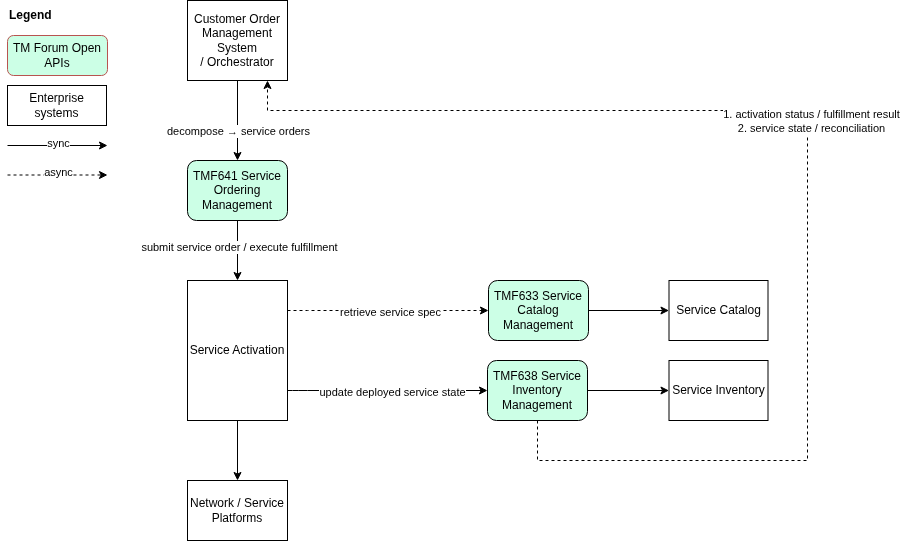
This domain represents the transition from commercial abstraction to technical execution — where real infrastructure constraints, asynchronous processes, and operational reality must be handled pragmatically. This article demonstrates how TMF641 Service Ordering, TMF633 Service Catalog, and TMF638 Service Inventory can be applied without introducing unnecessary orchestration complexity or tightly coupled fulfillment architectures.
The Service Activation Domain
The Service Activation domain operates under fundamentally different conditions than commercial order management. Where product ordering captures commercial intent, service activation is responsible for executing that intent within the operational environment. It translates service orders into concrete technical actions across network platforms, infrastructure components, and operational support systems.
Typical responsibilities within this domain include:
Responsibility
Description
Network provisioning
Configuring network elements, access technologies, or connectivity services
Resource configuration
Allocating and binding technical resources required for service delivery
Platform activation
Enabling services on application or service platforms (e.g., IPTV, VoIP, mobile)
OSS integration
Interacting with provisioning systems, resource managers, and inventory platforms
External vendor integration
Invoking third-party or partner systems required for service delivery
Operational characteristics in this domain differ significantly from upstream commercial systems. Service activation processes are typically:
Long-running — execution may span minutes, hours, or longer depending on infrastructure dependencies
Asynchronous — progress and results are delivered through events or status updates, not immediate responses
Partially executable — complex services may activate some components successfully while others require retries or remediation
Architectural Implication Because of these characteristics, the Service Activation domain must be designed to handle asynchronous execution, tolerate partial outcomes, and provide clear operational feedback to upstream order management systems. Architectures that assume synchronous, always-successful activation will fail at operational scale.
Service Ordering — TMF641
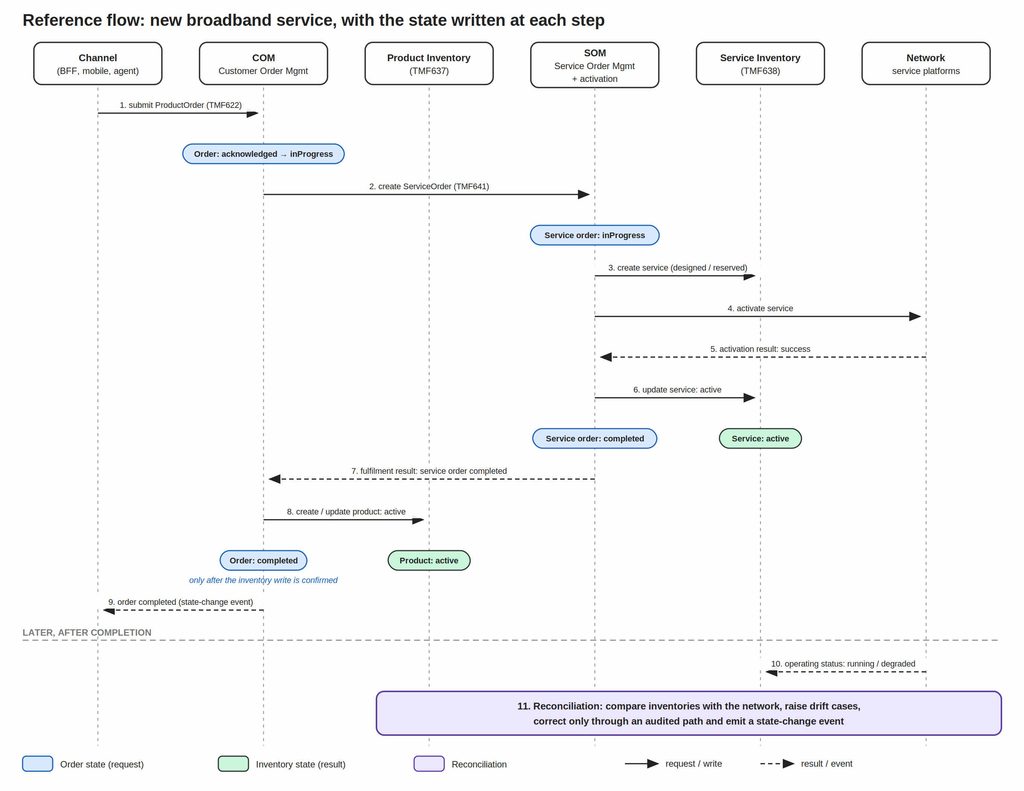
TMF641 Service Ordering Management API acts as the operational boundary between order orchestration and service execution. When Customer Order Management completes product order decomposition, the resulting service-level work requests are submitted through TMF641. At this point, responsibility shifts from commercial orchestration to technical fulfillment.
TMF641 therefore provides a stable execution interface that allows the orchestration layer to trigger service delivery while remaining independent from the internal design of activation systems.
What TMF641 Is — and Is Not
TMF641 IS…
TMF641 is NOT…
A contract for requesting service execution
A workflow engine
A lifecycle state tracking interface
A process definition framework
An operational boundary between domains
A platform for implementing provisioning logic
A stable integration surface for orchestrators
An internal activation system
Through this contract, the orchestrator can reliably initiate fulfillment activities without needing to understand how those activities are implemented internally. The key architectural rule is:
TMF641 enables execution requests — it does not define execution logic.
Separation of Responsibilities: Orchestration vs. Fulfillment
A clean architecture requires a clear distinction between order orchestration decisions and service activation execution. The two domains have fundamentally different roles:
Customer Order Management (COM)
Service Activation Domain
Interprets the incoming TMF622 ProductOrder
Determines how provisioning must be performed
Decomposes the order into service-level actions
Identifies which OSS systems or network controllers to invoke
Submits ServiceOrders through TMF641
Manages dependencies between provisioning steps
Monitors fulfillment progress and advances product order state
Handles technical failures, retries, and recovery
In simple terms: COM decides what must be delivered. Service Activation decides how it is delivered.
Maintaining this separation prevents a common and costly anti-pattern: embedding provisioning logic inside the orchestration domain. When orchestration layers begin implementing detailed activation workflows, they become tightly coupled to network implementation details, making the system difficult to evolve and scale.
By keeping execution logic inside the fulfillment domain and using TMF641 purely as an execution contract, the architecture remains modular, maintainable, and resilient as both commercial and operational systems evolve independently.
Service Catalog — TMF633
TMF633 Service Catalog Management API provides the technical definitions of services required by fulfillment and activation domains. While product catalogs describe commercial offerings, the service catalog defines how those offerings are realized at the technical level.
The Service Catalog typically contains:
Service specifications describing the structure and characteristics of technical services
Resource requirements indicating dependencies on network or platform resources
Configuration templates used during provisioning and activation
Activation metadata that guides provisioning systems on how services should be instantiated
Activation and fulfillment systems may use TMF633 to resolve service specification details, validate technical configuration constraints, and retrieve provisioning parameters referenced in service orders.
Design-Time Reference, Not Runtime Dependency
From an architectural perspective, the Service Catalog should be treated as a supporting design-time and reference domain — not a synchronous runtime dependency on every activation request.
Recommended Approach Cache required catalog metadata within fulfillment systems at startup or on demand. Apply explicit versioning of service specifications to ensure predictable execution across releases. Avoid synchronous catalog lookups on critical provisioning paths — catalog unavailability must never block service activation.
This approach maintains activation performance, resilience, and operational stability, while ensuring that fulfillment systems rely on consistent and governed service definitions.
Execution Model — Asynchronous by Design
Service activation processes are inherently asynchronous and long-running. Unlike commercial order submission, technical provisioning typically involves multiple downstream systems, infrastructure platforms, and external integrations that cannot complete within a single synchronous request.
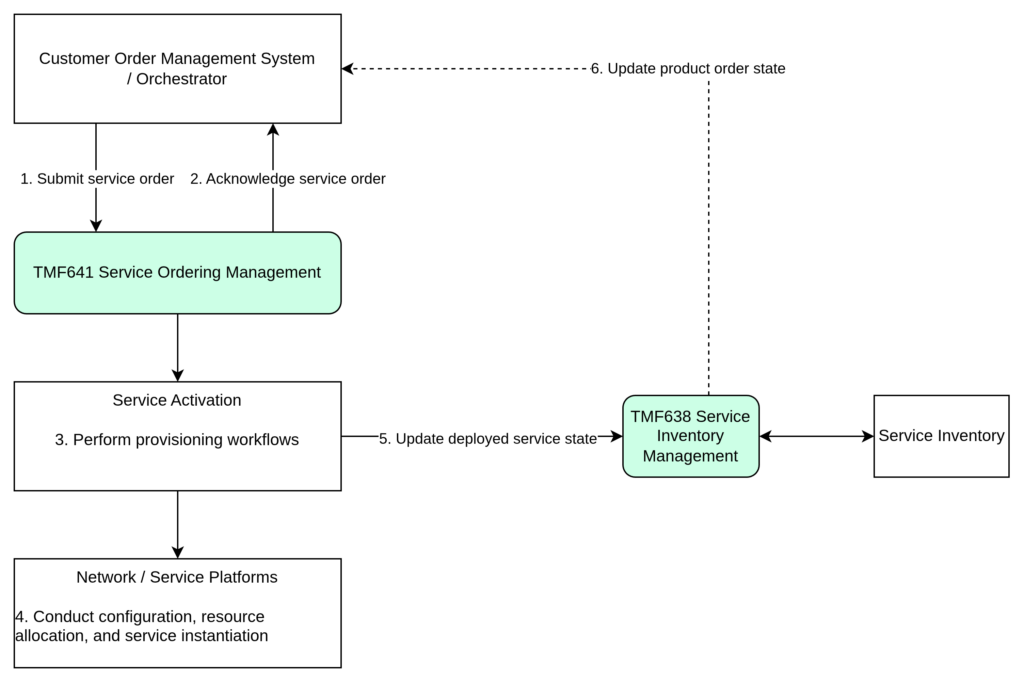
Typical Execution Lifecycle
Step
Actor
Action
1
COM
Submits ServiceOrder via TMF641
2
Activation Domain
Accepts and acknowledges the ServiceOrder
3
Activation Domain
Initiates internal provisioning workflows
4
Underlying Systems
Perform configuration, resource allocation, and service instantiation
5
Activation Domain
Emits lifecycle status updates as execution progresses
6
COM
Processes status events and advances product order state
Lifecycle States
During execution, the activation domain reports the following intermediate lifecycle states:
State
Meaning
COM Response
acknowledged
Request accepted for processing
Record confirmation; no state change
inProgress
Provisioning activities are executing
Maintain InProgress order state
pendingExternal
Waiting on an external system or vendor
Apply timeout monitoring; prepare retry
completed
Service successfully activated
Advance order to Completed; update TMF637
failed
Provisioning could not be completed
Enter recovery logic; evaluate retry or rollback
Design Principle Orchestration and order management domains must rely on event-driven feedback and lifecycle state transitions — not on synchronous completion of activation requests. A completed API call means the request was accepted. It does not mean the service was activated.
Service Inventory — TMF638
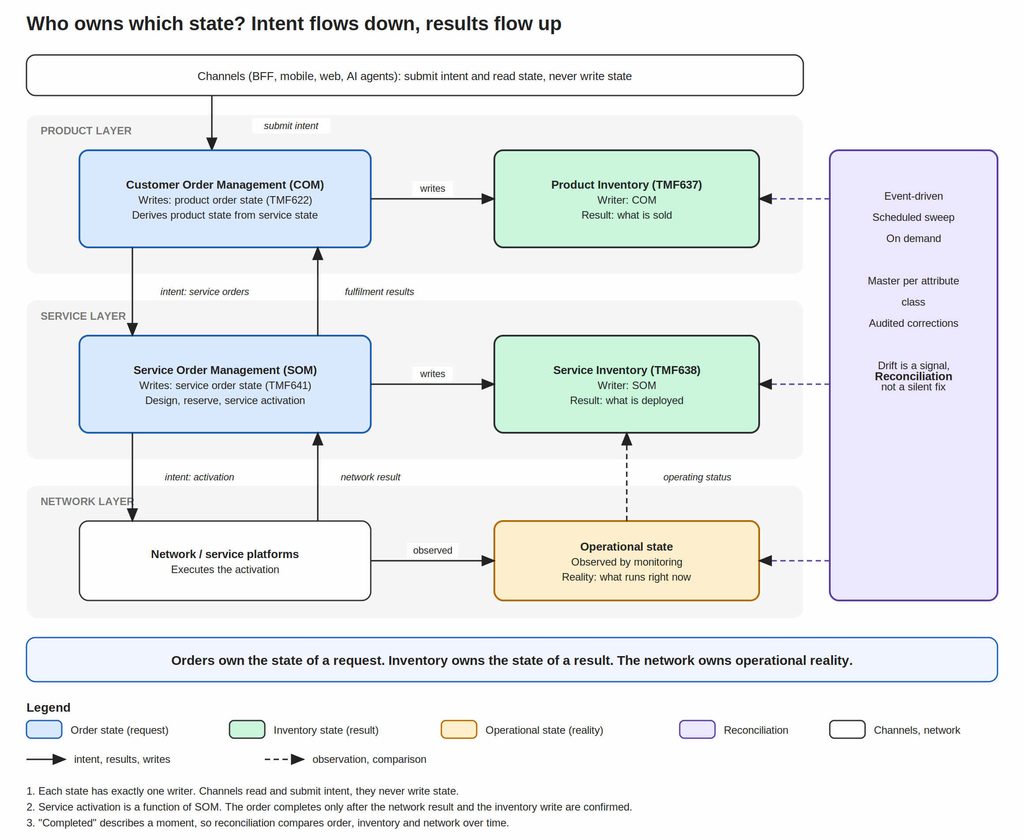
A fundamental architectural principle of fulfillment architecture is: the authoritative deployed state of services must be maintained in Service Inventory.
TMF638 Service Inventory represents the actual technical deployment of services in the network and platforms. It reflects what is really running in the infrastructure, independent of commercial intent or ordering processes.
TMF638 typically stores:
Deployed service instances and their identifiers
Active configurations and binding parameters
Relationships between services and underlying resources
Operational lifecycle state of each service (active, suspended, terminated, degraded)
Key Principle Service Inventory is not a tracking repository for orders. It is the source of truth for operational reality within the OSS landscape. Other domains — assurance, monitoring, reconciliation — must rely on TMF638, not on order state, to understand what is actually deployed.
During service activation, provisioning systems interact with infrastructure components and progressively update Service Inventory as deployment evolves — creating new service instances, modifying configuration, and recording operational state changes.
Feedback to the Order Domain
Once service activation begins, Customer Order Management must rely on asynchronous feedback from fulfillment and inventory domains to understand how execution is progressing. Two primary categories of signals flow back to the order domain.
1. Fulfillment Results
Fulfillment systems provide execution outcomes for service orders, typically through TMF641 interfaces. These signals drive the lifecycle of the commercial order managed through TMF622 and are used to:
A second category of signals originates from the operational environment — specifically, the service inventory maintained through TMF638. These updates represent the actual technical state of deployed services, independent of the order workflow.
Operational state signals are used for:
Inventory reconciliation and drift detection
Identifying service degradation or configuration inconsistencies
Triggering corrective actions in assurance or orchestration systems
Example Scenario A ProductOrder has been marked Completed in the order domain. Later, TMF638 Service Inventory reports that the corresponding service instance has entered a degraded operational state. In this situation: COM may initiate corrective workflows, assurance systems may trigger incident handling, and orchestration may request re-provisioning.
Order completion does not guarantee long-term operational correctness. Robust architectures must maintain continuous feedback loops between fulfillment, inventory, and order management.
Handling Reality Drift
In operational environments, reality drift occurs when the actual deployed state of a service diverges from the expected state defined during order fulfillment. This divergence is common in large distributed telecom environments and must be explicitly addressed in system design.
Delayed or incomplete responses from partner or third-party APIs
Partial provisioning failures
Some service components activate successfully while others fail silently
Out-of-band interventions
Operational changes applied during incident resolution without proper lifecycle tracking
Architectural Patterns for Managing Drift
1. Periodic Reconciliation
Scheduled reconciliation jobs compare the deployed service state stored in TMF638 with the real configuration observed in network or platform systems. These processes identify discrepancies and trigger corrective actions when necessary. Reconciliation frequency should be calibrated to the operational risk tolerance of the service type.
2. Event-Driven Inventory Updates
Modern architectures increasingly rely on event-driven mechanisms where network platforms emit state change events that update Service Inventory in near real time. This approach significantly reduces the window during which inconsistencies can exist undetected, and eliminates the latency inherent in scheduled reconciliation.
3. Domain-Specific Repair Workflows
When inconsistencies are detected — whether through reconciliation or event-driven signals — specialized repair workflows are triggered within the activation domain. These workflows may:
Reapply configuration to bring the network element back to the expected state
Restore missing or corrupted service components
Synchronize service state across all affected inventory and assurance systems
Escalate to manual intervention when automated repair is not viable
Avoiding Fulfillment Complexity Traps
Service activation architectures accumulate complexity over time — often through well-intentioned design decisions that solve short-term problems while creating long-term constraints. The following anti-patterns appear repeatedly in telecom BSS/OSS implementations and are worth addressing explicitly.
1. The Centralized Mega-Orchestrator
As activation requirements grow, there is a recurring temptation to introduce a single orchestration platform that owns the end-to-end fulfillment workflow — from ServiceOrder receipt through network provisioning, resource allocation, and inventory update. This approach typically starts as a pragmatic shortcut and gradually accumulates ownership of everything.
The consequences are predictable:
A single point of failure that affects all service types simultaneously
Deployment bottlenecks — every change to any service requires a release of the central platform
Performance degradation as order volumes grow and all execution serializes through one engine
Deep coupling between commercial product models and network implementation details
Preferred Approach Prefer domain-specific execution logic. Each service type or service family should own its activation workflow. Use TMF641 as the stable interface through which these domain-specific activators are invoked. Orchestration coordinates — it does not implement provisioning steps.
2. Overusing Workflow Engines
Visual workflow engines (BPM platforms, low-code orchestration tools) are valuable for genuinely complex, human-in-the-loop, or highly variable processes. However, many telecom provisioning flows are deterministic, rule-based, and predictable. Modeling these flows in a heavyweight workflow engine introduces operational overhead without architectural benefit.
Signs that a workflow engine is being overused:
Simple sequential activation steps modeled as multi-node workflows with branching logic
The workflow engine becomes the only way to understand what the system does
Changes to provisioning logic require workflow designer involvement rather than code review
Preferred Approach Use state-machine-based execution for deterministic provisioning flows. Reserve workflow engines for processes that are genuinely variable, approval-dependent, or require human intervention. Explicit state machines are easier to test, version, and reason about than visual workflow definitions.
3. Synchronous Activation Chains
A synchronous activation chain occurs when each provisioning step waits for the previous one to complete before proceeding — creating a long, blocking call chain that spans multiple systems. This pattern is fragile: a single slow or unavailable system causes the entire chain to stall or time out.
Common manifestations include:
Direct synchronous calls from the orchestrator into multiple downstream provisioning systems in sequence
Timeout values set high to accommodate slow external systems, masking latency problems
Error handling that propagates exceptions upward through the call chain rather than isolating failures
Preferred Approach Design activation flows as asynchronous command-and-event sequences. Each provisioning step emits a completion event. The next step is triggered by that event, not by a return value. This decouples execution timing, isolates failures, and allows individual steps to retry independently without affecting the rest of the workflow.
Integration Pattern Summary
When the Service Activation domain is implemented correctly, it becomes a well-bounded, operationally stable execution layer that supports both commercial agility and technical evolution. The following summarizes the key responsibilities and their rationale.
Responsibility
Mechanism
Rationale
Execute ServiceOrders
TMF641 Service Ordering API
Provides a stable, domain-independent execution contract
Resolve technical definitions
TMF633 Service Catalog (cached)
Decouples activation from catalog availability at runtime
Maintain authoritative deployed state
TMF638 Service Inventory
Ensures operational truth is available to all consuming domains
Emit lifecycle updates
Asynchronous events / callbacks
Allows orchestration to progress without blocking on activation
Decouple from commercial models
Anti-Corruption Layer at domain boundary
Allows product and service domains to evolve independently
Handle failures locally
Domain-specific retry and repair workflows
Prevents failure propagation into orchestration and order domains
When implemented correctly:
Operational complexity is isolated within the activation domain and does not leak into orchestration
The orchestration layer remains clean, focused on lifecycle coordination rather than provisioning detail
Individual activation domains can be scaled, replaced, or evolved without impacting upstream systems
TMF APIs serve as integration boundaries — not as architectural foundations for internal design
Closing the Lifecycle
This article concludes the three-part series on TM Forum Open API architecture. Across the trilogy, three distinct domains work in sequence to translate a customer’s commercial intent into a delivered, operational service.
Domain
Primary APIs
Core Responsibility
Customer Order Capture
TMF622 Product Ordering
Validates and standardizes commercial intent into a structured ProductOrder
Customer Order Management
TMF622, TMF641, TMF637
Decomposes the ProductOrder, orchestrates lifecycle, and coordinates fulfillment feedback
Service Activation & Inventory
TMF641, TMF633, TMF638
Executes technical provisioning and maintains authoritative operational state
TM Forum Open APIs serve a specific and bounded purpose in this architecture: they define domain boundaries, provide integration contracts, and establish interoperability standards between systems. They define the shape of the interface between domains — not the internal behavior of those domains.
A Closing Principle TMF APIs should never dictate internal architecture. A system that models its internal domain logic directly on TMF JSON structures will be brittle, difficult to evolve, and tightly coupled to API version cycles. Use TMF APIs at the boundary. Use domain models internally. The Anti-Corruption Layer is not optional — it is the mechanism that keeps these concerns separate.
Across all three domains, the architectural thread is consistent: own your domain logic, expose clean contracts, and use standard APIs as integration surfaces — not as blueprints for internal design. That separation is what makes telecom BSS/OSS architectures scalable, maintainable, and capable of evolving with both business and technology change.
Implementation Approaches: Platforms vs. Tailor-Made Development
Service Activation architectures can be implemented in several ways, each with distinct trade-offs in cost, flexibility, time-to-market, and long-term maintainability. The right choice depends on the operator’s scale, existing technology landscape, team capabilities, and the degree of domain specificity required.
Option 1 — Vendor Platforms
Established commercial platforms such as Nokia NSP, Ericsson OSS/BSS, IBM Sterling Order Management, and Netcracker provide pre-built fulfillment engines with native TMF API support, lifecycle management, and operational tooling. These solutions reduce time-to-market and bring proven operational patterns validated across large deployments.
Trade-offs to consider:
High upfront licensing and integration cost
Customisation of domain-specific business rules is constrained by the platform model
Vendor lock-in can limit architecture evolution and renegotiation leverage
Option 2 — Open-Source Platforms
Frameworks such as ONAP (Open Network Automation Platform) and OSM (Open Source MANO) provide community-driven orchestration and fulfillment capabilities with TMF alignment. These platforms are particularly relevant for operators pursuing open ecosystem strategies or needing multi-vendor network automation.
Trade-offs to consider:
Lower licensing cost, but significant investment in integration, configuration, and support
Community-driven TMF alignment varies in completeness across modules
Operational maturity depends heavily on internal DevOps and OSS expertise
Option 3 — Composable Frameworks
A growing number of teams adopt a composable approach: using a lightweight orchestration framework such as Temporal, Conductor, or Camunda for workflow coordination, while keeping domain-specific activation logic in purpose-built microservices that expose TMF641-compliant interfaces. This model offers high flexibility without building everything from scratch.
Trade-offs to consider:
Requires strong distributed systems expertise to operate reliably at scale
TMF alignment is manual — the team owns the integration contract design
Well-suited to organizations with mature engineering practices and evolving product portfolios
Option 4 — Tailor-Made Development
Full custom development — typically using runtimes such as Spring Boot, Quarkus, or Node.js combined with event streaming platforms like Apache Kafka or RabbitMQ — gives teams complete control over domain logic, state machine design, and integration contracts. This approach is justified when the domain logic is genuinely unique and no existing platform models it adequately.
Trade-offs to consider:
Highest initial investment in design, development, and operational tooling
Long-term maintenance ownership rests entirely with the internal team
Full alignment with domain model and TMF contracts — no platform constraints
Option 5 — Hybrid Approach
In brownfield environments, a hybrid strategy is often the most pragmatic path: retaining existing vendor platforms for stable, high-volume service types while introducing composable or tailor-made components for new services, digital channels, or domains requiring faster evolution. This allows incremental modernization without a full platform replacement.
Decision Matrix
The following matrix summarizes the key dimensions across all five approaches to support architectural decision-making:
Criterion
Vendor Platform
Open-Source Platform
Composable Framework
Tailor-Made
Hybrid
Time to market
Fast
Medium
Medium
Slow
Medium
Upfront cost
High
Low–Medium
Low–Medium
High
Medium–High
Vendor lock-in
High
Low
Low
None
Partial
TMF alignment
Native/partial
Community-driven
Manual
Full control
Mixed
Customisation
Limited
Moderate
High
Full
High
Operational maturity
High
Medium
Medium
Low initially
Medium–High
Team skill demand
Platform-specific
DevOps + OSS
Distributed systems
Strong dev team
Mixed
Best fit
Large operators,fast rollout
Cost-sensitive, open ecosystem
Flexible orchestration needs
Unique domain logic
Brownfield + evolution
A Constant Across All Approaches Regardless of the implementation path chosen, the architectural principles remain the same. TMF APIs define the boundaries. Domain logic stays internal. Operational state is always owned by Service Inventory. The platform or framework is an implementation detail — the domain model is the architecture.
Customer Order Management Domain Design & Orchestration with TMF622, TMF641, and TMF637
In the previous article, we examined how customer intent is captured and validated before being submitted as a standardized ProductOrder via TMF622. Now we move into the most critical domain of the lifecycle: Customer Order Management (COM).
Customer Order Management (COM) is where commercial intent is translated into technical execution. Done well, it keeps orchestration logic transparent, systems decoupled, and order state reliable. Done poorly — whether by becoming an ESB, a BPM monolith, or a thin pass-through — it becomes the bottleneck that breaks every large-scale telecom BSS deployment.
This article demonstrates how TMF622, TMF641, and TMF637 can be used in a pragmatic, domain-owned orchestration model — and explains the design decisions behind each choice.
The Role of Customer Order Management
Customer Order Management is frequently misunderstood. Its scope is often either too narrow (a simple API proxy) or too broad (a central workflow engine). Neither works at scale.
COM is NOT…
COM IS…
A simple pass-through integration layer
Owns the order lifecycle state
A centralized ESB routing all messages
Contains decomposition logic
A BPM monolith with complex workflows
Governs orchestration and coordination rules
A proxy that only exposes TMF schemas
Handles failures and exception recovery
Correlates fulfillment feedback and events
The distinction matters architecturally: COM owns behavior, not infrastructure. It does not route messages between systems — it governs how an order progresses through its lifecycle.
Architectural Boundary Recap
COM sits between the commercial and technical domains, acting as the translation and orchestration layer:
Downstream — TMF641 Service Ordering triggers technical execution (how it gets built)
Downstream — TMF637 Product Inventory reflects the customer-facing subscription state
Key Principle TM Forum Open APIs define the integration contracts between systems. Customer Order Management defines the lifecycle behavior — how orders progress, decompose, and react to fulfillment outcomes. These are separate concerns. Do not conflate the schema with the behavior.
From Product Order to Service Orders
What a ProductOrder Represents
A ProductOrder captures what a customer wants to buy — not how it gets delivered. It records the commercial agreement: which products or services were requested, at what price, under what terms, and by when.
For example, a ProductOrder might express: „Customer A wants 3 units of Fiber 1Gbps service, billed monthly, starting June 1“ — but it says nothing about which router will carry the traffic, which platform will host the service, or what provisioning steps engineers must follow.
A ProductOrder DOES represent…
A ProductOrder does NOT represent…
Commercial intent
Network topology or routing decisions
Customer-agreed products and terms
Service platform configuration
Requested start dates and pricing
Provisioning steps or activation sequences
Order-level identity and correlation ID
Technical resource allocation
In short: a ProductOrder answers „what was sold and agreed upon“ — not „how do we build or activate it.“ The downstream technical concerns belong to separate domains and are expressed through TMF641 ServiceOrders.
Order Decomposition
Inside COM, the ProductOrder must be decomposed into one or more ServiceOrders (TMF641). A single commercial product often requires multiple independent service activations:
Decomposes into: • Access service order (fiber circuit provisioning) • IP configuration service order (static IP assignment) • CPE provisioning service order (managed router configuration)
This decomposition must be:
Deterministic — the same ProductOrder always produces the same set of ServiceOrders
Version-aware — decomposition rules must account for product catalog changes over time
Idempotent — reprocessing an order due to failure must not create duplicate ServiceOrders
Decomposition as Domain Logic
Decomposition logic belongs inside COM, not in integration layers or external workflow engines. It should:
Use product-to-service mapping rules defined within the domain
Operate on internal domain models, not directly on TMF JSON structures
Be isolated from external API schema changes through an Anti-Corruption Layer (ACL)
The recommended mapping approach is a five-stage pipeline:
Step
Stage
Description
1
Receive
Accept TMF622 ProductOrder as the external integration contract
2
ACL Transform
Decouple the TMF schema from internal models via an Anti-Corruption Layer
3
Domain Mapping
Map to the internal Order domain model used by the Order Management system
4
Decomposition
Execute the Order Decomposition Engine to generate technical fulfillment actions
5
Submission
Generate and submit TMF641 ServiceOrder requests to downstream systems
This approach avoids the anti-pattern of designing the entire system around TMF JSON structures — a trap that makes internal logic brittle whenever the external API evolves.
Orchestration Without a Monolith
One of the most common architectural traps in telecom implementations is introducing a centralized BPM or workflow engine that gradually absorbs the entire order lifecycle. These systems tend to:
Embed complex orchestration logic in large, opaque workflow definitions
Own state management in a way that makes external observation difficult
Become performance and change bottlenecks as order volumes grow
A more pragmatic alternative is state-machine-based, event-driven orchestration. Instead of a visual workflow engine, implement orchestration using:
An explicit Order State Machine that governs lifecycle transitions
Domain events that communicate progress and trigger next actions
Clear, testable transition rules that define how the order moves between states
Order Lifecycle State Machine
The order lifecycle moves through the following states, each triggered by specific operational events:
State
Trigger Event
Next Action
Validated
Order accepted and validated
Begin decomposition
Decomposed
ServiceOrders generated
Submit to TMF641
InProgress
At least one ServiceOrder submitted
Await fulfillment events
PartiallyCompleted
Some components succeeded, some pending/failed
Evaluate retry or compensation
Completed
All components succeeded
Update Product Inventory (TMF637)
Failed
Unrecoverable failure across components
Trigger compensation / notify upstream
Why State Machines Over Workflow Engines?
Transparent — the current state and permitted transitions are always visible and auditable Testable — each transition rule can be validated independently, without running a full workflow Scalable — state is explicit data; it scales horizontally without centralized orchestration bottlenecks
Handling Asynchronous Feedback
Service execution rarely completes synchronously. After COM submits ServiceOrders via TMF641, fulfillment systems process requests and return status updates asynchronously. COM must be designed to handle this correctly.
What COM Receives
Typical asynchronous status updates from fulfillment systems include:
inProgress — fulfillment has started but is not yet complete
completed — the service component was successfully activated
failed — activation failed, with error context
partialActivation — some sub-components succeeded, others did not
How COM Must Respond
For each incoming event, COM must:
Correlate the feedback message with the correct orderItem using the correlation ID
Update the internal order state based on the outcome
Evaluate whether the overall ProductOrder can advance to the next lifecycle stage
Design Principle Order state progression must be driven by actual fulfillment outcomes — not by the immediate response of synchronous API calls. A 200 OK from TMF641 means the ServiceOrder was accepted, not that the service was activated.
Partial Failures and Recovery
In real-world fulfillment, not all service components succeed simultaneously. One component may complete while another fails due to a resource shortage, a downstream timeout, or a configuration conflict. COM must have a defined recovery strategy for each scenario.
Use explicit retry counters to prevent infinite loops
Compensate
Partial success where completed steps must be undone
Compensation logic must be defined per service type
Roll back
Critical failure where no partial state is acceptable
Ensure rollback is idempotent and auditable
Mark PartiallyCompleted
Some components are acceptable without others (by business rule)
Requires explicit product catalog guidance on optionality
Recommended Approach Keep retry logic inside the domain layer, where business rules are well understood. Avoid embedding retry behavior in external workflow or orchestration platforms. Maintain explicit retry counters. Unbounded retries are an operational risk, not a safety net.
Product Inventory Update — TMF637
Once fulfillment reaches a stable state, COM updates the Product Inventory using TMF637. A critical architectural principle governs this step: product and service inventories must remain separate.
TMF638 Service Inventory reflects technical service reality in the network and platforms
TMF637 Product Inventory represents the customer-facing subscription state
COM acts as the translation and alignment layer between these two domains. It maps service states to product states and triggers reconciliation if mismatches occur.
State Mapping
TMF641 Service State
TMF637 Product State
Notes
completed
active
All components fulfilled; customer-visible
suspended
suspended
Service paused; subscription retained
failed
pendingTermination or failed
Business rule governs customer notification
partialActivation
pendingActive
Awaiting remaining components; not yet customer-visible
terminated
terminated
Service decommissioned; subscription closed
This mapping ensures that customer-visible subscription status accurately reflects the underlying service activation state, while preserving the domain separation between service operations and product lifecycle management.
Synchronous vs Asynchronous Interactions
In order management architecture, it is critical to clearly separate synchronous API interactions from asynchronous operational feedback. Conflating the two leads to brittle, blocking systems that fail unpredictably at scale.
Synchronous Interactions — Request Acceptance
Synchronous calls are used for request submission and immediate validation. They confirm that a request has been received and is structurally valid — but they do not guarantee fulfillment.
Submission of customer orders via TMF622 Product Order
Creation of service fulfillment requests via TMF641 Service Order
What a synchronous response guarantees: • The request is structurally valid • It has been accepted for processing • Processing has started
What it does NOT guarantee: fulfillment completion. Long-running fulfillment activities must never block synchronous API calls.
Asynchronous Interactions — Fulfillment Feedback
Actual service fulfillment occurs asynchronously across multiple downstream systems. These systems emit events or callbacks that COM must process to advance the order lifecycle:
Service activation progress and completion updates
Failure notifications from fulfillment systems
Inventory reconciliation events from TMF638 or TMF637
Why This Separation Matters
Benefit
Explanation
Resilience
Failures in fulfillment systems do not block or degrade API responses
Scalability
Long-running operations are handled through events rather than blocking threads
Transparency
Order state progression is driven by real fulfillment outcomes, not API latency
Loose Coupling
Upstream systems are not tightly bound to downstream execution timing
Avoiding Common Anti-Patterns
1. COM as an ESB
COM must not become a routing hub for all integrations. It owns order lifecycle state and decomposition logic — nothing more. When COM starts routing messages between unrelated systems, it accumulates accidental complexity and becomes a single point of failure.
2. Deep Coupling to TMF Models
Internal state machines and domain logic must not depend directly on TMF JSON structures. External schemas change with API versions. An Anti-Corruption Layer decouples the external contract from the internal model, allowing both to evolve independently.
3. Centralized Workflow for Everything
Not every step in the order lifecycle requires BPM modeling. Many telecom fulfillment flows are predictable, rule-driven, and state-based. Introducing a visual workflow engine for these flows adds operational overhead without architectural benefit. Start with a state machine; escalate to a workflow engine only when the complexity genuinely demands it.
Integration Pattern Summary
When implemented correctly, Customer Order Management is a domain-focused orchestrator — not a middleware platform. It keeps orchestration complexity contained, treats TMF APIs as integration boundaries rather than internal data models, and produces systems that remain evolvable as products and technology change.
COM should:
Own lifecycle state — no external system should drive order progression
Decompose ProductOrders deterministically and idempotently
Trigger ServiceOrders via TMF641 and treat the response as acceptance, not completion
Process asynchronous fulfillment events to drive state transitions
Update Product Inventory via TMF637 only after reaching a stable fulfillment state
Orchestration complexity is contained within a single, observable domain
TMF APIs remain clean integration boundaries, not architectural foundations
Systems remain independently deployable and evolvable
What’s Next
In the next article, we move into the Service Activation domain and explore how technical execution is handled once COM has submitted its ServiceOrders:
TMF641 execution patterns and state management
The role of TMF633 Service Catalog in driving activation logic
TMF638 Service Inventory as the authoritative deployed state
Reconciliation strategies for handling drift between network reality and customer product state
(Not TMF633 — that’s Service Catalog. The Shopping Cart API is TMF663.)
In modern telecom architectures, one recurring question appears during digital transformation programs:
“Do we really need a standardized Shopping Cart API?”
With microservices, composable frontends, and powerful BFF layers, many teams assume the shopping cart can simply be implemented inside the digital channel.
So where does TMF663 actually fit? And is it still relevant?
Let’s analyze this architecturally.
What TMF663 Is
TMF663 – Shopping Cart Management is designed to:
Manage pre-order cart state,
Persist selected product offerings,
Support configuration updates,
Transition cart into a ProductOrder.
It is not:
A pricing engine,
A qualification engine,
An orchestration engine,
A product catalog.
It exists in the pre-order domain, before TMF622 Product Ordering.
The Core Architectural Question
The real question is not:
“Do we need TMF663?”
The real question is:
“Where should cart state live in a distributed architecture?”
There are three common patterns.
Pattern 1 – Cart Inside the BFF (Channel-Owned)
In this approach:
Digital Channels (e.g., Mobile/Web) interact directly with the BFF (Backend for Frontend).
Cart Management is implemented inside the BFF.
The BFF submits orders to TMF622 Product Ordering Management.
TMF622 integrates with Enterprise Systems (SoR).
Architectural Characteristics
In this pattern, the shopping cart is not a separate domain capability. It is embedded within the channel layer.
The BFF is responsible for:
Managing cart state
Handling product configuration
Preparing the ProductOrder payload
Calling TMF622
There is no reusable cart service outside the channel context.
When It Fits
Single or tightly controlled digital channel
Minimal partner exposure
Strong UX ownership
Fast delivery priority
Architectural Trade-Off
Cart logic is tightly coupled to channel implementation. Reusability across channels or partners is limited.
Submit the Executable Order Create and submit a formal customer order through:
TMF622 – Product Ordering
Orchestrate and Decompose the Order Coordinate fulfillment logic and manage order state within the Order Management domain (typically consuming TMF622 events and interacting with downstream APIs such as TMF641 where required)
Activate and Provision Services Trigger technical fulfillment and manage service lifecycle using:
TMF641 – Service Ordering
TMF638 – Service Inventory
In this model:
Qualification verifies commercial and technical feasibility first.
Only valid, sellable configurations are added to the cart.
The cart stores already qualified commercial intent.
The formal order lifecycle begins only when a TMF622 ProductOrder is submitted. TMF663, if used, sits between qualification and order submission. Its purpose is to organize and persist validated intent – not to perform eligibility or orchestration logic. When designed this way, the cart becomes a clean transition layer. When qualification is skipped or deferred, the cart turns into a staging area for errors that will surface later in order management or activation.
Conclusion
There is no single “correct” way to structure shopping cart management.
As we’ve seen, you can:
Keep the cart inside the digital channel,
Implement a dedicated domain cart service, or
Expose TMF663 as a standardized integration boundary.
Each option is valid — depending on your scale, channel strategy, partner model, and architectural maturity.
Now that you see the different patterns and trade-offs, the question is no longer “Do we need TMF663?”
The real question becomes:
Which option best fits your context, complexity, and long-term integration goals?
Architecture is about making deliberate choices — not following standards blindly.
Telecommunication architectures often struggle not with service activation or network execution, but with the very first step of the lifecycle: translating customer intent into a clean, valid order.
Many transformation programs introduce complexity at this stage by tightly coupling digital channels to backend systems, embedding business rules inside frontends, or overloading orchestration platforms with responsibilities that belong to domain boundaries.
This article explores a pragmatic approach to customer order capture using TM Forum Open APIs as stable integration contracts — focusing on how commercial validation, technical feasibility, and order submission can be implemented without creating architectural bottlenecks.
The discussion builds on the master architecture presented in TM Forum Open APIs Without the Complexity Trap and focuses specifically on the capture layer.
Diagram 1 – Customer Order Capture Flow
Architectural Scope
This article focuses on the commercial entry point of the lifecycle — the transition from customer interaction to standardized product order submission.
Core APIs covered:
TMF620 — Product Catalog Management
TMF679 — Product Offering Qualification
TMF645 — Service Qualification
TMF622 — Product Ordering Management
These APIs represent the boundary between digital engagement and downstream operational domains.
Key Architectural Principle
TM Forum APIs should act as:
stable integration contracts
domain boundaries
interoperability interfaces
They should NOT:
define internal data models
dictate orchestration logic
force digital channels to mirror backend complexity.
The goal of customer order capture is simple:
Produce a clean, validated ProductOrder representing commercial intent.
Everything else belongs downstream.
Engagement Layer — Digital Channel / BFF
Customer interaction begins in digital channels:
Web portals
Mobile applications
Partner systems
The BFF (Backend-for-Frontend) plays a crucial role:
Aggregates multiple backend APIs
Shields frontend from domain complexity
Maintains UX-specific workflows.
However, a common anti-pattern is turning the BFF into a business logic engine.
Pragmatic rule:
Validation logic lives behind TMF APIs, not inside the channel.
Product Discovery — TMF620 Product Catalog
The lifecycle begins with browsing commercial offerings via TMF620.
Responsibilities:
Retrieve product offerings
Resolve bundles and configurations
Provide structured product metadata.
Architectural pattern:
TMF620 often acts as an API facade over legacy catalog platforms.
Benefits:
Stable contract for digital channels
Decoupling from catalog implementation
Incremental modernization possible.
Important design choice:
The catalog provides information — it does not validate eligibility.
Intelligent Chatbots for Business: Practical Guide
Choosing the right architecture for your specific goals
📅 Juni 2026 · ⏱ 6 Min. Lesezeit · 🏷 Automatisierung · KI · Entscheidungshilfe
You can try out the chatbot on this website – just click on the widget icon in the bottom right corner.
The Business Case: Why Chatbots Matter Today
Customer expectations have fundamentally changed. Users expect immediate answers, multilingual support, and seamless digital interaction — regardless of time zone or business hours. At the same time, companies face increasing pressure to reduce operational costs while maintaining high-quality service.
Chatbots have emerged as a practical solution to this challenge. When implemented correctly, they help organizations:
Provide instant responses to repetitive inquiries
Reduce manual workload for support teams
Offer consistent and structured customer interactions
Guide users toward products, services, or next actions
Capture valuable structured data during conversations
Support international audiences with multilingual capabilities
Unlike traditional automation tools, modern chatbots can combine structured dialog flows with intelligent language understanding, enabling natural yet controlled interactions.
For many organizations, the primary motivation is not replacing human interaction but optimizing it — allowing human agents to focus on complex tasks while automation handles predictable workflows.
What Problems Chatbots Actually Solve
The value of chatbots becomes clear when examining real business scenarios. Instead of being generic “AI assistants”, successful chatbot implementations usually target specific operational challenges.
Typical use cases include:
Customer Support Automation – Chatbots can handle frequently asked questions, guide users through troubleshooting steps, and collect structured information before escalating to human agents.
Product and Service Guidance – Interactive conversations can help customers understand offerings, compare options, and navigate complex product portfolios.
Order Tracking and Status Updates – By integrating with backend systems, chatbots can provide real-time information without requiring manual support intervention.
Structured Data Collection – Forms integrated into conversational flows can gather requests, tickets, or onboarding data more efficiently than static forms.
Knowledge Base Access – Chatbots can serve as conversational interfaces for internal or external documentation systems.
Lead Qualification and Marketing Interaction – By guiding visitors through questions, chatbots can identify user intent, capture contact information, and route leads appropriately.
In practice, the most successful deployments start with clearly defined goals rather than attempting to solve every problem at once.
Types of Chatbots
Not all chatbots are created equal. Understanding the main categories helps businesses select the right approach.
Rule-Based Chatbots
These systems follow predefined conversation paths using buttons or fixed decision trees.
Advantages:
Predictable behavior
Easy compliance control
Suitable for structured workflows
Limitations:
Limited flexibility
Poor handling of unexpected input
NLP-Based Intent Chatbots
These bots use natural language processing to interpret user input and map it to predefined intents.
Advantages:
Flexible input handling
Structured backend integration
High reliability in enterprise contexts
Limitations:
Requires training data
Design effort for dialog flows
LLM-Powered Conversational Assistants
Large Language Model (LLM) chatbots generate responses dynamically using generative AI.
Advantages:
Highly natural conversations
Broad knowledge capabilities
Reduced need for predefined responses
Limitations:
Less predictable outputs
Governance and security considerations
Potential hallucinations
Hybrid Architectures
Many modern solutions combine structured dialog flows with AI-powered components. Structured workflows ensure reliability and compliance, while AI enhances flexibility where needed.
Technology Landscape: Popular Chatbot Frameworks and Platforms
Organizations typically choose between open-source frameworks, commercial platforms, or custom architectures.
The Reality of Chatbot Development — What Is Actually Hard
One of the biggest misconceptions is that chatbot development is primarily about selecting a framework or training an AI model. In reality, most effort lies elsewhere.
Dialog Design – Creating natural, efficient conversations that guide users toward outcomes requires deep understanding of business processes and user behavior.
Backend Integration – Real value comes from connecting chatbots to enterprise systems such as CRM, ERP, or billing platforms. Designing reliable API integrations is often more complex than building the conversation itself.
Multilingual Modeling – Supporting multiple languages requires careful intent design, testing, and content management.
Fallback Strategy – Handling unknown inputs gracefully is essential to maintaining user trust.
Security and Data Governance – Enterprise deployments must consider:
data privacy
logging policies
infrastructure architecture
authentication flows
Testing Real Conversations – Users behave unpredictably. Extensive testing with real-world scenarios is necessary to achieve reliable automation.
Common Mistakes Companies Make With Chatbots
Many projects struggle not because of technology limitations but because of incorrect assumptions.
Common pitfalls include:
Attempting full automation without clear use cases
Using generative AI without structured guardrails
Underestimating dialog design complexity
Ignoring fallback and escalation paths
Choosing tools based solely on trends rather than requirements
Treating chatbots as marketing features instead of operational tools
Avoiding these mistakes significantly increases project success rates.
AI Agents vs Chatbots — Evolution or Replacement?
With the rise of AI agents, many organizations ask whether traditional chatbots will become obsolete.
AI agents offer:
autonomous reasoning
dynamic task execution
flexible conversation flows
However, enterprise environments often require:
predictable workflows
compliance control
auditability
structured integration logic
For this reason, many experts see the future not as replacement but as convergence.
AI agents assist with reasoning, summarization, or complex queries
This balanced approach provides innovation without sacrificing control.
Diagram “Chatbots – Hybrid Architecture Model”
How to Choose the Right Chatbot Approach
Selecting the right chatbot architecture depends on business goals, regulatory constraints, integration complexity, and long-term strategy. The technology should follow the operational requirements — not the other way around.
Below is practical guidance based on typical enterprise scenarios.
Need FAQ automation? – Use “Structured Chatbot”
If the primary goal is to automate repetitive questions with predefined answers, a structured chatbot with clear dialog flows is often the most efficient solution.
Why this works:
High predictability
Easy testing and validation
Controlled user experience
Minimal AI complexity
Lower development risk
Structured bots are ideal when:
The content is well-defined
Compliance and accuracy matter
The goal is deflection of repetitive support load
They are often more cost-effective and stable than LLM-driven solutions for this use case.
Need to support enterprise workflows? – Use “Hybrid Architecture”
If the chatbot must integrate deeply with CRM, ERP, billing, or other backend systems, a hybrid architecture is typically the most robust option.
This means:
Structured dialog engine controls workflow logic
AI/LLM components assist where flexibility is useful
Clear integration layer connects enterprise systems
Why this works:
Predictable business process handling
Reliable backend API integration
Controlled fallback and escalation logic
Reduced hallucination risk
Better auditability
Hybrid models are particularly suited for regulated industries and mission-critical workflows.
Want to try experimental innovation? – Use “AI Agent Prototypes”
If the objective is to explore advanced conversational AI capabilities, such as autonomous reasoning or complex information synthesis, AI agent prototypes can be appropriate.
Why this works:
Rapid experimentation
Less need for predefined dialog trees
Natural interaction style
Strong knowledge exploration capability
However, this approach should be chosen carefully because:
Outputs may be less predictable
Governance requires additional safeguards
Integration into structured business processes can be challenging
Best suited for innovation labs, internal tools, or knowledge assistants.
Must follow strict data governance requirements? – Use “Controlled Infrastructure Deployment (On-Premises or Private Cloud)”
If your organization operates under strict regulatory requirements (e.g., financial services, healthcare, public sector), infrastructure control becomes a primary architectural driver.
In such cases, you should consider:
On-premises deployment
Private cloud hosting within the EU
Data residency guarantees
Controlled logging and access policies
Why this matters:
Compliance with GDPR and industry regulations
Full control over customer data
Reduced exposure to third-party data processors
Auditability and traceability
Open-source frameworks are often a strong fit here because they allow self-hosting and eliminate dependency on external SaaS providers. However, the key factor is not “open-source” itself — it is infrastructure control and data ownership.
Strategic Consideration
Early architectural decisions significantly influence:
long-term operational cost
scalability
vendor lock-in risk
compliance flexibility
ability to extend functionality later
A chatbot project should therefore start with architectural assessment rather than tool selection.
Conclusion
Chatbots are no longer experimental tools. When designed with clear objectives and integrated into real business processes, they become powerful automation components that improve customer experience and operational efficiency.
The key is not selecting the most advanced technology but choosing the right architecture for your specific goals.
Discuss Your Chatbot Strategy
If you are evaluating chatbot solutions or planning to introduce conversational automation, a structured architectural approach helps avoid costly redesigns later.
An independent expert perspective can help:
assess feasibility
select appropriate technology
design scalable architecture
align automation with business processes
A short initial discussion can clarify whether chatbot automation is the right next step for your organization.