Autor: admin

  • TMF OpenAPIs – Customer Order Management

    Customer Order Management Domain Design & Orchestration with TMF622, TMF641, and TMF637

    In the previous article, we examined how customer intent is captured and validated before being submitted as a standardized ProductOrder via TMF622. Now we move into the most critical domain of the lifecycle: Customer Order Management (COM).

    Customer Order Management (COM) is where commercial intent is translated into technical execution. Done well, it keeps orchestration logic transparent, systems decoupled, and order state reliable. Done poorly — whether by becoming an ESB, a BPM monolith, or a thin pass-through — it becomes the bottleneck that breaks every large-scale telecom BSS deployment.

    This article demonstrates how TMF622, TMF641, and TMF637 can be used in a pragmatic, domain-owned orchestration model — and explains the design decisions behind each choice.

    The Role of Customer Order Management

    Customer Order Management is frequently misunderstood. Its scope is often either too narrow (a simple API proxy) or too broad (a central workflow engine). Neither works at scale.

    COM is NOT…COM IS…
    A simple pass-through integration layerOwns the order lifecycle state
    A centralized ESB routing all messagesContains decomposition logic
    A BPM monolith with complex workflowsGoverns orchestration and coordination rules
    A proxy that only exposes TMF schemasHandles failures and exception recovery

    Correlates fulfillment feedback and events

    The distinction matters architecturally: COM owns behavior, not infrastructure. It does not route messages between systems — it governs how an order progresses through its lifecycle.

    Architectural Boundary Recap

    COM sits between the commercial and technical domains, acting as the translation and orchestration layer:

    • Upstream — TMF622 Product Ordering captures commercial intent (what the customer bought)
    • Downstream — TMF641 Service Ordering triggers technical execution (how it gets built)
    • Downstream — TMF637 Product Inventory reflects the customer-facing subscription state
    Key Principle TM Forum Open APIs define the integration contracts between systems. Customer Order Management defines the lifecycle behavior — how orders progress, decompose, and react to fulfillment outcomes. These are separate concerns. Do not conflate the schema with the behavior.

    From Product Order to Service Orders

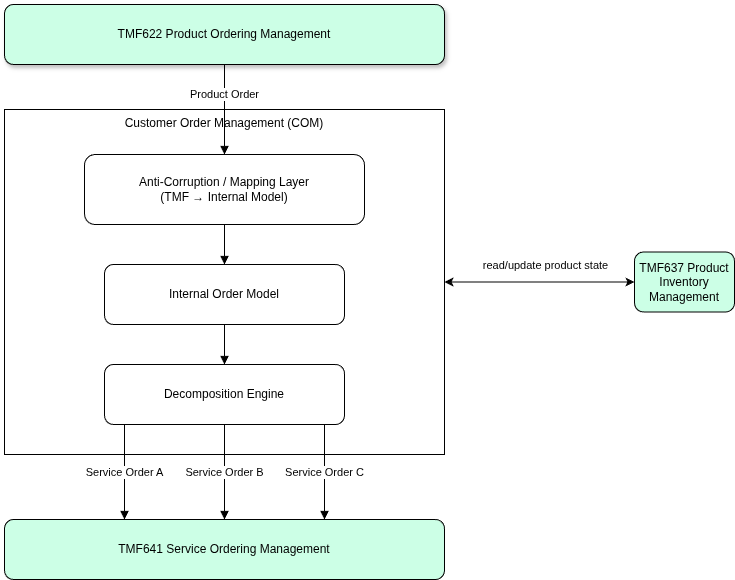
    From Product Order to Service Orders:
- Upstream — TMF622 Product Ordering captures commercial intent (what the customer bought)
- Downstream — TMF641 Service Ordering triggers technical execution (how it gets built)
- Downstream — TMF637 Product Inventory reflects the customer-facing subscription state

    What a ProductOrder Represents

    A ProductOrder captures what a customer wants to buy — not how it gets delivered. It records the commercial agreement: which products or services were requested, at what price, under what terms, and by when.

    For example, a ProductOrder might express: „Customer A wants 3 units of Fiber 1Gbps service, billed monthly, starting June 1“ — but it says nothing about which router will carry the traffic, which platform will host the service, or what provisioning steps engineers must follow.

    A ProductOrder DOES represent…A ProductOrder does NOT represent…
    Commercial intentNetwork topology or routing decisions
    Customer-agreed products and termsService platform configuration
    Requested start dates and pricingProvisioning steps or activation sequences
    Order-level identity and correlation IDTechnical resource allocation

    In short: a ProductOrder answers „what was sold and agreed upon“ — not „how do we build or activate it.“ The downstream technical concerns belong to separate domains and are expressed through TMF641 ServiceOrders.

    Order Decomposition

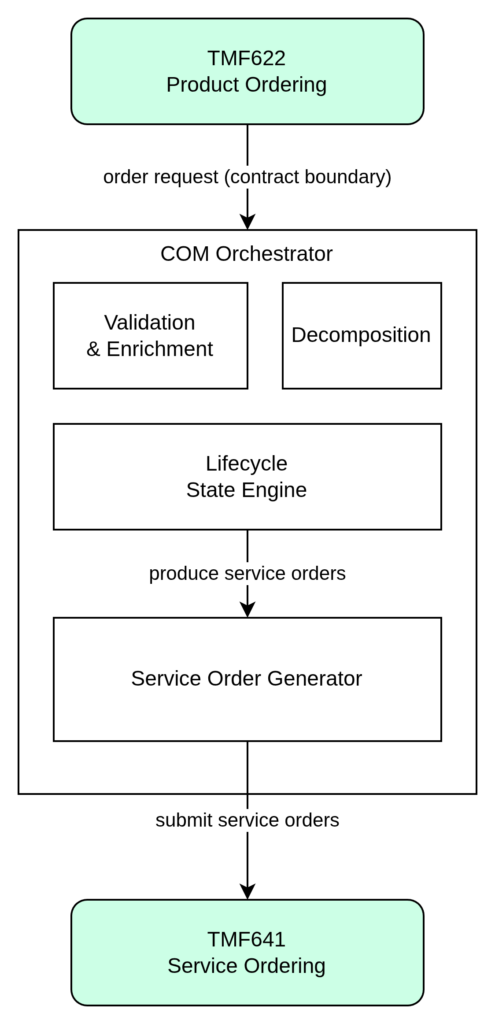
    Inside COM, the ProductOrder must be decomposed into one or more ServiceOrders (TMF641). A single commercial product often requires multiple independent service activations:

    Example: ProductOrder — „Business Fiber + Static IP + Managed Router“

    Decomposes into: • Access service order (fiber circuit provisioning) • IP configuration service order (static IP assignment) • CPE provisioning service order (managed router configuration)

    This decomposition must be:

    • Deterministic — the same ProductOrder always produces the same set of ServiceOrders
    • Version-aware — decomposition rules must account for product catalog changes over time
    • Idempotent — reprocessing an order due to failure must not create duplicate ServiceOrders

    Decomposition as Domain Logic

    Decomposition logic belongs inside COM, not in integration layers or external workflow engines. It should:

    • Use product-to-service mapping rules defined within the domain
    • Operate on internal domain models, not directly on TMF JSON structures
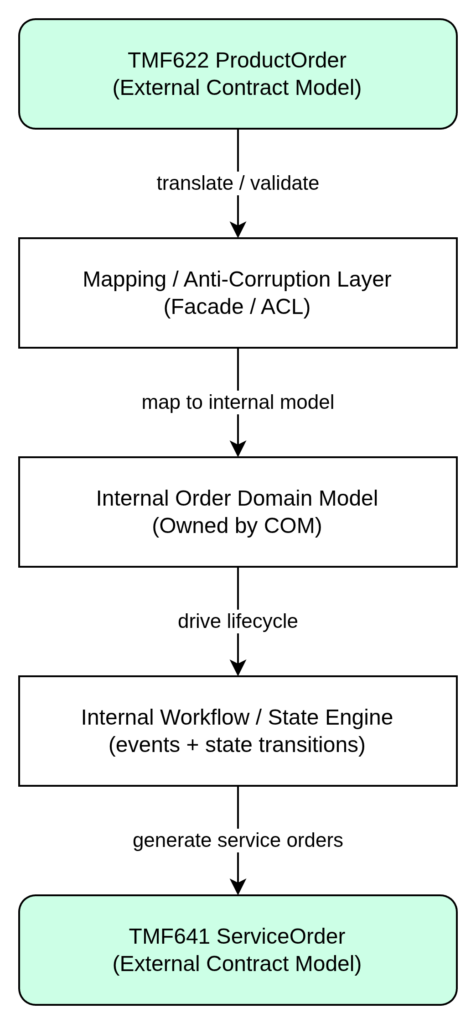
    • Be isolated from external API schema changes through an Anti-Corruption Layer (ACL)

    The recommended mapping approach is a five-stage pipeline:

    StepStageDescription
    1ReceiveAccept TMF622 ProductOrder as the external integration contract
    2ACL TransformDecouple the TMF schema from internal models via an Anti-Corruption Layer
    3Domain MappingMap to the internal Order domain model used by the Order Management system
    4DecompositionExecute the Order Decomposition Engine to generate technical fulfillment actions
    5SubmissionGenerate and submit TMF641 ServiceOrder requests to downstream systems

    This approach avoids the anti-pattern of designing the entire system around TMF JSON structures — a trap that makes internal logic brittle whenever the external API evolves.

    Orchestration Without a Monolith

    One of the most common architectural traps in telecom implementations is introducing a centralized BPM or workflow engine that gradually absorbs the entire order lifecycle. These systems tend to:

    • Embed complex orchestration logic in large, opaque workflow definitions
    • Own state management in a way that makes external observation difficult
    • Become performance and change bottlenecks as order volumes grow

    A more pragmatic alternative is state-machine-based, event-driven orchestration. Instead of a visual workflow engine, implement orchestration using:

    • An explicit Order State Machine that governs lifecycle transitions
    • Domain events that communicate progress and trigger next actions
    • Clear, testable transition rules that define how the order moves between states

    Order Lifecycle State Machine
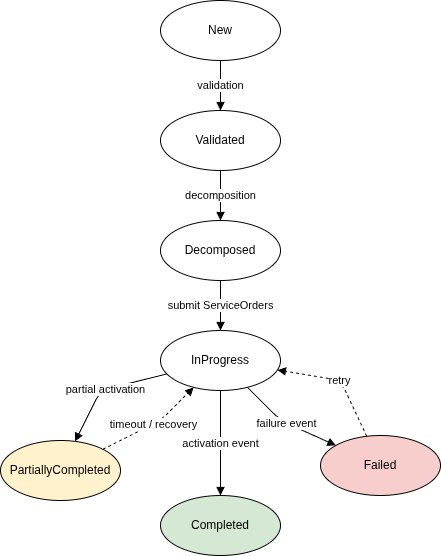
    Order Lifecycle State Machine

    The order lifecycle moves through the following states, each triggered by specific operational events:

    StateTrigger EventNext Action
    ValidatedOrder accepted and validatedBegin decomposition
    DecomposedServiceOrders generatedSubmit to TMF641
    InProgressAt least one ServiceOrder submittedAwait fulfillment events
    PartiallyCompletedSome components succeeded, some pending/failedEvaluate retry or compensation
    CompletedAll components succeededUpdate Product Inventory (TMF637)
    FailedUnrecoverable failure across componentsTrigger compensation / notify upstream
    Why State Machines Over Workflow Engines?

    Transparent — the current state and permitted transitions are always visible and auditable Testable — each transition rule can be validated independently, without running a full workflow Scalable — state is explicit data; it scales horizontally without centralized orchestration bottlenecks

    Handling Asynchronous Feedback

    Service execution rarely completes synchronously. After COM submits ServiceOrders via TMF641, fulfillment systems process requests and return status updates asynchronously. COM must be designed to handle this correctly.

    What COM Receives

    Typical asynchronous status updates from fulfillment systems include:

    • inProgress — fulfillment has started but is not yet complete
    • completed — the service component was successfully activated
    • failed — activation failed, with error context
    • partialActivation — some sub-components succeeded, others did not

    How COM Must Respond

    For each incoming event, COM must:

    • Correlate the feedback message with the correct orderItem using the correlation ID
    • Update the internal order state based on the outcome
    • Evaluate whether the overall ProductOrder can advance to the next lifecycle stage
    Design Principle Order state progression must be driven by actual fulfillment outcomes — not by the immediate response of synchronous API calls. A 200 OK from TMF641 means the ServiceOrder was accepted, not that the service was activated.

    Partial Failures and Recovery

    In real-world fulfillment, not all service components succeed simultaneously. One component may complete while another fails due to a resource shortage, a downstream timeout, or a configuration conflict. COM must have a defined recovery strategy for each scenario.

    Recovery Options

    StrategyWhen to UseKey Consideration
    RetryTransient failure (timeout, resource temporarily unavailable)Use explicit retry counters to prevent infinite loops
    CompensatePartial success where completed steps must be undoneCompensation logic must be defined per service type
    Roll backCritical failure where no partial state is acceptableEnsure rollback is idempotent and auditable
    Mark PartiallyCompletedSome components are acceptable without others (by business rule)Requires explicit product catalog guidance on optionality
    Recommended Approach Keep retry logic inside the domain layer, where business rules are well understood. Avoid embedding retry behavior in external workflow or orchestration platforms. Maintain explicit retry counters. Unbounded retries are an operational risk, not a safety net.

    Product Inventory Update — TMF637

    Once fulfillment reaches a stable state, COM updates the Product Inventory using TMF637. A critical architectural principle governs this step: product and service inventories must remain separate.

    • TMF638 Service Inventory reflects technical service reality in the network and platforms
    • TMF637 Product Inventory represents the customer-facing subscription state

    COM acts as the translation and alignment layer between these two domains. It maps service states to product states and triggers reconciliation if mismatches occur.

    State Mapping

    TMF641 Service StateTMF637 Product StateNotes
    completedactiveAll components fulfilled; customer-visible
    suspendedsuspendedService paused; subscription retained
    failedpendingTermination or failedBusiness rule governs customer notification
    partialActivationpendingActiveAwaiting remaining components; not yet customer-visible
    terminatedterminatedService decommissioned; subscription closed

    This mapping ensures that customer-visible subscription status accurately reflects the underlying service activation state, while preserving the domain separation between service operations and product lifecycle management.

    Synchronous vs Asynchronous Interactions

    In order management architecture, it is critical to clearly separate synchronous API interactions from asynchronous operational feedback. Conflating the two leads to brittle, blocking systems that fail unpredictably at scale.

    Synchronous Interactions — Request Acceptance

    Synchronous calls are used for request submission and immediate validation. They confirm that a request has been received and is structurally valid — but they do not guarantee fulfillment.

    • Submission of customer orders via TMF622 Product Order
    • Creation of service fulfillment requests via TMF641 Service Order
    What a synchronous response guarantees: • The request is structurally valid • It has been accepted for processing • Processing has started

    What it does NOT guarantee: fulfillment completion. Long-running fulfillment activities must never block synchronous API calls.

    Asynchronous Interactions — Fulfillment Feedback

    Actual service fulfillment occurs asynchronously across multiple downstream systems. These systems emit events or callbacks that COM must process to advance the order lifecycle:

    • Service activation progress and completion updates
    • Failure notifications from fulfillment systems
    • Inventory reconciliation events from TMF638 or TMF637

    Why This Separation Matters

    BenefitExplanation
    ResilienceFailures in fulfillment systems do not block or degrade API responses
    ScalabilityLong-running operations are handled through events rather than blocking threads
    TransparencyOrder state progression is driven by real fulfillment outcomes, not API latency
    Loose CouplingUpstream systems are not tightly bound to downstream execution timing

    Avoiding Common Anti-Patterns

    1. COM as an ESB

    COM must not become a routing hub for all integrations. It owns order lifecycle state and decomposition logic — nothing more. When COM starts routing messages between unrelated systems, it accumulates accidental complexity and becomes a single point of failure.

    2. Deep Coupling to TMF Models

    Internal state machines and domain logic must not depend directly on TMF JSON structures. External schemas change with API versions. An Anti-Corruption Layer decouples the external contract from the internal model, allowing both to evolve independently.

    3. Centralized Workflow for Everything

    Not every step in the order lifecycle requires BPM modeling. Many telecom fulfillment flows are predictable, rule-driven, and state-based. Introducing a visual workflow engine for these flows adds operational overhead without architectural benefit. Start with a state machine; escalate to a workflow engine only when the complexity genuinely demands it.

    Integration Pattern Summary

    When implemented correctly, Customer Order Management is a domain-focused orchestrator — not a middleware platform. It keeps orchestration complexity contained, treats TMF APIs as integration boundaries rather than internal data models, and produces systems that remain evolvable as products and technology change.

    COM should:

    • Own lifecycle state — no external system should drive order progression
    • Decompose ProductOrders deterministically and idempotently
    • Trigger ServiceOrders via TMF641 and treat the response as acceptance, not completion
    • Process asynchronous fulfillment events to drive state transitions
    • Update Product Inventory via TMF637 only after reaching a stable fulfillment state
    • Remain domain-focused — integration routing belongs elsewhere

    When these principles hold:

    • Orchestration complexity is contained within a single, observable domain
    • TMF APIs remain clean integration boundaries, not architectural foundations
    • Systems remain independently deployable and evolvable

    What’s Next

    In the next article, we move into the Service Activation domain and explore how technical execution is handled once COM has submitted its ServiceOrders:

    • TMF641 execution patterns and state management
    • The role of TMF633 Service Catalog in driving activation logic
    • TMF638 Service Inventory as the authoritative deployed state
    • Reconciliation strategies for handling drift between network reality and customer product state
  • TMF Open APIs – TMF663 Shopping Cart Management

    In modern telecom architectures, one recurring question appears during digital transformation programs:

    “Do we really need a standardized Shopping Cart API?”

    With microservices, composable frontends, and powerful BFF layers, many teams assume the shopping cart can simply be implemented inside the digital channel.

    So where does TMF663 actually fit? And is it still relevant?

    Let’s analyze this architecturally.

    What TMF663 Is

    TMF663 – Shopping Cart Management is designed to:

    • Manage pre-order cart state,
    • Persist selected product offerings,
    • Support configuration updates,
    • Transition cart into a ProductOrder.

    It is not:

    • A pricing engine,
    • A qualification engine,
    • An orchestration engine,
    • A product catalog.

    It exists in the pre-order domain, before TMF622 Product Ordering.

    The Core Architectural Question

    The real question is not:

    “Do we need TMF663?”

    The real question is:

    “Where should cart state live in a distributed architecture?”

    There are three common patterns.

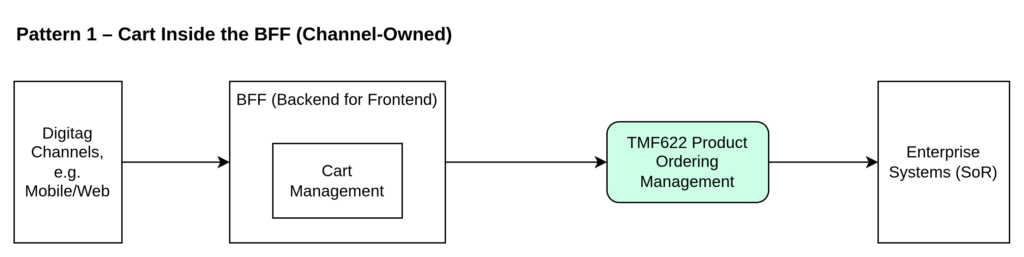
    Pattern 1 – Cart Inside the BFF (Channel-Owned)

    TMF663 – Shopping Cart Management. Pattern 1 – Cart Inside the BFF (Channel-Owned).

    In this approach:

    • Digital Channels (e.g., Mobile/Web) interact directly with the BFF (Backend for Frontend).
    • Cart Management is implemented inside the BFF.
    • The BFF submits orders to TMF622 Product Ordering Management.
    • TMF622 integrates with Enterprise Systems (SoR).

    Architectural Characteristics

    In this pattern, the shopping cart is not a separate domain capability.
    It is embedded within the channel layer.

    The BFF is responsible for:

    • Managing cart state
    • Handling product configuration
    • Preparing the ProductOrder payload
    • Calling TMF622

    There is no reusable cart service outside the channel context.

    When It Fits

    • Single or tightly controlled digital channel
    • Minimal partner exposure
    • Strong UX ownership
    • Fast delivery priority

    Architectural Trade-Off

    Cart logic is tightly coupled to channel implementation.
    Reusability across channels or partners is limited.

    Pattern 2 – Centralized Cart Microservice (Non-TMF)

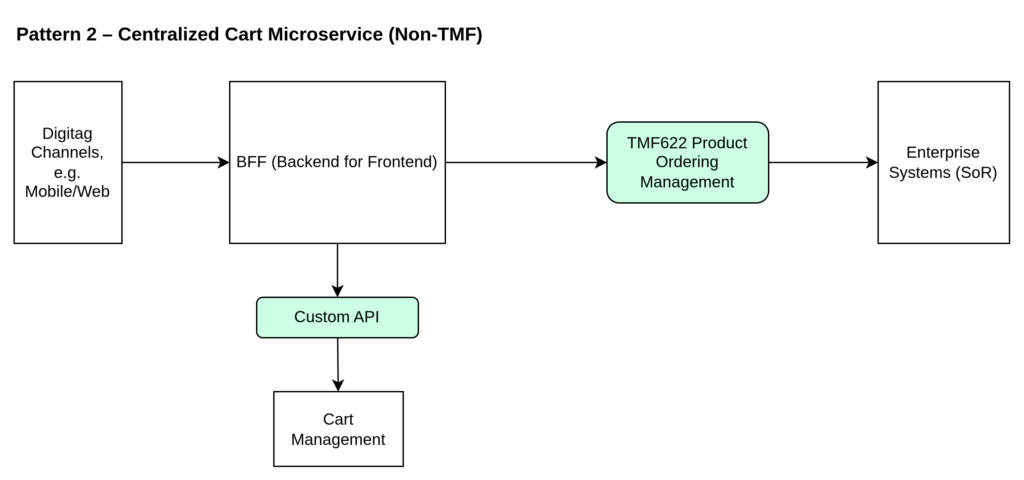
    TMF663 – Shopping Cart Management. Pattern 2 – Centralized Cart Microservice (Non-TMF).

    Here, cart becomes:

    • Digital Channels interact with the BFF.
    • The BFF calls a Custom API.
    • That API exposes a centralized Cart Management service.
    • The cart service supports order submission via TMF622 Product Ordering Management.
    • TMF622 integrates with Enterprise Systems (SoR).

    Architectural Characteristics

    In this model, the cart becomes a domain-level microservice.

    Key aspects:

    • Cart logic is removed from the BFF.
    • Cart is exposed through a custom (non-TMF) API.
    • It can serve multiple channels.
    • It manages cart persistence independently of UX logic.

    The BFF orchestrates between channels and the cart service but does not own cart state.

    When It Fits

    • Multi-channel environments
    • Need for shared commercial intent
    • Internal domain reuse without ecosystem standardization
    • Organizations comfortable with custom API contracts

    Architectural Trade-Off

    While reusable, the API is proprietary.
    External integrations require mapping rather than native TMF compatibility.

    Pattern 3 – TMF663 as Integration Contract

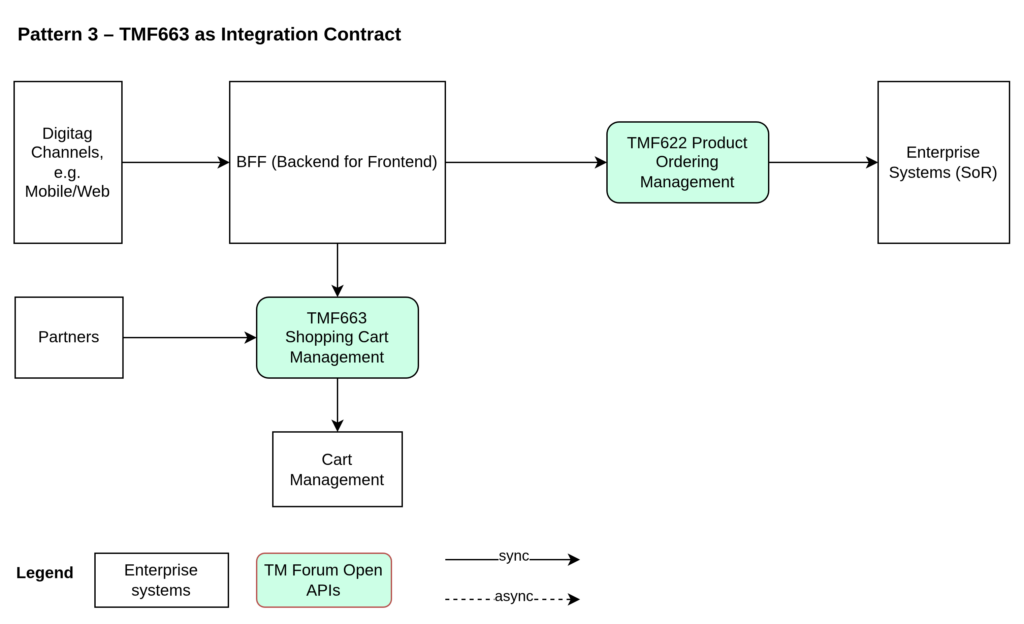
    TMF663 – Shopping Cart Management. Pattern 3 – TMF663 as Integration Contract.

    In this model:

    • Digital Channels and Partners both interact with the BFF.
    • The BFF integrates with TMF663 Shopping Cart Management.
    • TMF663 represents a formalized cart boundary.
    • Orders are submitted to TMF622 Product Ordering Management.
    • TMF622 integrates with Enterprise Systems (SoR).

    Architectural Characteristics

    Here, the shopping cart becomes a standardized integration boundary.

    TMF663:

    • Exposes cart capabilities through a TM Forum Open API.
    • Enables partner access.
    • Decouples cart management from the channel layer.
    • Provides ecosystem-level interoperability.

    Cart logic is elevated from an internal capability to a commercial integration contract.

    When It Fits

    • Partner ecosystems
    • B2B2X models
    • Marketplace exposure
    • Multi-vendor architecture
    • Strategic TM Forum alignment

    Architectural Trade-Off

    This introduces additional abstraction and governance.
    It is justified when interoperability and ecosystem scalability are priorities.

    When TMF663 Makes Architectural Sense

    You likely need TMF663 if:

    • You operate multiple digital channels,
    • You integrate partners who must create carts,
    • You require persistent pre-order state across systems,
    • You want clear separation between UX logic and commercial domain.

    You probably don’t need TMF663 if:

    • You have one tightly controlled channel,
    • Cart is purely session-based,
    • No cross-domain reuse is required,
    • Simplicity is your primary driver.

    The Real Architectural Decision

    Shopping cart is not about APIs. It is about ownership of pre-order state.

    • If cart logic is deeply UX-driven and temporary, then channel ownership may be enough.
    • If cart represents shared commercial intent across systems, then domain ownership becomes necessary.

    TMF663 is valuable when the cart becomes a reusable commercial asset, not just a UI artifact.

    Common Anti-Patterns

    1. Implementing TMF663 but keeping cart logic inside BFF anyway.
    2. Treating cart as orchestration pre-stage.
    3. Embedding pricing and qualification rules inside cart service.
    4. Over-engineering cart for small digital contexts.

    Relationship to the Order Lifecycle

    In a well-structured order lifecycle, validation should happen before commercial intent is persisted.

    A cleaner lifecycle flow can be structured as follows:

    1. Perform Qualification
      Validate commercial and technical feasibility using:
      • TMF679 – Product Offering Qualification
      • TMF645 – Service Qualification
    2. Manage and Persist Commercial Intent
      Store and maintain the validated configuration in:
      • TMF663 – Shopping Cart Management (optional architectural boundary)
    3. Submit the Executable Order
      Create and submit a formal customer order through:
      • TMF622 – Product Ordering
    4. Orchestrate and Decompose the Order
      Coordinate fulfillment logic and manage order state within the Order Management domain
      (typically consuming TMF622 events and interacting with downstream APIs such as TMF641 where required)
    5. Activate and Provision Services
      Trigger technical fulfillment and manage service lifecycle using:
      • TMF641 – Service Ordering
      • TMF638 – Service Inventory

    In this model:

    • Qualification verifies commercial and technical feasibility first.
    • Only valid, sellable configurations are added to the cart.
    • The cart stores already qualified commercial intent.

    The formal order lifecycle begins only when a TMF622 ProductOrder is submitted. TMF663, if used, sits between qualification and order submission. Its purpose is to organize and persist validated intent – not to perform eligibility or orchestration logic. When designed this way, the cart becomes a clean transition layer. When qualification is skipped or deferred, the cart turns into a staging area for errors that will surface later in order management or activation.

    Conclusion

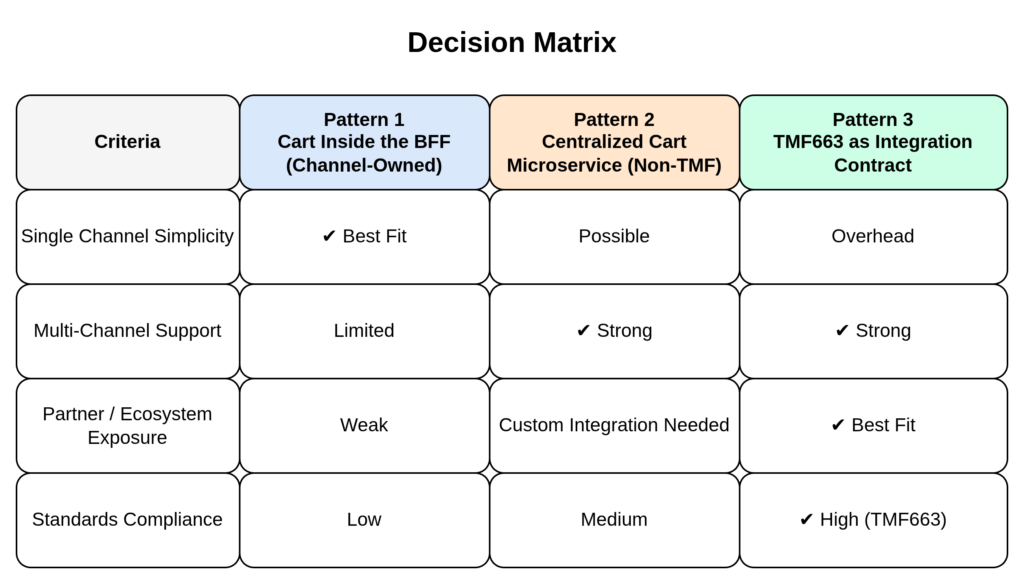
    TMF663 – Shopping Cart Management - Decision Matrix.

    There is no single “correct” way to structure shopping cart management.

    As we’ve seen, you can:

    • Keep the cart inside the digital channel,
    • Implement a dedicated domain cart service, or
    • Expose TMF663 as a standardized integration boundary.

    Each option is valid — depending on your scale, channel strategy, partner model, and architectural maturity.

    Now that you see the different patterns and trade-offs, the question is no longer “Do we need TMF663?”

    The real question becomes:

    Which option best fits your context, complexity, and long-term integration goals?

    Architecture is about making deliberate choices — not following standards blindly.

  • TMF Open APIs – Customer Order Capture

    From Qualification to ProductOrder

    Telecommunication architectures often struggle not with service activation or network execution, but with the very first step of the lifecycle: translating customer intent into a clean, valid order.

    Many transformation programs introduce complexity at this stage by tightly coupling digital channels to backend systems, embedding business rules inside frontends, or overloading orchestration platforms with responsibilities that belong to domain boundaries.

    This article explores a pragmatic approach to customer order capture using TM Forum Open APIs as stable integration contracts — focusing on how commercial validation, technical feasibility, and order submission can be implemented without creating architectural bottlenecks.

    The discussion builds on the master architecture presented in TM Forum Open APIs Without the Complexity Trap and focuses specifically on the capture layer.

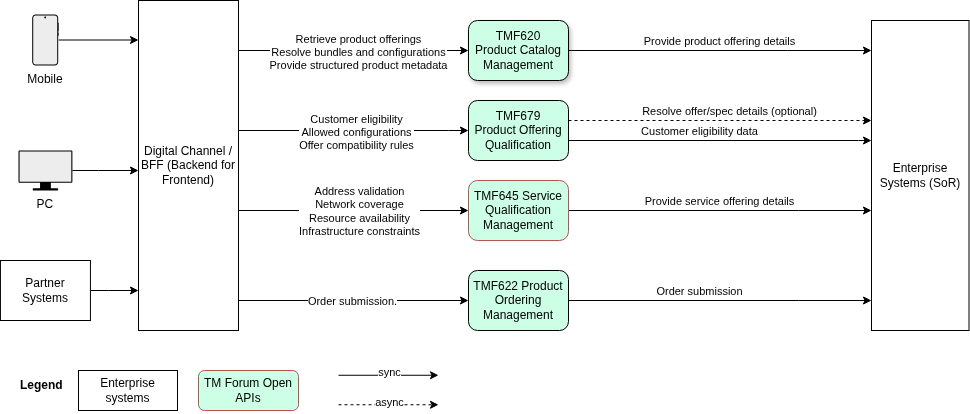
    Diagram 1 – Customer Order Capture Flow

    Customer Order Capture:
- TMF620 — Product Catalog Management
- TMF679 — Product Offering Qualification
- TMF645 — Service Qualification
- TMF622 — Product Ordering Management

    Architectural Scope

    This article focuses on the commercial entry point of the lifecycle — the transition from customer interaction to standardized product order submission.

    Core APIs covered:

    • TMF620 — Product Catalog Management
    • TMF679 — Product Offering Qualification
    • TMF645 — Service Qualification
    • TMF622 — Product Ordering Management

    These APIs represent the boundary between digital engagement and downstream operational domains.

    Key Architectural Principle

    TM Forum APIs should act as:

    • stable integration contracts
    • domain boundaries
    • interoperability interfaces

    They should NOT:

    • define internal data models
    • dictate orchestration logic
    • force digital channels to mirror backend complexity.

    The goal of customer order capture is simple:

    Produce a clean, validated ProductOrder representing commercial intent.

    Everything else belongs downstream.

    Engagement Layer — Digital Channel / BFF

    Customer interaction begins in digital channels:

    • Web portals
    • Mobile applications
    • Partner systems

    The BFF (Backend-for-Frontend) plays a crucial role:

    • Aggregates multiple backend APIs
    • Shields frontend from domain complexity
    • Maintains UX-specific workflows.

    However, a common anti-pattern is turning the BFF into a business logic engine.

    Pragmatic rule:

    Validation logic lives behind TMF APIs, not inside the channel.

    Product Discovery — TMF620 Product Catalog

    The lifecycle begins with browsing commercial offerings via TMF620.

    Responsibilities:

    • Retrieve product offerings
    • Resolve bundles and configurations
    • Provide structured product metadata.

    Architectural pattern:

    TMF620 often acts as an API facade over legacy catalog platforms.

    Benefits:

    • Stable contract for digital channels
    • Decoupling from catalog implementation
    • Incremental modernization possible.

    Important design choice:

    The catalog provides information — it does not validate eligibility.

    Commercial Qualification — TMF679 Product Offering Qualification

    Product Offering Qualification validates commercial constraints:

    • Customer eligibility
    • Allowed configurations
    • Offer compatibility rules.

    Typical inputs:

    • customerId
    • selected offering
    • requested characteristics.

    Typical outputs:

    • qualificationResult (qualified/notQualified)
    • validation messages
    • adjusted configuration suggestions.

    Common complexity trap:

    Embedding qualification logic inside order processing.

    Pragmatic approach:

    Qualification remains a separate validation boundary.

    This allows:

    • early failure detection
    • faster UX feedback
    • reduced orchestration complexity.

    Technical Feasibility — TMF645 Service Qualification

    One of the most important architectural separations is:

    Commercial validation ≠ Technical feasibility.

    TMF645 handles:

    • address validation
    • network coverage
    • resource availability
    • infrastructure constraints.

    Why separate?

    If technical feasibility is checked only during activation:

    • orders fail late
    • customer experience suffers
    • orchestration becomes complex.

    Using TMF645 early:

    • prevents invalid orders entering lifecycle
    • reduces downstream rework.

    Transition Boundary — TMF622 Product Ordering

    Once qualification is complete and customer confirms purchase, the digital channel submits a ProductOrder via TMF622.

    TMF622 acts as:

    The boundary between commercial intent and operational execution.

    Responsibilities:

    • Capture standardized commercial request
    • Provide initial acknowledgement
    • Hand ownership to order management domain.

    Key design goals:

    • ProductOrder payload should be minimal but complete.
    • Avoid embedding downstream execution details.

    Example conceptual structure:

    • orderItem
    • productOffering
    • customer reference
    • requested characteristics
    • relatedParty.

    Designing a Clean ProductOrder

    A pragmatic ProductOrder:

    • Represents what the customer wants, not how to execute it.

    Avoid:

    • technical resource details
    • network-specific parameters
    • service-level workflows.

    These belong to decomposition inside Order Management.

    Recommended practices:

    • include clear correlation identifiers
    • ensure idempotent submission
    • keep optional attributes truly optional.

    State Management at Capture Stage

    Typical lifecycle states after submission:

    • acknowledged
    • inProgress.

    Digital channels should:

    • rely on asynchronous updates rather than polling excessively.
    • treat TMF622 response as acceptance of intent, not completion.

    Common Anti-Patterns

    1. Fat BFF

    Embedding:

    • qualification logic
    • catalog rules
    • decomposition logic

    inside the channel layer.

    Result:

    • duplicated rules
    • inconsistent behavior.

    2. TMF-First Internal Modeling

    Designing internal microservices directly around TMF schemas.

    Result:

    • tight coupling
    • inflexible evolution.

    3. Central Workflow Engine Too Early

    Using external BPM tools to orchestrate order capture.

    Better:

    Simple capture triggers domain-owned orchestration later.

    Integration Pattern Summary

    Customer Order Capture architecture should:

    • Use TMF620 for discovery
    • Use TMF679 for commercial validation
    • Use TMF645 for technical feasibility
    • Submit via TMF622 as standardized boundary.

    This separation ensures:

    • early validation
    • cleaner orchestration downstream
    • reduced coupling.

    What’s Next

    This article focused on capturing commercial intent and producing a clean ProductOrder.

    In the next publications, we move inside the Customer Order Management domain and explore:

    • Product-to-service decomposition
    • State machines vs workflow engines
    • Asynchronous orchestration patterns
    • Handling partial fulfillment and failure scenarios
    • Updating Product Inventory (TMF637) from lifecycle events.
  • Intelligent Chatbots for Business: Practical Guide

    Business Automation · KMU-Guide

    Intelligent Chatbots for Business: Practical Guide

    📅 Juni 2026  ·  ⏱ 6 Min. Lesezeit  ·  🏷 Automatisierung · KI · Entscheidungshilfe

    You can try out the chatbot on this website – just click on the widget icon in the bottom right corner.


    The Business Case: Why Chatbots Matter Today

    Customer expectations have fundamentally changed. Users expect immediate answers, multilingual support, and seamless digital interaction — regardless of time zone or business hours. At the same time, companies face increasing pressure to reduce operational costs while maintaining high-quality service.

    Chatbots have emerged as a practical solution to this challenge. When implemented correctly, they help organizations:

    • Provide instant responses to repetitive inquiries
    • Reduce manual workload for support teams
    • Offer consistent and structured customer interactions
    • Guide users toward products, services, or next actions
    • Capture valuable structured data during conversations
    • Support international audiences with multilingual capabilities

    Unlike traditional automation tools, modern chatbots can combine structured dialog flows with intelligent language understanding, enabling natural yet controlled interactions.

    For many organizations, the primary motivation is not replacing human interaction but optimizing it — allowing human agents to focus on complex tasks while automation handles predictable workflows.


    What Problems Chatbots Actually Solve

    The value of chatbots becomes clear when examining real business scenarios. Instead of being generic “AI assistants”, successful chatbot implementations usually target specific operational challenges.

    Typical use cases include:

    • Customer Support Automation – Chatbots can handle frequently asked questions, guide users through troubleshooting steps, and collect structured information before escalating to human agents.
    • Product and Service Guidance – Interactive conversations can help customers understand offerings, compare options, and navigate complex product portfolios.
    • Order Tracking and Status Updates – By integrating with backend systems, chatbots can provide real-time information without requiring manual support intervention.
    • Structured Data Collection – Forms integrated into conversational flows can gather requests, tickets, or onboarding data more efficiently than static forms.
    • Knowledge Base Access – Chatbots can serve as conversational interfaces for internal or external documentation systems.
    • Lead Qualification and Marketing Interaction – By guiding visitors through questions, chatbots can identify user intent, capture contact information, and route leads appropriately.

    In practice, the most successful deployments start with clearly defined goals rather than attempting to solve every problem at once.


    Types of Chatbots

    Not all chatbots are created equal. Understanding the main categories helps businesses select the right approach.

    Rule-Based Chatbots

    These systems follow predefined conversation paths using buttons or fixed decision trees.

    Advantages:

    • Predictable behavior
    • Easy compliance control
    • Suitable for structured workflows

    Limitations:

    • Limited flexibility
    • Poor handling of unexpected input

    NLP-Based Intent Chatbots

    These bots use natural language processing to interpret user input and map it to predefined intents.

    Advantages:

    • Flexible input handling
    • Structured backend integration
    • High reliability in enterprise contexts

    Limitations:

    • Requires training data
    • Design effort for dialog flows

    LLM-Powered Conversational Assistants

    Large Language Model (LLM) chatbots generate responses dynamically using generative AI.

    Advantages:

    • Highly natural conversations
    • Broad knowledge capabilities
    • Reduced need for predefined responses

    Limitations:

    • Less predictable outputs
    • Governance and security considerations
    • Potential hallucinations

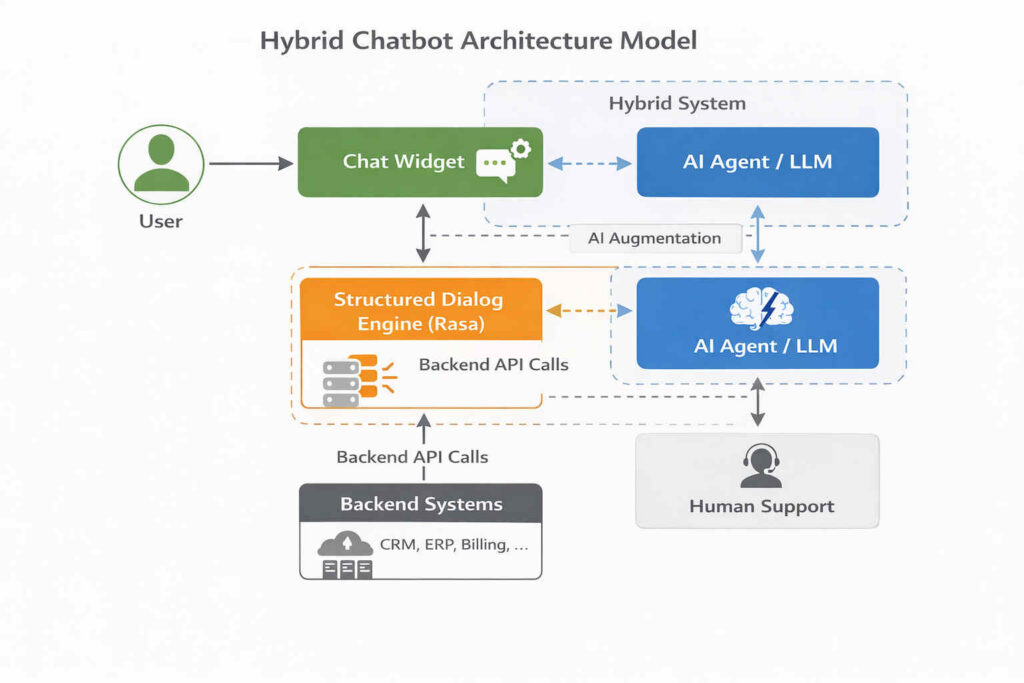
    Hybrid Architectures

    Many modern solutions combine structured dialog flows with AI-powered components. Structured workflows ensure reliability and compliance, while AI enhances flexibility where needed.


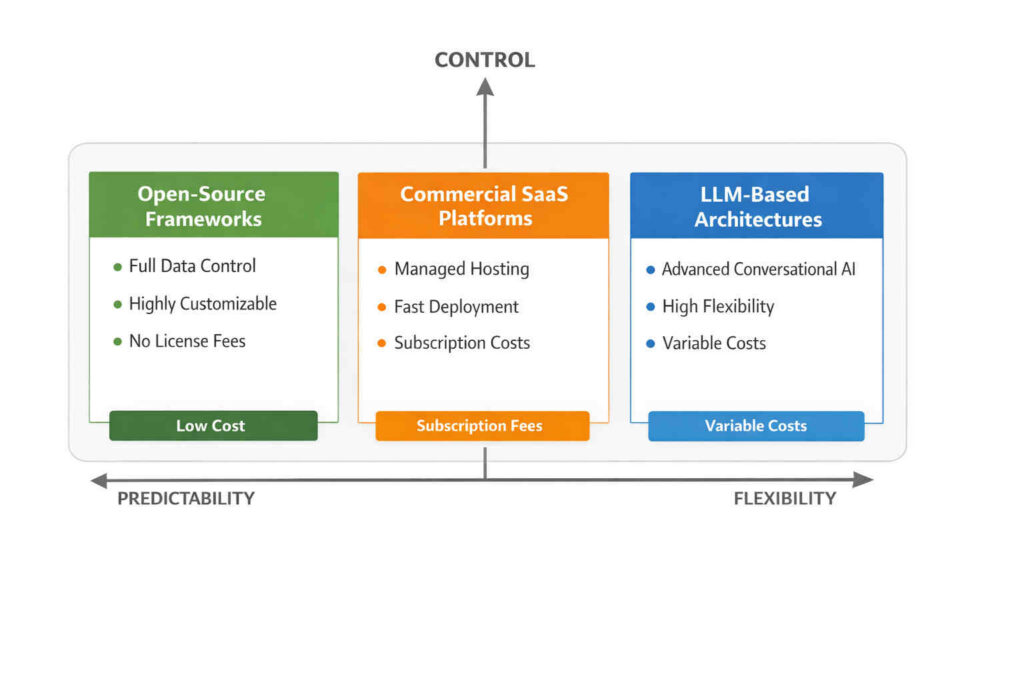
    Technology Landscape: Popular Chatbot Frameworks and Platforms

    Organizations typically choose between open-source frameworks, commercial platforms, or custom architectures.

    Open-Source Frameworks

    Examples:

    Characteristics:

    • Full control over data and deployment
    • No recurring license costs
    • High customization flexibility
    • Requires technical expertise

    Best for:

    • enterprise environments
    • complex integrations
    • long-term ownership strategies

    Commercial SaaS Platforms

    Examples:

    • Google Dialogflow
    • Microsoft Copilot Studio
    • Intercom AI chat solutions

    Characteristics:

    • Faster initial setup
    • managed infrastructure
    • subscription pricing
    • potential vendor lock-in

    Best for:

    • rapid prototyping
    • smaller teams without engineering resources

    LLM-Based Architectures

    These solutions integrate models such as GPT-based systems into chatbot workflows.

    Characteristics:

    • advanced conversational abilities
    • dynamic content generation
    • need for careful guardrails and architecture design

    Increasingly, organizations combine LLM capabilities with structured backend logic.

    Diagram “Chatbots – Technology Landscape Comparison”

    Technology Landscape: Popular Chatbot Frameworks and Platforms

    The Reality of Chatbot Development — What Is Actually Hard

    One of the biggest misconceptions is that chatbot development is primarily about selecting a framework or training an AI model. In reality, most effort lies elsewhere.

    • Dialog Design – Creating natural, efficient conversations that guide users toward outcomes requires deep understanding of business processes and user behavior.
    • Backend Integration – Real value comes from connecting chatbots to enterprise systems such as CRM, ERP, or billing platforms. Designing reliable API integrations is often more complex than building the conversation itself.
    • Multilingual Modeling – Supporting multiple languages requires careful intent design, testing, and content management.
    • Fallback Strategy – Handling unknown inputs gracefully is essential to maintaining user trust.
    • Security and Data Governance – Enterprise deployments must consider:
      • data privacy
      • logging policies
      • infrastructure architecture
      • authentication flows
    • Testing Real Conversations – Users behave unpredictably. Extensive testing with real-world scenarios is necessary to achieve reliable automation.

    Common Mistakes Companies Make With Chatbots

    Many projects struggle not because of technology limitations but because of incorrect assumptions.

    Common pitfalls include:

    • Attempting full automation without clear use cases
    • Using generative AI without structured guardrails
    • Underestimating dialog design complexity
    • Ignoring fallback and escalation paths
    • Choosing tools based solely on trends rather than requirements
    • Treating chatbots as marketing features instead of operational tools

    Avoiding these mistakes significantly increases project success rates.


    AI Agents vs Chatbots — Evolution or Replacement?

    With the rise of AI agents, many organizations ask whether traditional chatbots will become obsolete.

    AI agents offer:

    • autonomous reasoning
    • dynamic task execution
    • flexible conversation flows

    However, enterprise environments often require:

    • predictable workflows
    • compliance control
    • auditability
    • structured integration logic

    For this reason, many experts see the future not as replacement but as convergence.

    Hybrid architectures are emerging where:

    • structured chatbot flows manage reliable processes
    • AI agents assist with reasoning, summarization, or complex queries

    This balanced approach provides innovation without sacrificing control.

    Diagram “Chatbots – Hybrid Architecture Model”

    Diagram “Chatbots - Hybrid Architecture Model”

    How to Choose the Right Chatbot Approach

    Selecting the right chatbot architecture depends on business goals, regulatory constraints, integration complexity, and long-term strategy. The technology should follow the operational requirements — not the other way around.

    Below is practical guidance based on typical enterprise scenarios.

    Need FAQ automation? – Use “Structured Chatbot”

    If the primary goal is to automate repetitive questions with predefined answers, a structured chatbot with clear dialog flows is often the most efficient solution.

    Why this works:

    • High predictability
    • Easy testing and validation
    • Controlled user experience
    • Minimal AI complexity
    • Lower development risk

    Structured bots are ideal when:

    • The content is well-defined
    • Compliance and accuracy matter
    • The goal is deflection of repetitive support load

    They are often more cost-effective and stable than LLM-driven solutions for this use case.

    Need to support enterprise workflows? – Use “Hybrid Architecture”

    If the chatbot must integrate deeply with CRM, ERP, billing, or other backend systems, a hybrid architecture is typically the most robust option.

    This means:

    • Structured dialog engine controls workflow logic
    • AI/LLM components assist where flexibility is useful
    • Clear integration layer connects enterprise systems

    Why this works:

    • Predictable business process handling
    • Reliable backend API integration
    • Controlled fallback and escalation logic
    • Reduced hallucination risk
    • Better auditability

    Hybrid models are particularly suited for regulated industries and mission-critical workflows.

    Want to try experimental innovation? – Use “AI Agent Prototypes”

    If the objective is to explore advanced conversational AI capabilities, such as autonomous reasoning or complex information synthesis, AI agent prototypes can be appropriate.

    Why this works:

    • Rapid experimentation
    • Less need for predefined dialog trees
    • Natural interaction style
    • Strong knowledge exploration capability

    However, this approach should be chosen carefully because:

    • Outputs may be less predictable
    • Governance requires additional safeguards
    • Integration into structured business processes can be challenging

    Best suited for innovation labs, internal tools, or knowledge assistants.

    Must follow strict data governance requirements? – Use “Controlled Infrastructure Deployment (On-Premises or Private Cloud)”

    If your organization operates under strict regulatory requirements (e.g., financial services, healthcare, public sector), infrastructure control becomes a primary architectural driver.

    In such cases, you should consider:

    • On-premises deployment
    • Private cloud hosting within the EU
    • Data residency guarantees
    • Controlled logging and access policies

    Why this matters:

    • Compliance with GDPR and industry regulations
    • Full control over customer data
    • Reduced exposure to third-party data processors
    • Auditability and traceability

    Open-source frameworks are often a strong fit here because they allow self-hosting and eliminate dependency on external SaaS providers. However, the key factor is not “open-source” itself — it is infrastructure control and data ownership.

    Strategic Consideration

    Early architectural decisions significantly influence:

    • long-term operational cost
    • scalability
    • vendor lock-in risk
    • compliance flexibility
    • ability to extend functionality later

    A chatbot project should therefore start with architectural assessment rather than tool selection.


    Conclusion

    Chatbots are no longer experimental tools. When designed with clear objectives and integrated into real business processes, they become powerful automation components that improve customer experience and operational efficiency.

    The key is not selecting the most advanced technology but choosing the right architecture for your specific goals.


    Discuss Your Chatbot Strategy

    If you are evaluating chatbot solutions or planning to introduce conversational automation, a structured architectural approach helps avoid costly redesigns later.

    An independent expert perspective can help:

    • assess feasibility
    • select appropriate technology
    • design scalable architecture
    • align automation with business processes

    A short initial discussion can clarify whether chatbot automation is the right next step for your organization.

  • TMF Open APIs – Pragmatic Order Lifecycle Using TMF622 and TMF641

    The previous article introduced a pragmatic architectural approach for using TM Forum Open APIs as integration contracts rather than internal system models. While high-level architecture diagrams help clarify domain boundaries, the real complexity in telecom systems appears when commercial intent becomes operational execution — specifically within the order lifecycle.

    This article moves from architectural vision to practical execution. It describes how product orders progress through their lifecycle using TMF622 Product Ordering and TMF641 Service Ordering, demonstrating how orchestration can remain lightweight, domain-driven, and resilient without introducing unnecessary middleware complexity.

    The goal is not to describe TM Forum specifications themselves, but to show how they can be applied pragmatically in real enterprise environments.

    The Real Problem: Order Lifecycle Complexity

    Many telecom implementations encounter difficulty not because of TM Forum APIs, but because of architectural decisions around orchestration.

    Common patterns seen in real projects include:

    • Treating TMF622 as a central orchestration engine.
    • Introducing heavy workflow platforms controlling all lifecycle logic.
    • Tight coupling between ordering, inventory, and fulfillment systems through synchronous dependencies.
    • Modeling internal systems directly on TMF schemas.

    These approaches often lead to rigid architectures that are difficult to evolve and slow to deliver change.

    A pragmatic alternative is to treat TMF APIs as integration boundaries while keeping orchestration logic inside a domain-owned Order Management or Customer Order Management (COM) component.

    In this model:

    • TMF622 captures commercial intent.
    • Internal orchestration manages lifecycle progression.
    • TMF641 bridges commercial orders with technical fulfillment.
    • Asynchronous feedback drives state transitions.

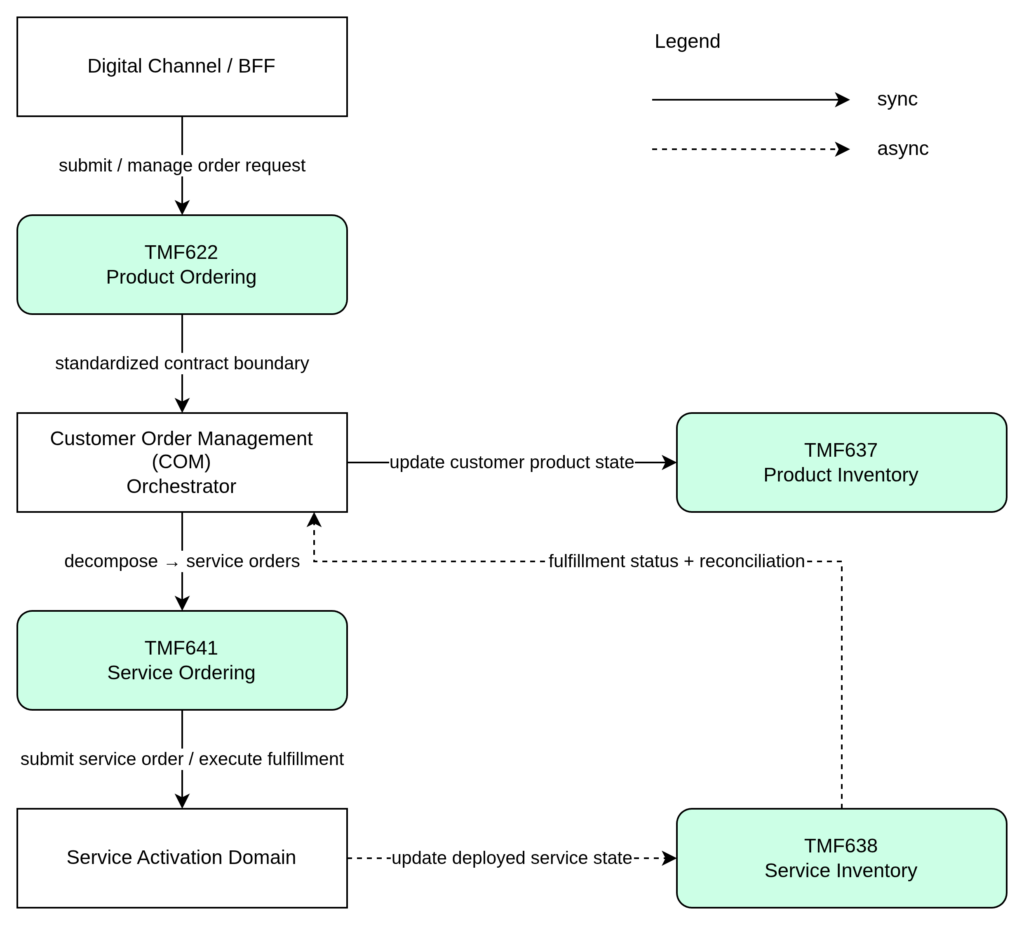
    High-Level Order Lifecycle Flow

    Pragmatic Order Lifecycle Using TMF622 and TMF641

    The lifecycle begins when a customer submits a confirmed purchase through a digital channel. The request enters the system through TMF622 Product Ordering, which acts as a standardized boundary between commercial engagement and operational processing.

    Internally, the Customer Order Management System assumes responsibility for:

    • validating order context,
    • managing lifecycle state,
    • decomposing product orders into service-level actions,
    • coordinating fulfillment execution.

    Instead of executing orchestration inside TMF interfaces themselves, the COM operates as a domain service that interprets external contracts and manages internal workflows independently.

    The typical lifecycle stages include:

    1. Order capture through TMF622.
    2. Validation and enrichment.
    3. Product-to-service decomposition.
    4. Service order creation via TMF641.
    5. Fulfillment execution.
    6. Asynchronous feedback processing.
    7. Product and service inventory synchronization.

    This separation maintains architectural clarity: TMF APIs remain interoperability interfaces, while orchestration logic stays within the owning domain.

    Synchronous vs Asynchronous Interaction Strategy

    One of the most important architectural decisions involves determining which interactions should remain synchronous and which should become event-driven.

    In pragmatic telecom architectures:

    Synchronous interactions are used where immediate validation or deterministic responses are required, such as:

    • order submission,
    • qualification checks,
    • catalog queries.

    These operations benefit from predictable response patterns and straightforward transactional behavior.

    However, fulfillment execution and lifecycle progression are inherently long-running processes. Attempting to model them synchronously introduces fragility and operational risk.

    Therefore, asynchronous workflows should drive:

    • fulfillment status updates,
    • service activation progress,
    • inventory reconciliation,
    • order lifecycle transitions.

    Asynchronous feedback allows independent scaling of fulfillment components and reduces tight coupling between systems.

    Order Orchestration Without Overengineering

    Pragmatic Order Lifecycle Using TMF622 and TMF641

    A common misconception is that complex telecom order orchestration requires a centralized workflow engine controlling every step.

    While workflow platforms can provide visibility, they frequently become architectural bottlenecks:

    • forcing global coordination,
    • introducing additional operational layers,
    • making domain ownership unclear.

    A more pragmatic approach uses a domain-owned orchestrator inside the Customer Order Management layer.

    Key characteristics include:

    • lightweight state machines rather than monolithic workflows,
    • event-driven state transitions,
    • clear ownership of lifecycle progression.

    The orchestrator reacts to events such as:

    • service activation completion,
    • fulfillment failure notifications,
    • inventory updates.

    This pattern enables flexibility while maintaining clear domain responsibility.

    Data Model Boundaries and Anti-Corruption Layers

    Pragmatic Order Lifecycle Using TMF622 and TMF641

    Another critical design principle is maintaining separation between external TMF models and internal domain representations.

    TMF data structures define integration contracts between systems. They should not automatically dictate internal modeling.

    Instead:

    • TMF622 represents the external product order contract.
    • The COM translates this structure into internal order representations.
    • TMF641 service orders are generated from internal models.
    • Inventory updates are mapped back into standardized interfaces.

    This anti-corruption approach protects internal services from schema drift and prevents cascading changes across domains when specifications evolve.

    Inventory Synchronization and Lifecycle Authority

    In this architecture, service inventory and product inventory play distinct roles.

    TMF638 Service Inventory represents operational reality — the authoritative record of deployed technical services.

    Fulfillment systems update service inventory as activation progresses.

    These updates flow asynchronously back to the COM, where they serve two purposes:

    • advancing order lifecycle state,
    • enabling reconciliation between expected and actual deployment.

    Once service deployment reaches a stable state, the COM updates TMF637 Product Inventory to reflect customer-facing subscription state.

    Separating technical reality from commercial representation avoids coupling operational systems directly to customer-facing domains.

    Common Architecture Mistakes

    Several recurring anti-patterns appear in telecom transformations:

    • Using TMF622 as a workflow engine rather than an integration boundary.
    • Introducing synchronous dependencies on inventory during fulfillment.
    • Embedding qualification logic inside ordering flows.
    • Modeling internal services directly around TMF schemas.

    These decisions increase complexity and reduce flexibility over time.

    A pragmatic architecture instead prioritizes domain ownership, asynchronous lifecycle management, and contract-based integration.

    Conclusion

    The order lifecycle represents the transition from commercial intent to operational execution — and therefore is where integration architecture decisions have the greatest impact.

    By treating TM Forum Open APIs as stable integration contracts and placing orchestration responsibility inside a domain-owned order management layer, organizations can achieve:

    • reduced coupling,
    • improved resilience,
    • clearer ownership boundaries,
    • and incremental evolution of legacy environments.

    This approach allows teams to leverage TMF standards without introducing unnecessary architectural complexity.

    What’s Next

    This article focused on the high-level lifecycle and orchestration approach. In the next publications, we will dive deeper into detailed execution flows, including:

    • asynchronous event-driven lifecycle patterns,
    • practical request/response sequences,
    • data model mappings between TMF contracts and internal domains,
    • and reconciliation logic between service and product inventory.
  • TMF Open APIs Without the Complexity Trap

    Pragmatic Integration Patterns Using TMF620, TMF679, TMF622, TMF637, TMF641, TMF633, TMF645 and TMF638

    Telecommunication architectures increasingly adopt TM Forum Open APIs to standardize integration across OSS/BSS ecosystems. These APIs provide a shared semantic language that enables interoperability between systems from different vendors and internal domains.

    However, real-world implementations often struggle — not because of the APIs themselves, but because of how they are applied architecturally. Many organizations introduce unnecessary complexity: heavy middleware layers, rigid orchestration engines, or “TMF-first” internal modeling that couples everything to standard schemas and slows delivery.

    This article presents a set of pragmatic integration prototypes demonstrating how core TM Forum APIs can be used effectively as stable integration contracts, while avoiding common complexity traps. The goal is to show an approach that is realistic for enterprise landscapes, but still incremental and maintainable.

    The prototypes focus on the following APIs:

    • TMF620 Product Catalog Management
    • TMF679 Product Offering Qualification
    • TMF622 Product Ordering Management
    • TMF637 Product Inventory Management
    • TMF641 Service Ordering Management
    • TMF633 Service Catalog Management
    • TMF645 Service Qualification Management
    • TMF638 Service Inventory Management

    Together, these APIs cover a complete lifecycle from product discovery and qualification, through ordering and orchestration, to fulfillment and operational tracking.

    Architectural principles

    Before exploring specific patterns, it is important to clarify the architectural perspective used in these prototypes.

    TM Forum APIs should be treated as:

    • stable integration contracts
    • domain boundaries between systems
    • interoperability interfaces

    They should not automatically define internal architecture, internal data models, or orchestration strategy.

    The core principles applied here:

    • Use TMF APIs as integration boundaries rather than internal models.
    • Implement TMF APIs as API facades / anti-corruption layers when integrating legacy or vendor systems.
    • Keep orchestration inside a domain-owned Order Management / Orchestrator (COM) rather than in external workflow platforms by default.
    • Combine synchronous APIs at the boundaries with asynchronous lifecycle feedback where it improves resilience and decoupling.
    • Support incremental modernization rather than big-bang transformations.

    In practice, many telecom transformations fail when TM Forum APIs are treated as architectural frameworks rather than interoperability contracts.

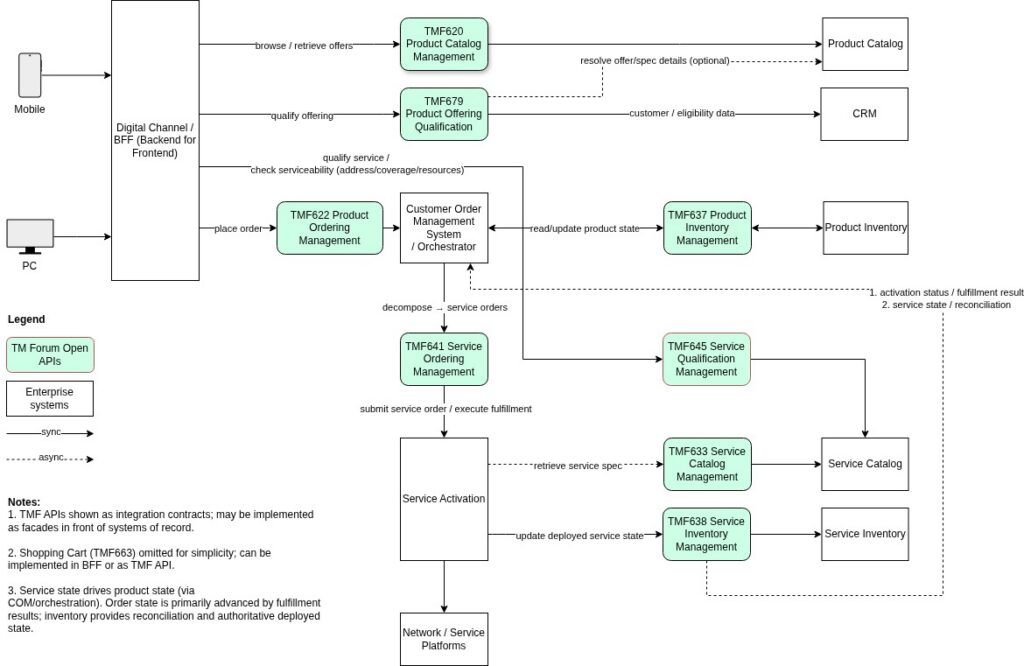
    End-to-End flow overview

    To understand how these TM Forum Open APIs work together in a pragmatic integration architecture, it is useful to examine the complete lifecycle from customer interaction to operational service state.

    Rather than presenting TMF APIs as isolated endpoints, this architecture shows how they form a set of integration contracts between clearly separated domains: digital engagement, commercial management, order orchestration, and service fulfillment.

    The goal is not to prescribe a rigid framework, but to illustrate how standardized APIs can be combined into a coherent flow while preserving domain autonomy and minimizing coupling between systems.

    Several important design choices shape this architecture:

    • Digital channels interact only with stable TMF contracts rather than internal system implementations.
    • Qualification is separated into commercial validation (product offering qualification) and technical feasibility (service qualification), preventing late-stage failures during fulfillment.
    • Product ordering defines the boundary between commercial intent and operational execution.
    • A domain-owned order management system performs orchestration, avoiding centralized integration bottlenecks.
    • Operational reality is reflected through service and product inventories, enabling lifecycle tracking and reconciliation.

    The diagram below presents a high-level view of this lifecycle, emphasizing architectural responsibilities rather than implementation details.

    Pragmatic Integration Patterns Using TMF620, TMF679, TMF622, TMF637, TMF641, TMF633, TMF645 and TMF638:
- TMF620 Product Catalog Management
- TMF679 Product Offering Qualification
- TMF622 Product Ordering Management
- TMF637 Product Inventory Management
- TMF641 Service Ordering Management
- TMF633 Service Catalog Management
- TMF645 Service Qualification Management
- TMF638 Service Inventory Management

    The lifecycle begins in a Digital Channel / BFF (Backend-for-Frontend). The BFF performs synchronous interactions with commerce-facing APIs:

    • TMF620 Product Catalog is used to browse and retrieve commercial offerings.
    • TMF679 Product Offering Qualification validates eligibility and configuration constraints for the selected offering. In some implementations, qualification may require resolving offer/spec details from the catalog — this is treated as an optional supporting lookup, not a mandatory dependency.
    • TMF645 Service Qualification checks serviceability (address / coverage / resource constraints). This keeps “can we technically deliver this?” separate from “is this product commercially valid?”, reducing hidden coupling and late-order failures.

    Once the customer confirms the purchase, the channel submits the request via TMF622 Product Ordering. This API acts as a key architectural boundary: it captures commercial intent using a standardized contract, while shielding downstream systems from channel-specific variations.

    Behind TMF622 sits the Customer Order Management System / Orchestrator (COM). The COM owns the order lifecycle and orchestration logic and is responsible for decomposing a product order into service-level actions. The COM then triggers fulfillment through TMF641 Service Ordering.

    Service activation executes the service order using underlying network/service platforms. During execution, the activation domain may retrieve service specifications via TMF633 Service Catalog, and it updates operational reality via TMF638 Service Inventory, which represents the authoritative record of deployed service state.

    A critical part of the lifecycle is feedback and reconciliation. Fulfillment results and service state updates flow back asynchronously to the COM to advance and complete order state:

    • activation status / fulfillment result (primary driver of order progression)
    • service state / reconciliation (authoritative deployed state used for alignment and correction)

    The COM then updates TMF637 Product Inventory, keeping responsibilities separated:
    service inventory reflects deployed technical reality, while product inventory reflects customer-facing product/subscription state.

    Note: Shopping Cart (TMF663) is omitted for simplicity in this diagram. It can be implemented inside the BFF (internal cart) or exposed as a separate TMF API depending on the channel strategy.

    What’s next

    The purpose of this publication is to establish the architecture and integration patterns without drowning in specification-level detail. In the next publications, I will describe the detailed flows and state transitions per step — including practical examples of request/response sequences, event-driven feedback, and data model mappings (qualification inputs, order decomposition outputs, inventory updates, and reconciliation logic).