Pragmatic Patterns Using TMF645 and Its Role in the Order Capture Lifecycle
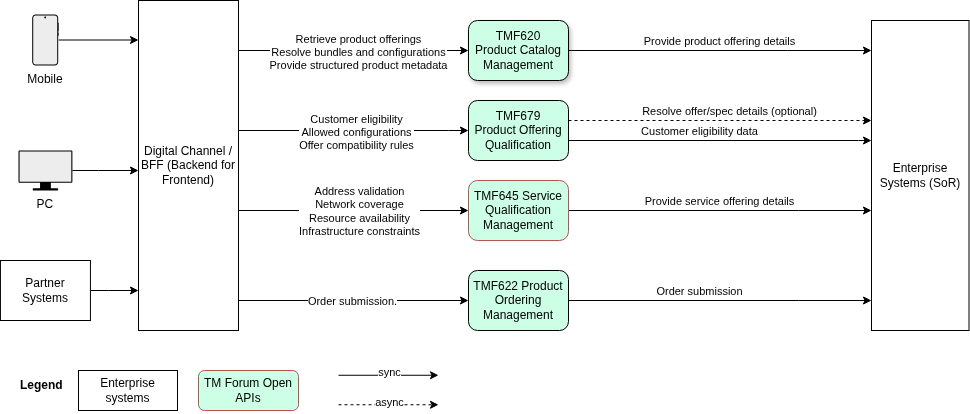
In the previous article on Customer Order Capture, TMF645 Service Qualification was identified as one of the four core APIs involved in translating customer intent into a valid ProductOrder. Alongside TMF620, TMF679, and TMF622, it occupies a specific and critical position in the architecture — the point at which commercial feasibility meets technical reality.
This article examines TMF645 Service Qualification in depth: what it does, how it fits into the broader order lifecycle, how it relates to other qualification APIs, and what practical patterns emerge when it is implemented correctly in telecom BSS/OSS architectures.
What Is Service Qualification?
Service Qualification answers a specific operational question: can this service actually be delivered to this customer at this location with these technical constraints?
The TM Forum TMF645 Service Qualification Management API provides a standardized interface for checking the technical feasibility of a service request before that request enters the order lifecycle. It sits upstream of order submission and downstream of commercial product selection, acting as a validation gate between intent and commitment.
TMF645 is not about whether a customer is eligible to purchase a product — that is the domain of TMF679 Product Offering Qualification. TMF645 is about whether the underlying infrastructure, network, or platform can actually support the requested service for that specific customer context.
| Why Service Qualification Matters |
| Service Qualification is the difference between selling what you offer and committing to what you can deliver. Without it, the gap between commercial intent and operational execution generates late failures, costly rework, and degraded customer experience. |
Where TMF645 Fits in the Order Lifecycle
The order capture lifecycle follows a structured progression from product discovery to order submission. TMF645 occupies the technical feasibility stage — after commercial qualification and before ProductOrder creation.
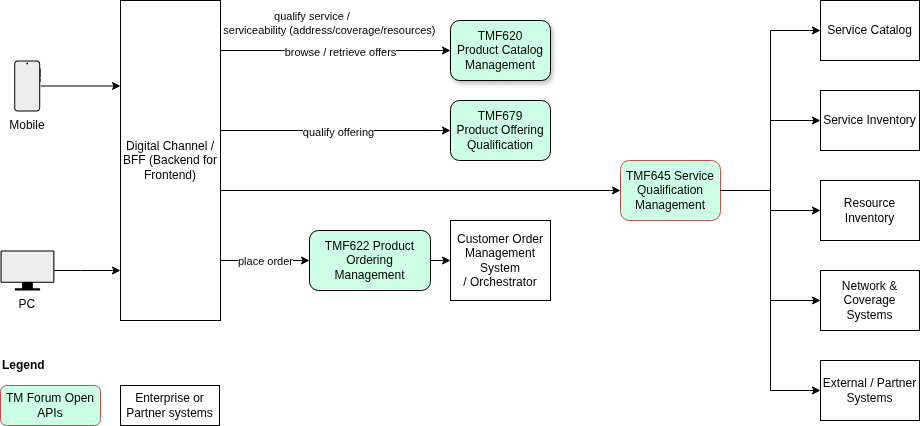
| Stage | Primary API | Core Responsibility |
| Product Discovery | TMF620 | Retrieve and browse available product offerings |
| Commercial Qualification | TMF679 | Validate customer eligibility and offer compatibility |
| Technical Feasibility | TMF645 | Verify infrastructure and network delivery capability |
| Order Submission | TMF622 | Capture and submit the standardized ProductOrder |
This sequencing is deliberate and architecturally significant. If technical feasibility is checked only during service activation — downstream in the lifecycle — orders that cannot be fulfilled will have already passed through multiple processing stages. The cost of late failure is substantially higher than the cost of early qualification.
By checking technical feasibility through TMF645 before the ProductOrder is submitted, the architecture ensures that only viable orders enter the fulfillment pipeline.
Commercial vs. Technical Qualification: A Critical Distinction
One of the most important architectural separations in the order capture domain is the distinction between commercial qualification and technical qualification. These two validation concerns are often conflated in legacy architectures, producing systems that are difficult to evolve and prone to inconsistency.
| TMF679 – Product Offering Qualification | TMF645 – Service Qualification |
| Is this customer eligible for this offer? | Can the network or infrastructure deliver this service? |
| Are the selected options compatible with the product? | Is there capacity or coverage at the requested location? |
| Does the customer’s account support this product? | Are the required resources available and allocatable? |
| Commercial rules and pricing constraints | Infrastructure, topology, and platform constraints |
| Catalog-driven validation | Network- and inventory-driven validation |
A customer may be fully eligible for a premium broadband offer (TMF679 qualified) but reside at an address outside the fiber coverage area (TMF645 not qualified). These are orthogonal checks that must remain independent to allow each domain to evolve without coupling.
| Anti-Pattern: Merged Qualification |
| Merging commercial and technical qualification into a single validation service is a recurring anti-pattern. It couples the product catalog model to network topology, forces synchronized releases across otherwise independent domains, and makes it impossible to clearly identify why a qualification failed. Keep these concerns separate. |
What TMF645 Checks
The scope of a TMF645 qualification check depends on the service type and operational context. Typical checks include:
| Check Type | Description |
| Address and location validation | Confirms the customer’s service address is within the delivery area for the requested service |
| Network coverage verification | Validates that the required network technology (fiber, cable, mobile, etc.) reaches the specified location |
| Resource availability | Checks whether required infrastructure resources — ports, bandwidth, spectrum, or capacity — are available |
| Infrastructure constraints | Identifies topology-specific limitations that may affect service parameters or options |
| Technology-specific feasibility | For services such as VoIP, IPTV, or mobile, verifies platform availability and compatibility |
| Third-party or partner dependency checks | For wholesale or shared infrastructure scenarios, queries external qualification systems |
The qualification result includes not just a binary qualified or not-qualified outcome, but structured detail about the constraints encountered, the alternatives available, and any parameters that must be adjusted before order submission.
TMF645 API Structure
The TMF645 API supports both synchronous and asynchronous qualification patterns, reflecting the reality that some qualification checks can be resolved immediately while others require queries to external or slow systems.
Core Resources
| Resource | Purpose |
| ServiceQualification | The primary qualification request and result object |
| ServiceQualificationItem | Represents a single service within a multi-service qualification request |
| QualificationResult | The outcome per qualification item: qualified, notQualified, or partiallyQualified |
| AlternateServiceProposal | Proposed alternative configurations when the original request cannot be qualified as submitted |
| ServiceabilityDate | Earliest date on which the service can be delivered if not immediately available |
Qualification States
A qualification request progresses through a defined lifecycle:
| State | Meaning | Caller Response |
| acknowledged | Request received and accepted for processing | Retain qualification ID; await next state |
| inProgress | Qualification checks are executing | Continue monitoring via polling or event |
| done | Qualification completed with a result | Process result and proceed or adjust |
| terminatedWithError | Qualification could not be completed | Evaluate error and retry or escalate |
Synchronous vs. Asynchronous Execution
TMF645 supports both execution patterns. The choice between them is not arbitrary — it should reflect the operational characteristics of the underlying qualification systems.
| Synchronous Qualification | Asynchronous Qualification |
| Result returned in same API call response | Result delivered via event callback or polling |
| Appropriate when all checks are local and fast | Required when external systems or slow lookups are involved |
| Simpler caller implementation | More complex state management required by caller |
| Fragile if any downstream system is slow | Resilient to variable response times |
| Suitable for simple address lookups | Required for partner or wholesale qualification flows |
| Design Recommendation |
| Architectural Recommendation: Even when synchronous qualification is technically feasible, designing the caller (typically the BFF or order capture service) to handle asynchronous results makes the integration more resilient. A synchronous qualification that becomes slower over time due to infrastructure growth should not require a re-architecture of the calling layer. |
Qualification in the BFF and Channel Layer
In a well-structured order capture architecture, the BFF (Backend-for-Frontend) orchestrates qualification calls on behalf of the digital channel. This keeps the frontend free from direct dependency on TMF APIs while maintaining a clean separation between engagement logic and domain validation.
The BFF is responsible for:
- Aggregating product selection, customer context, and location data into a qualification request
- Calling TMF679 for commercial qualification and TMF645 for technical qualification
- Presenting qualification results to the frontend in a channel-appropriate format
- Blocking order submission if qualification has not succeeded
- Surfacing alternative proposals from TMF645 if the original request cannot be qualified
The BFF should not implement qualification logic itself. Its role is orchestration and translation — not validation. Qualification rules live behind the TMF645 interface, inside the domain that owns the qualification logic.
| Anti-Pattern: Qualification in the Channel |
| A common mistake is implementing address validation or coverage checks inside the BFF or frontend layer. This creates duplicated logic, inconsistencies between channels, and tight coupling to infrastructure data that changes independently of digital channel releases. Qualification logic belongs behind TMF APIs. |
Handling Qualification Results
The outcome of a TMF645 qualification is not always a simple pass or fail. Three result types must be handled explicitly:
1. Qualified
The service can be delivered as requested. The qualification result may include additional information — such as confirmed delivery dates, available service parameters, or resource identifiers — that should be carried forward into the ProductOrder payload.
2. Not Qualified
The service cannot be delivered as requested. The result should include structured detail on the reason for disqualification: coverage boundary, resource unavailability, platform incompatibility, or infrastructure constraint. This information should be surfaced to the customer clearly, with appropriate next steps.
In some architectures, a not-qualified result triggers a waitlist or future-date qualification flow, where the system tracks the customer’s intent and notifies them when qualification conditions change.
3. Partially Qualified or Alternative Proposed
TMF645 supports the return of alternative service proposals when the requested configuration cannot be qualified but a modified version can. Alternatives may include:
- A lower bandwidth tier where the full requested speed is not available
- A different access technology (e.g., FTTC instead of FTTP)
- A future delivery date when current resources are temporarily exhausted
- A modified service area or endpoint if the exact address has limited coverage
Alternative proposals must be presented to the customer as genuine choices, not silent fallbacks. The channel layer must handle these gracefully and allow the customer to accept, reject, or modify their selection before proceeding.
Relationship to Order Submission via TMF622
The output of a successful TMF645 qualification is not discarded — it informs the structure and content of the ProductOrder submitted through TMF622. Key qualification data that flows into the order includes:
| Qualification Output | Role in TMF622 ProductOrder |
| Qualification ID | Carried as a correlation reference in the ProductOrder for traceability |
| Confirmed service parameters | Used to populate the requested characteristics of the order item |
| Resource identifiers | Referenced in the order to ensure the correct infrastructure is reserved |
| Delivery date commitment | Reflected in the requested start date of the order |
| Alternative proposal reference | Included if the customer accepted an alternative configuration |
This linkage between qualification and order is architecturally important. It ensures that the ProductOrder reflects not just what the customer wants, but what the network has confirmed it can deliver. Orders that do not carry qualification context force downstream systems to re-check feasibility, introducing redundancy, delay, and potential inconsistency.
| Design Principle |
| Design Principle: The qualification reference should be treated as a first-class attribute of the ProductOrder, not an optional annotation. Downstream decomposition and service activation systems rely on this reference to skip redundant feasibility checks and proceed directly to fulfillment. |
Caching, Validity, and Qualification Windows
A qualification result is not indefinitely valid. Infrastructure conditions, resource availability, and coverage boundaries can change. TMF645 results should carry an explicit validity window, after which the qualification must be refreshed before order submission.
Common validity patterns include:
| Pattern | Description |
| Time-bounded validity | Qualification result is valid for a defined period (e.g., 24–72 hours) before expiry |
| Event-invalidated qualification | Qualification is invalidated if specific network events occur (maintenance, topology changes) |
| Commitment-based holding | For high-demand resources, qualification results may optionally reserve capacity for a defined window |
| Re-qualification on modification | Any change to the order parameters (address, service tier, options) requires a fresh qualification |
Digital channels and BFFs must enforce qualification validity. Submitting a ProductOrder against an expired qualification is a common source of late-stage failures that could have been avoided with appropriate staleness detection.
Common Anti-Patterns in Service Qualification
1. Qualification as an Afterthought
Some architectures treat service qualification as an optional pre-check rather than a required gate. Orders are accepted and submitted regardless of whether qualification has been completed, relying on activation-time failure handling to catch infeasible requests.
This pattern multiplies the cost of failure. An order that fails during activation has already consumed order management processing, inventory reservation, and orchestration capacity. An order that fails at qualification consumes only a lightweight API call.
2. Embedding Qualification Logic in Activation
When qualification logic is not exposed through a dedicated interface like TMF645, it tends to migrate into the activation domain, where it is evaluated at provisioning time. This delays failure detection, increases orchestration complexity, and mixes technical feasibility concerns with execution logic.
3. Silently Accepting Alternatives
Returning an alternative service proposal without explicit customer confirmation is a source of downstream disputes and operational confusion. If the customer ordered 1 Gbps fiber and the network can only deliver 500 Mbps FTTC, that substitution must be surfaced and confirmed — not silently applied to the order.
4. Not Propagating Qualification Context
Discarding the qualification reference after order submission disconnects the ProductOrder from its feasibility basis. Activation systems that cannot reference the qualification outcome are forced to repeat checks, introducing latency and creating opportunities for divergence between what was qualified and what is provisioned.
Integration Pattern Summary
When TMF645 is implemented correctly, it provides a clean, early validation gate that prevents infeasible orders from entering the fulfillment pipeline and ensures that downstream processing operates on committed, technically verified requests.
| Responsibility | Mechanism | Rationale |
| Validate technical feasibility early | TMF645 Service Qualification before TMF622 order submission | Prevents late failures and reduces orchestration complexity |
| Separate commercial from technical validation | TMF679 for eligibility, TMF645 for feasibility — independent calls | Allows each domain to evolve independently |
| Surface alternatives explicitly | Return AlternateServiceProposal with qualification result | Ensures customer confirmation before substitution is applied |
| Propagate qualification context to orders | Carry qualification ID and confirmed parameters in ProductOrder | Enables activation to skip redundant checks |
| Enforce qualification validity windows | Track expiry and re-qualify if window elapses or parameters change | Prevents order submission against stale feasibility data |
| Keep qualification logic behind the API | Validation in the domain, not in BFF or frontend | Eliminates duplication and maintains consistency across channels |
What’s Next
This article examined TMF645 Service Qualification as a standalone domain: its structure, its role in the order lifecycle, its relationship to commercial qualification via TMF679, and the practical patterns required to implement it without introducing architectural fragility.
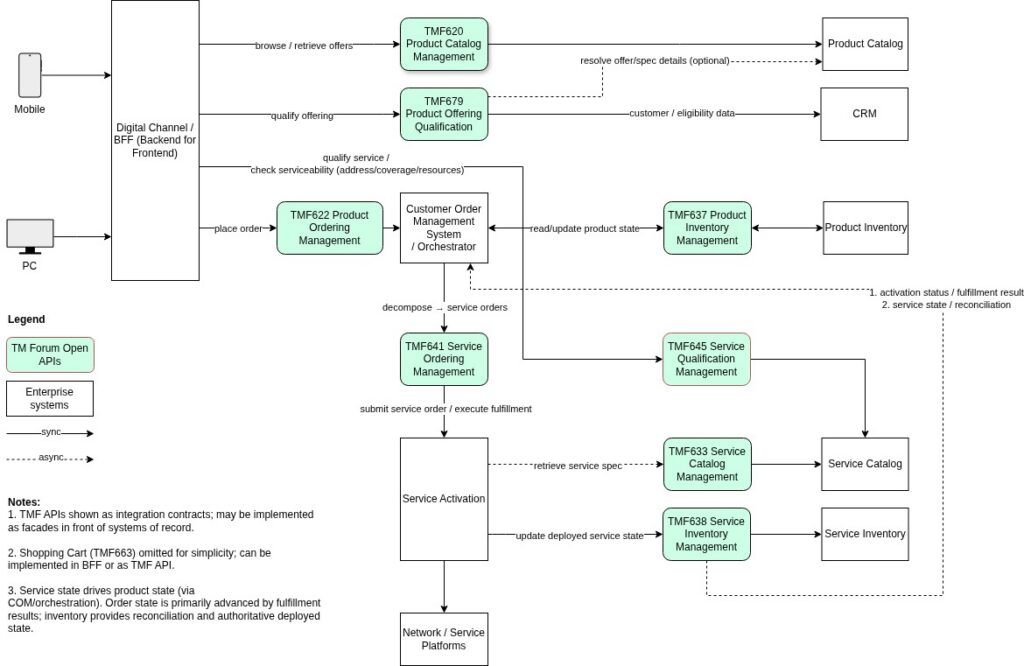
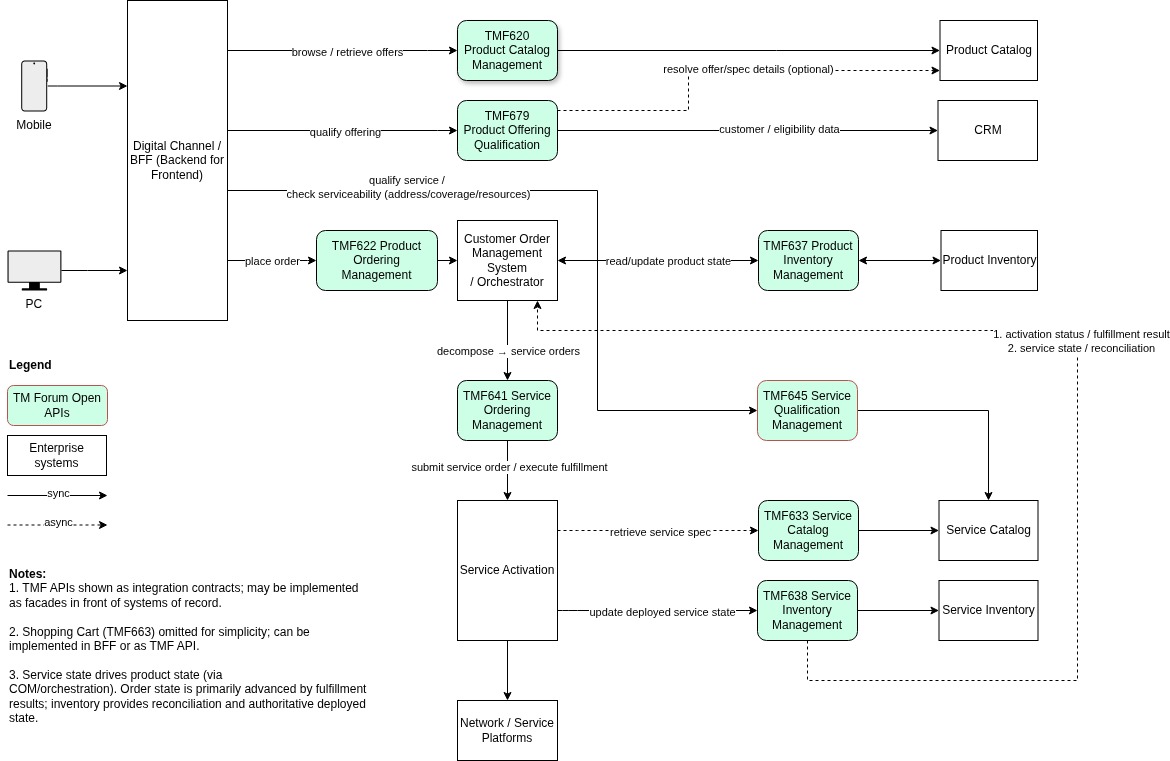
Together with the preceding articles in this series, the full order capture lifecycle is now covered from first product discovery through technical feasibility to order submission:
| Article | Primary APIs | Focus |
| Customer Order Capture | TMF620, TMF679, TMF645, TMF622 | End-to-end order capture lifecycle overview |
| TMF663 Shopping Cart Management | TMF663 | Pre-order cart aggregation and session management |
| Service Qualification (this article) | TMF645 | Technical feasibility validation in depth |
| Customer Order Management | TMF622, TMF641, TMF637 | Order decomposition and orchestration |
| Service Activation | TMF641, TMF633, TMF638 | Technical execution and inventory management |
The next publication in the series will examine TMF620 Product Catalog Management in depth — exploring how catalog design decisions shape the complexity (or simplicity) of every downstream domain, from qualification through to activation.
| Closing Principle |
| Closing Principle: Service Qualification is not a technical detail to be deferred. It is the architectural mechanism that aligns commercial commitment with operational capability. Systems that skip this step shift the cost of infeasibility downstream, where it is harder to handle, more expensive to recover from, and more visible to the customer. |