Schlagwort: TMF Open API

  • TMF Open APIs – Service Qualification

    TMF Open APIs – Service Qualification

    Pragmatic Patterns Using TMF645 and Its Role in the Order Capture Lifecycle

    In the previous article on Customer Order Capture, TMF645 Service Qualification was identified as one of the four core APIs involved in translating customer intent into a valid ProductOrder. Alongside TMF620, TMF679, and TMF622, it occupies a specific and critical position in the architecture — the point at which commercial feasibility meets technical reality.

    This article examines TMF645 Service Qualification in depth: what it does, how it fits into the broader order lifecycle, how it relates to other qualification APIs, and what practical patterns emerge when it is implemented correctly in telecom BSS/OSS architectures.

    What Is Service Qualification?

    Service Qualification answers a specific operational question: can this service actually be delivered to this customer at this location with these technical constraints?

    The TM Forum TMF645 Service Qualification Management API provides a standardized interface for checking the technical feasibility of a service request before that request enters the order lifecycle. It sits upstream of order submission and downstream of commercial product selection, acting as a validation gate between intent and commitment.

    TMF645 is not about whether a customer is eligible to purchase a product — that is the domain of TMF679 Product Offering Qualification. TMF645 is about whether the underlying infrastructure, network, or platform can actually support the requested service for that specific customer context.

    Why Service Qualification Matters
    Service Qualification is the difference between selling what you offer and committing to what you can deliver. Without it, the gap between commercial intent and operational execution generates late failures, costly rework, and degraded customer experience.

    Where TMF645 Fits in the Order Lifecycle

    The order capture lifecycle follows a structured progression from product discovery to order submission. TMF645 occupies the technical feasibility stage — after commercial qualification and before ProductOrder creation.
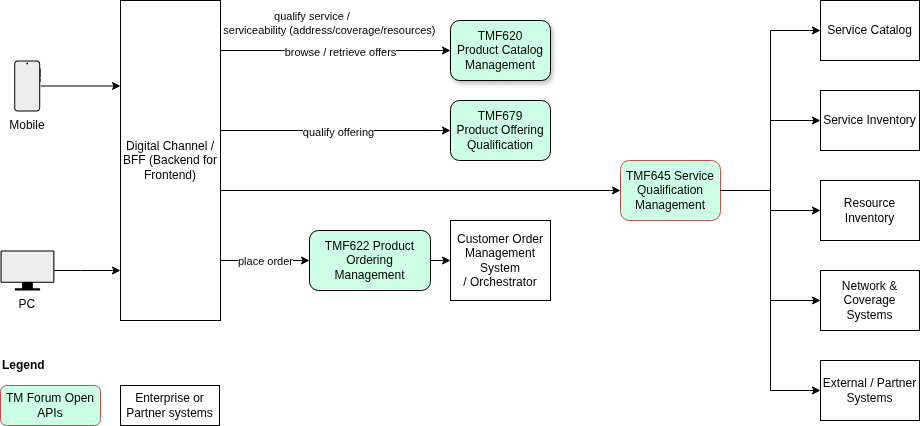
    The TM Forum TMF645 Service Qualification Management API provides a standardized interface for checking the technical feasibility of a service request before that request enters the order lifecycle. It sits upstream of order submission and downstream of commercial product selection, acting as a validation gate between intent and commitment.
    StagePrimary APICore Responsibility
    Product DiscoveryTMF620Retrieve and browse available product offerings
    Commercial QualificationTMF679Validate customer eligibility and offer compatibility
    Technical FeasibilityTMF645Verify infrastructure and network delivery capability
    Order SubmissionTMF622Capture and submit the standardized ProductOrder

    This sequencing is deliberate and architecturally significant. If technical feasibility is checked only during service activation — downstream in the lifecycle — orders that cannot be fulfilled will have already passed through multiple processing stages. The cost of late failure is substantially higher than the cost of early qualification.

    By checking technical feasibility through TMF645 before the ProductOrder is submitted, the architecture ensures that only viable orders enter the fulfillment pipeline.

    Commercial vs. Technical Qualification: A Critical Distinction

    One of the most important architectural separations in the order capture domain is the distinction between commercial qualification and technical qualification. These two validation concerns are often conflated in legacy architectures, producing systems that are difficult to evolve and prone to inconsistency.

    TMF679 – Product Offering QualificationTMF645 – Service Qualification
    Is this customer eligible for this offer?Can the network or infrastructure deliver this service?
    Are the selected options compatible with the product?Is there capacity or coverage at the requested location?
    Does the customer’s account support this product?Are the required resources available and allocatable?
    Commercial rules and pricing constraintsInfrastructure, topology, and platform constraints
    Catalog-driven validationNetwork- and inventory-driven validation

    A customer may be fully eligible for a premium broadband offer (TMF679 qualified) but reside at an address outside the fiber coverage area (TMF645 not qualified). These are orthogonal checks that must remain independent to allow each domain to evolve without coupling.

    Anti-Pattern: Merged Qualification
    Merging commercial and technical qualification into a single validation service is a recurring anti-pattern. It couples the product catalog model to network topology, forces synchronized releases across otherwise independent domains, and makes it impossible to clearly identify why a qualification failed. Keep these concerns separate.

    What TMF645 Checks

    The scope of a TMF645 qualification check depends on the service type and operational context. Typical checks include:

    Check TypeDescription
    Address and location validationConfirms the customer’s service address is within the delivery area for the requested service
    Network coverage verificationValidates that the required network technology (fiber, cable, mobile, etc.) reaches the specified location
    Resource availabilityChecks whether required infrastructure resources — ports, bandwidth, spectrum, or capacity — are available
    Infrastructure constraintsIdentifies topology-specific limitations that may affect service parameters or options
    Technology-specific feasibilityFor services such as VoIP, IPTV, or mobile, verifies platform availability and compatibility
    Third-party or partner dependency checksFor wholesale or shared infrastructure scenarios, queries external qualification systems

    The qualification result includes not just a binary qualified or not-qualified outcome, but structured detail about the constraints encountered, the alternatives available, and any parameters that must be adjusted before order submission.

    TMF645 API Structure

    The TMF645 API supports both synchronous and asynchronous qualification patterns, reflecting the reality that some qualification checks can be resolved immediately while others require queries to external or slow systems.

    Core Resources

    ResourcePurpose
    ServiceQualificationThe primary qualification request and result object
    ServiceQualificationItemRepresents a single service within a multi-service qualification request
    QualificationResultThe outcome per qualification item: qualified, notQualified, or partiallyQualified
    AlternateServiceProposalProposed alternative configurations when the original request cannot be qualified as submitted
    ServiceabilityDateEarliest date on which the service can be delivered if not immediately available

    Qualification States

    A qualification request progresses through a defined lifecycle:

    StateMeaningCaller Response
    acknowledgedRequest received and accepted for processingRetain qualification ID; await next state
    inProgressQualification checks are executingContinue monitoring via polling or event
    doneQualification completed with a resultProcess result and proceed or adjust
    terminatedWithErrorQualification could not be completedEvaluate error and retry or escalate

    Synchronous vs. Asynchronous Execution

    TMF645 supports both execution patterns. The choice between them is not arbitrary — it should reflect the operational characteristics of the underlying qualification systems.

    Synchronous QualificationAsynchronous Qualification
    Result returned in same API call responseResult delivered via event callback or polling
    Appropriate when all checks are local and fastRequired when external systems or slow lookups are involved
    Simpler caller implementationMore complex state management required by caller
    Fragile if any downstream system is slowResilient to variable response times
    Suitable for simple address lookupsRequired for partner or wholesale qualification flows
    Design Recommendation
    Architectural Recommendation: Even when synchronous qualification is technically feasible, designing the caller (typically the BFF or order capture service) to handle asynchronous results makes the integration more resilient. A synchronous qualification that becomes slower over time due to infrastructure growth should not require a re-architecture of the calling layer.

    Qualification in the BFF and Channel Layer

    In a well-structured order capture architecture, the BFF (Backend-for-Frontend) orchestrates qualification calls on behalf of the digital channel. This keeps the frontend free from direct dependency on TMF APIs while maintaining a clean separation between engagement logic and domain validation.

    The BFF is responsible for:

    • Aggregating product selection, customer context, and location data into a qualification request
    • Calling TMF679 for commercial qualification and TMF645 for technical qualification
    • Presenting qualification results to the frontend in a channel-appropriate format
    • Blocking order submission if qualification has not succeeded
    • Surfacing alternative proposals from TMF645 if the original request cannot be qualified

    The BFF should not implement qualification logic itself. Its role is orchestration and translation — not validation. Qualification rules live behind the TMF645 interface, inside the domain that owns the qualification logic.

    Anti-Pattern: Qualification in the Channel
    A common mistake is implementing address validation or coverage checks inside the BFF or frontend layer. This creates duplicated logic, inconsistencies between channels, and tight coupling to infrastructure data that changes independently of digital channel releases. Qualification logic belongs behind TMF APIs.

    Handling Qualification Results

    The outcome of a TMF645 qualification is not always a simple pass or fail. Three result types must be handled explicitly:

    1. Qualified

    The service can be delivered as requested. The qualification result may include additional information — such as confirmed delivery dates, available service parameters, or resource identifiers — that should be carried forward into the ProductOrder payload.

    2. Not Qualified

    The service cannot be delivered as requested. The result should include structured detail on the reason for disqualification: coverage boundary, resource unavailability, platform incompatibility, or infrastructure constraint. This information should be surfaced to the customer clearly, with appropriate next steps.

    In some architectures, a not-qualified result triggers a waitlist or future-date qualification flow, where the system tracks the customer’s intent and notifies them when qualification conditions change.

    3. Partially Qualified or Alternative Proposed

    TMF645 supports the return of alternative service proposals when the requested configuration cannot be qualified but a modified version can. Alternatives may include:

    • A lower bandwidth tier where the full requested speed is not available
    • A different access technology (e.g., FTTC instead of FTTP)
    • A future delivery date when current resources are temporarily exhausted
    • A modified service area or endpoint if the exact address has limited coverage

    Alternative proposals must be presented to the customer as genuine choices, not silent fallbacks. The channel layer must handle these gracefully and allow the customer to accept, reject, or modify their selection before proceeding.

    Relationship to Order Submission via TMF622

    The output of a successful TMF645 qualification is not discarded — it informs the structure and content of the ProductOrder submitted through TMF622. Key qualification data that flows into the order includes:

    Qualification OutputRole in TMF622 ProductOrder
    Qualification IDCarried as a correlation reference in the ProductOrder for traceability
    Confirmed service parametersUsed to populate the requested characteristics of the order item
    Resource identifiersReferenced in the order to ensure the correct infrastructure is reserved
    Delivery date commitmentReflected in the requested start date of the order
    Alternative proposal referenceIncluded if the customer accepted an alternative configuration

    This linkage between qualification and order is architecturally important. It ensures that the ProductOrder reflects not just what the customer wants, but what the network has confirmed it can deliver. Orders that do not carry qualification context force downstream systems to re-check feasibility, introducing redundancy, delay, and potential inconsistency.

    Design Principle
    Design Principle: The qualification reference should be treated as a first-class attribute of the ProductOrder, not an optional annotation. Downstream decomposition and service activation systems rely on this reference to skip redundant feasibility checks and proceed directly to fulfillment.

    Caching, Validity, and Qualification Windows

    A qualification result is not indefinitely valid. Infrastructure conditions, resource availability, and coverage boundaries can change. TMF645 results should carry an explicit validity window, after which the qualification must be refreshed before order submission.

    Common validity patterns include:

    PatternDescription
    Time-bounded validityQualification result is valid for a defined period (e.g., 24–72 hours) before expiry
    Event-invalidated qualificationQualification is invalidated if specific network events occur (maintenance, topology changes)
    Commitment-based holdingFor high-demand resources, qualification results may optionally reserve capacity for a defined window
    Re-qualification on modificationAny change to the order parameters (address, service tier, options) requires a fresh qualification

    Digital channels and BFFs must enforce qualification validity. Submitting a ProductOrder against an expired qualification is a common source of late-stage failures that could have been avoided with appropriate staleness detection.

    Common Anti-Patterns in Service Qualification

    1. Qualification as an Afterthought

    Some architectures treat service qualification as an optional pre-check rather than a required gate. Orders are accepted and submitted regardless of whether qualification has been completed, relying on activation-time failure handling to catch infeasible requests.

    This pattern multiplies the cost of failure. An order that fails during activation has already consumed order management processing, inventory reservation, and orchestration capacity. An order that fails at qualification consumes only a lightweight API call.

    2. Embedding Qualification Logic in Activation

    When qualification logic is not exposed through a dedicated interface like TMF645, it tends to migrate into the activation domain, where it is evaluated at provisioning time. This delays failure detection, increases orchestration complexity, and mixes technical feasibility concerns with execution logic.

    3. Silently Accepting Alternatives

    Returning an alternative service proposal without explicit customer confirmation is a source of downstream disputes and operational confusion. If the customer ordered 1 Gbps fiber and the network can only deliver 500 Mbps FTTC, that substitution must be surfaced and confirmed — not silently applied to the order.

    4. Not Propagating Qualification Context

    Discarding the qualification reference after order submission disconnects the ProductOrder from its feasibility basis. Activation systems that cannot reference the qualification outcome are forced to repeat checks, introducing latency and creating opportunities for divergence between what was qualified and what is provisioned.

    Integration Pattern Summary

    When TMF645 is implemented correctly, it provides a clean, early validation gate that prevents infeasible orders from entering the fulfillment pipeline and ensures that downstream processing operates on committed, technically verified requests.

    ResponsibilityMechanismRationale
    Validate technical feasibility earlyTMF645 Service Qualification before TMF622 order submissionPrevents late failures and reduces orchestration complexity
    Separate commercial from technical validationTMF679 for eligibility, TMF645 for feasibility — independent callsAllows each domain to evolve independently
    Surface alternatives explicitlyReturn AlternateServiceProposal with qualification resultEnsures customer confirmation before substitution is applied
    Propagate qualification context to ordersCarry qualification ID and confirmed parameters in ProductOrderEnables activation to skip redundant checks
    Enforce qualification validity windowsTrack expiry and re-qualify if window elapses or parameters changePrevents order submission against stale feasibility data
    Keep qualification logic behind the APIValidation in the domain, not in BFF or frontendEliminates duplication and maintains consistency across channels

    What’s Next

    This article examined TMF645 Service Qualification as a standalone domain: its structure, its role in the order lifecycle, its relationship to commercial qualification via TMF679, and the practical patterns required to implement it without introducing architectural fragility.

    Together with the preceding articles in this series, the full order capture lifecycle is now covered from first product discovery through technical feasibility to order submission:

    ArticlePrimary APIsFocus
    Customer Order CaptureTMF620, TMF679, TMF645, TMF622End-to-end order capture lifecycle overview
    TMF663 Shopping Cart ManagementTMF663Pre-order cart aggregation and session management
    Service Qualification (this article)TMF645Technical feasibility validation in depth
    Customer Order ManagementTMF622, TMF641, TMF637Order decomposition and orchestration
    Service ActivationTMF641, TMF633, TMF638Technical execution and inventory management

    The next publication in the series will examine TMF620 Product Catalog Management in depth — exploring how catalog design decisions shape the complexity (or simplicity) of every downstream domain, from qualification through to activation.

    Closing Principle
    Closing Principle: Service Qualification is not a technical detail to be deferred. It is the architectural mechanism that aligns commercial commitment with operational capability. Systems that skip this step shift the cost of infeasibility downstream, where it is harder to handle, more expensive to recover from, and more visible to the customer.
  • TMF Open APIs – Service Activation

    TMF Open APIs – Pragmatic Patterns Using TMF641, TMF633, and TMF638

    In the previous articles, we examined how customer intent is captured and standardized through TMF622 Product Ordering, and how Customer Order Management decomposes product orders and orchestrates lifecycle progression. Now we move to the final and often most complex domain: Service Activation and Operational State Management.

    This domain represents the transition from commercial abstraction to technical execution — where real infrastructure constraints, asynchronous processes, and operational reality must be handled pragmatically. This article demonstrates how TMF641 Service Ordering, TMF633 Service Catalog, and TMF638 Service Inventory can be applied without introducing unnecessary orchestration complexity or tightly coupled fulfillment architectures.

    The Service Activation Domain

    The Service Activation domain operates under fundamentally different conditions than commercial order management. Where product ordering captures commercial intent, service activation is responsible for executing that intent within the operational environment. It translates service orders into concrete technical actions across network platforms, infrastructure components, and operational support systems.

    TMF Open APIs
TMF641 Service Ordering for the Service Activation Domain.
The Service Activation domain operates under fundamentally different conditions than commercial order management. Where product ordering captures commercial intent, service activation is responsible for executing that intent within the operational environment. It translates service orders into concrete technical actions across network platforms, infrastructure components, and operational support systems.

    Typical responsibilities within this domain include:

    ResponsibilityDescription
    Network provisioningConfiguring network elements, access technologies, or connectivity services
    Resource configurationAllocating and binding technical resources required for service delivery
    Platform activationEnabling services on application or service platforms (e.g., IPTV, VoIP, mobile)
    OSS integrationInteracting with provisioning systems, resource managers, and inventory platforms
    External vendor integrationInvoking third-party or partner systems required for service delivery

    Operational characteristics in this domain differ significantly from upstream commercial systems. Service activation processes are typically:

    • Long-running — execution may span minutes, hours, or longer depending on infrastructure dependencies
    • Asynchronous — progress and results are delivered through events or status updates, not immediate responses
    • Failure-prone — network conditions, resource constraints, and external dependencies introduce frequent failure scenarios
    • Partially executable — complex services may activate some components successfully while others require retries or remediation
    Architectural Implication Because of these characteristics, the Service Activation domain must be designed to handle asynchronous execution, tolerate partial outcomes, and provide clear operational feedback to upstream order management systems. Architectures that assume synchronous, always-successful activation will fail at operational scale.

    Service Ordering — TMF641

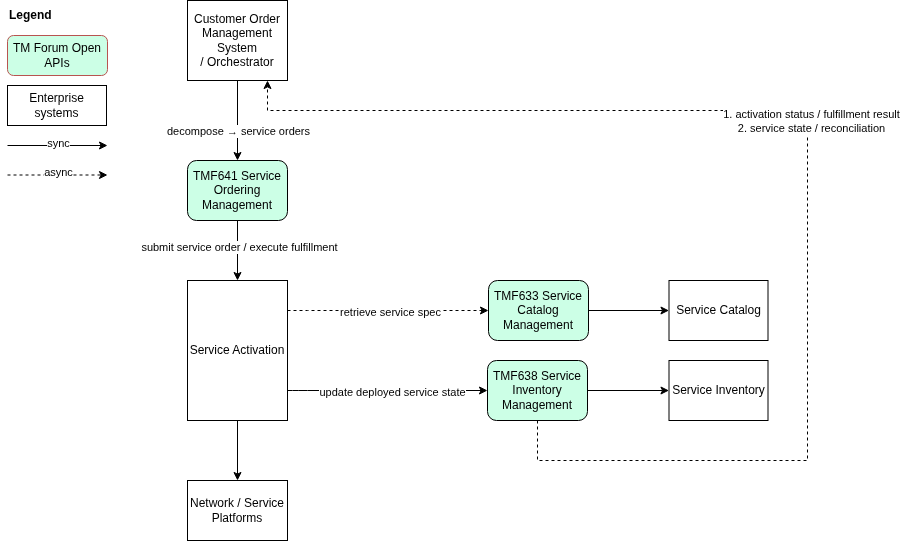
    TMF641 Service Ordering Management API acts as the operational boundary between order orchestration and service execution. When Customer Order Management completes product order decomposition, the resulting service-level work requests are submitted through TMF641. At this point, responsibility shifts from commercial orchestration to technical fulfillment.

    TMF641 therefore provides a stable execution interface that allows the orchestration layer to trigger service delivery while remaining independent from the internal design of activation systems.

    What TMF641 Is — and Is Not

    TMF641 IS…TMF641 is NOT…
    A contract for requesting service executionA workflow engine
    A lifecycle state tracking interfaceA process definition framework
    An operational boundary between domainsA platform for implementing provisioning logic
    A stable integration surface for orchestratorsAn internal activation system

    Through this contract, the orchestrator can reliably initiate fulfillment activities without needing to understand how those activities are implemented internally. The key architectural rule is:

    TMF641 enables execution requests — it does not define execution logic.

    Separation of Responsibilities: Orchestration vs. Fulfillment

    A clean architecture requires a clear distinction between order orchestration decisions and service activation execution. The two domains have fundamentally different roles:

    Customer Order Management (COM)Service Activation Domain
    Interprets the incoming TMF622 ProductOrderDetermines how provisioning must be performed
    Decomposes the order into service-level actionsIdentifies which OSS systems or network controllers to invoke
    Submits ServiceOrders through TMF641Manages dependencies between provisioning steps
    Monitors fulfillment progress and advances product order stateHandles technical failures, retries, and recovery

    In simple terms: COM decides what must be delivered. Service Activation decides how it is delivered.

    Maintaining this separation prevents a common and costly anti-pattern: embedding provisioning logic inside the orchestration domain. When orchestration layers begin implementing detailed activation workflows, they become tightly coupled to network implementation details, making the system difficult to evolve and scale.

    By keeping execution logic inside the fulfillment domain and using TMF641 purely as an execution contract, the architecture remains modular, maintainable, and resilient as both commercial and operational systems evolve independently.

    Service Catalog — TMF633

    TMF633 Service Catalog Management API provides the technical definitions of services required by fulfillment and activation domains. While product catalogs describe commercial offerings, the service catalog defines how those offerings are realized at the technical level.

    The Service Catalog typically contains:

    • Service specifications describing the structure and characteristics of technical services
    • Resource requirements indicating dependencies on network or platform resources
    • Configuration templates used during provisioning and activation
    • Activation metadata that guides provisioning systems on how services should be instantiated

    Activation and fulfillment systems may use TMF633 to resolve service specification details, validate technical configuration constraints, and retrieve provisioning parameters referenced in service orders.

    Design-Time Reference, Not Runtime Dependency

    From an architectural perspective, the Service Catalog should be treated as a supporting design-time and reference domain — not a synchronous runtime dependency on every activation request.

    Recommended Approach Cache required catalog metadata within fulfillment systems at startup or on demand. Apply explicit versioning of service specifications to ensure predictable execution across releases. Avoid synchronous catalog lookups on critical provisioning paths — catalog unavailability must never block service activation.

    This approach maintains activation performance, resilience, and operational stability, while ensuring that fulfillment systems rely on consistent and governed service definitions.

    Execution Model — Asynchronous by Design

    Service activation processes are inherently asynchronous and long-running. Unlike commercial order submission, technical provisioning typically involves multiple downstream systems, infrastructure platforms, and external integrations that cannot complete within a single synchronous request.

    Typical Execution Lifecycle

    TMF Open APIs: Execution Model — Asynchronous by Design
Service activation processes are inherently asynchronous and long-running. Unlike commercial order submission, technical provisioning typically involves multiple downstream systems, infrastructure platforms, and external integrations that cannot complete within a single synchronous request.
    StepActorAction
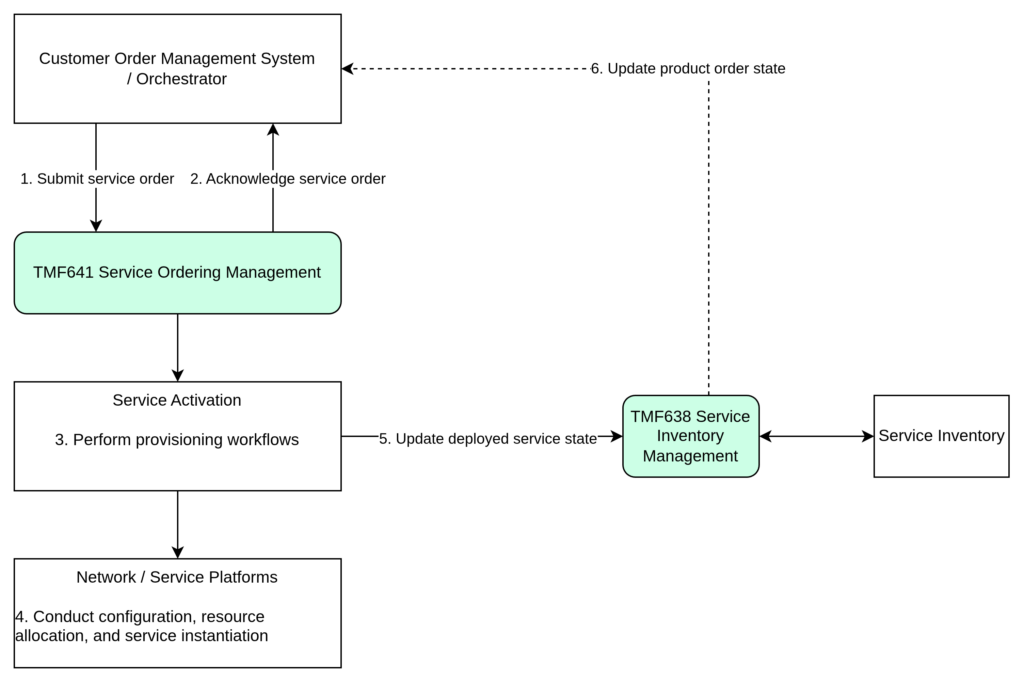
    1COMSubmits ServiceOrder via TMF641
    2Activation DomainAccepts and acknowledges the ServiceOrder
    3Activation DomainInitiates internal provisioning workflows
    4Underlying SystemsPerform configuration, resource allocation, and service instantiation
    5Activation DomainEmits lifecycle status updates as execution progresses
    6COMProcesses status events and advances product order state

    Lifecycle States

    During execution, the activation domain reports the following intermediate lifecycle states:

    StateMeaningCOM Response
    acknowledgedRequest accepted for processingRecord confirmation; no state change
    inProgressProvisioning activities are executingMaintain InProgress order state
    pendingExternalWaiting on an external system or vendorApply timeout monitoring; prepare retry
    completedService successfully activatedAdvance order to Completed; update TMF637
    failedProvisioning could not be completedEnter recovery logic; evaluate retry or rollback
    Design Principle Orchestration and order management domains must rely on event-driven feedback and lifecycle state transitions — not on synchronous completion of activation requests. A completed API call means the request was accepted. It does not mean the service was activated.

    Service Inventory — TMF638

    A fundamental architectural principle of fulfillment architecture is: the authoritative deployed state of services must be maintained in Service Inventory.

    TMF638 Service Inventory represents the actual technical deployment of services in the network and platforms. It reflects what is really running in the infrastructure, independent of commercial intent or ordering processes.

    TMF638 typically stores:

    • Deployed service instances and their identifiers
    • Active configurations and binding parameters
    • Relationships between services and underlying resources
    • Operational lifecycle state of each service (active, suspended, terminated, degraded)
    Key Principle Service Inventory is not a tracking repository for orders. It is the source of truth for operational reality within the OSS landscape. Other domains — assurance, monitoring, reconciliation — must rely on TMF638, not on order state, to understand what is actually deployed.

    During service activation, provisioning systems interact with infrastructure components and progressively update Service Inventory as deployment evolves — creating new service instances, modifying configuration, and recording operational state changes.

    Feedback to the Order Domain

    Once service activation begins, Customer Order Management must rely on asynchronous feedback from fulfillment and inventory domains to understand how execution is progressing. Two primary categories of signals flow back to the order domain.

    1. Fulfillment Results

    Fulfillment systems provide execution outcomes for service orders, typically through TMF641 interfaces. These signals drive the lifecycle of the commercial order managed through TMF622 and are used to:

    • Advance the order state machine
    • Confirm successful activation
    • Report execution failures for recovery handling
    • Identify partial completion scenarios requiring intervention

    2. Operational State Updates

    A second category of signals originates from the operational environment — specifically, the service inventory maintained through TMF638. These updates represent the actual technical state of deployed services, independent of the order workflow.

    Operational state signals are used for:

    • Inventory reconciliation and drift detection
    • Identifying service degradation or configuration inconsistencies
    • Triggering corrective actions in assurance or orchestration systems
    Example Scenario A ProductOrder has been marked Completed in the order domain. Later, TMF638 Service Inventory reports that the corresponding service instance has entered a degraded operational state. In this situation: COM may initiate corrective workflows, assurance systems may trigger incident handling, and orchestration may request re-provisioning.

    Order completion does not guarantee long-term operational correctness. Robust architectures must maintain continuous feedback loops between fulfillment, inventory, and order management.

    Handling Reality Drift

    In operational environments, reality drift occurs when the actual deployed state of a service diverges from the expected state defined during order fulfillment. This divergence is common in large distributed telecom environments and must be explicitly addressed in system design.

    Common Causes

    CauseDescription
    Manual network changesConfiguration changes applied outside automated workflows, bypassing inventory updates
    Vendor inconsistenciesDelayed or incomplete responses from partner or third-party APIs
    Partial provisioning failuresSome service components activate successfully while others fail silently
    Out-of-band interventionsOperational changes applied during incident resolution without proper lifecycle tracking

    Architectural Patterns for Managing Drift

    1. Periodic Reconciliation

    Scheduled reconciliation jobs compare the deployed service state stored in TMF638 with the real configuration observed in network or platform systems. These processes identify discrepancies and trigger corrective actions when necessary. Reconciliation frequency should be calibrated to the operational risk tolerance of the service type.

    2. Event-Driven Inventory Updates

    Modern architectures increasingly rely on event-driven mechanisms where network platforms emit state change events that update Service Inventory in near real time. This approach significantly reduces the window during which inconsistencies can exist undetected, and eliminates the latency inherent in scheduled reconciliation.

    3. Domain-Specific Repair Workflows

    When inconsistencies are detected — whether through reconciliation or event-driven signals — specialized repair workflows are triggered within the activation domain. These workflows may:

    • Reapply configuration to bring the network element back to the expected state
    • Restore missing or corrupted service components
    • Synchronize service state across all affected inventory and assurance systems
    • Escalate to manual intervention when automated repair is not viable

    Avoiding Fulfillment Complexity Traps

    Service activation architectures accumulate complexity over time — often through well-intentioned design decisions that solve short-term problems while creating long-term constraints. The following anti-patterns appear repeatedly in telecom BSS/OSS implementations and are worth addressing explicitly.

    1. The Centralized Mega-Orchestrator

    As activation requirements grow, there is a recurring temptation to introduce a single orchestration platform that owns the end-to-end fulfillment workflow — from ServiceOrder receipt through network provisioning, resource allocation, and inventory update. This approach typically starts as a pragmatic shortcut and gradually accumulates ownership of everything.

    The consequences are predictable:

    • A single point of failure that affects all service types simultaneously
    • Deployment bottlenecks — every change to any service requires a release of the central platform
    • Performance degradation as order volumes grow and all execution serializes through one engine
    • Deep coupling between commercial product models and network implementation details
    Preferred Approach Prefer domain-specific execution logic. Each service type or service family should own its activation workflow. Use TMF641 as the stable interface through which these domain-specific activators are invoked. Orchestration coordinates — it does not implement provisioning steps.

    2. Overusing Workflow Engines

    Visual workflow engines (BPM platforms, low-code orchestration tools) are valuable for genuinely complex, human-in-the-loop, or highly variable processes. However, many telecom provisioning flows are deterministic, rule-based, and predictable. Modeling these flows in a heavyweight workflow engine introduces operational overhead without architectural benefit.

    Signs that a workflow engine is being overused:

    • Simple sequential activation steps modeled as multi-node workflows with branching logic
    • The workflow engine becomes the only way to understand what the system does
    • Changes to provisioning logic require workflow designer involvement rather than code review
    Preferred Approach Use state-machine-based execution for deterministic provisioning flows. Reserve workflow engines for processes that are genuinely variable, approval-dependent, or require human intervention. Explicit state machines are easier to test, version, and reason about than visual workflow definitions.

    3. Synchronous Activation Chains

    A synchronous activation chain occurs when each provisioning step waits for the previous one to complete before proceeding — creating a long, blocking call chain that spans multiple systems. This pattern is fragile: a single slow or unavailable system causes the entire chain to stall or time out.

    Common manifestations include:

    • Direct synchronous calls from the orchestrator into multiple downstream provisioning systems in sequence
    • Timeout values set high to accommodate slow external systems, masking latency problems
    • Error handling that propagates exceptions upward through the call chain rather than isolating failures
    Preferred Approach Design activation flows as asynchronous command-and-event sequences. Each provisioning step emits a completion event. The next step is triggered by that event, not by a return value. This decouples execution timing, isolates failures, and allows individual steps to retry independently without affecting the rest of the workflow.

    Integration Pattern Summary

    When the Service Activation domain is implemented correctly, it becomes a well-bounded, operationally stable execution layer that supports both commercial agility and technical evolution. The following summarizes the key responsibilities and their rationale.

    ResponsibilityMechanismRationale
    Execute ServiceOrdersTMF641 Service Ordering APIProvides a stable, domain-independent execution contract
    Resolve technical definitionsTMF633 Service Catalog (cached)Decouples activation from catalog availability at runtime
    Maintain authoritative deployed stateTMF638 Service InventoryEnsures operational truth is available to all consuming domains
    Emit lifecycle updatesAsynchronous events / callbacksAllows orchestration to progress without blocking on activation
    Decouple from commercial modelsAnti-Corruption Layer at domain boundaryAllows product and service domains to evolve independently
    Handle failures locallyDomain-specific retry and repair workflowsPrevents failure propagation into orchestration and order domains

    When implemented correctly:

    • Operational complexity is isolated within the activation domain and does not leak into orchestration
    • The orchestration layer remains clean, focused on lifecycle coordination rather than provisioning detail
    • Individual activation domains can be scaled, replaced, or evolved without impacting upstream systems
    • TMF APIs serve as integration boundaries — not as architectural foundations for internal design

    Closing the Lifecycle

    This article concludes the three-part series on TM Forum Open API architecture. Across the trilogy, three distinct domains work in sequence to translate a customer’s commercial intent into a delivered, operational service.

    DomainPrimary APIsCore Responsibility
    Customer Order CaptureTMF622 Product OrderingValidates and standardizes commercial intent into a structured ProductOrder
    Customer Order ManagementTMF622, TMF641, TMF637Decomposes the ProductOrder, orchestrates lifecycle, and coordinates fulfillment feedback
    Service Activation & InventoryTMF641, TMF633, TMF638Executes technical provisioning and maintains authoritative operational state

    TM Forum Open APIs serve a specific and bounded purpose in this architecture: they define domain boundaries, provide integration contracts, and establish interoperability standards between systems. They define the shape of the interface between domains — not the internal behavior of those domains.

    A Closing Principle TMF APIs should never dictate internal architecture. A system that models its internal domain logic directly on TMF JSON structures will be brittle, difficult to evolve, and tightly coupled to API version cycles. Use TMF APIs at the boundary. Use domain models internally. The Anti-Corruption Layer is not optional — it is the mechanism that keeps these concerns separate.

    Across all three domains, the architectural thread is consistent: own your domain logic, expose clean contracts, and use standard APIs as integration surfaces — not as blueprints for internal design. That separation is what makes telecom BSS/OSS architectures scalable, maintainable, and capable of evolving with both business and technology change.

    Implementation Approaches: Platforms vs. Tailor-Made Development

    Service Activation architectures can be implemented in several ways, each with distinct trade-offs in cost, flexibility, time-to-market, and long-term maintainability. The right choice depends on the operator’s scale, existing technology landscape, team capabilities, and the degree of domain specificity required.

    Option 1 — Vendor Platforms

    Established commercial platforms such as Nokia NSP, Ericsson OSS/BSS, IBM Sterling Order Management, and Netcracker provide pre-built fulfillment engines with native TMF API support, lifecycle management, and operational tooling. These solutions reduce time-to-market and bring proven operational patterns validated across large deployments.

    Trade-offs to consider:

    1. High upfront licensing and integration cost
    2. Customisation of domain-specific business rules is constrained by the platform model
    3. Vendor lock-in can limit architecture evolution and renegotiation leverage

    Option 2 — Open-Source Platforms

    Frameworks such as ONAP (Open Network Automation Platform) and OSM (Open Source MANO) provide community-driven orchestration and fulfillment capabilities with TMF alignment. These platforms are particularly relevant for operators pursuing open ecosystem strategies or needing multi-vendor network automation.

    Trade-offs to consider:

    1. Lower licensing cost, but significant investment in integration, configuration, and support
    2. Community-driven TMF alignment varies in completeness across modules
    3. Operational maturity depends heavily on internal DevOps and OSS expertise

    Option 3 — Composable Frameworks

    A growing number of teams adopt a composable approach: using a lightweight orchestration framework such as Temporal, Conductor, or Camunda for workflow coordination, while keeping domain-specific activation logic in purpose-built microservices that expose TMF641-compliant interfaces. This model offers high flexibility without building everything from scratch.

    Trade-offs to consider:

    1. Requires strong distributed systems expertise to operate reliably at scale
    2. TMF alignment is manual — the team owns the integration contract design
    3. Well-suited to organizations with mature engineering practices and evolving product portfolios

    Option 4 — Tailor-Made Development

    Full custom development — typically using runtimes such as Spring Boot, Quarkus, or Node.js combined with event streaming platforms like Apache Kafka or RabbitMQ — gives teams complete control over domain logic, state machine design, and integration contracts. This approach is justified when the domain logic is genuinely unique and no existing platform models it adequately.

    Trade-offs to consider:

    1. Highest initial investment in design, development, and operational tooling
    2. Long-term maintenance ownership rests entirely with the internal team
    3. Full alignment with domain model and TMF contracts — no platform constraints

    Option 5 — Hybrid Approach

    In brownfield environments, a hybrid strategy is often the most pragmatic path: retaining existing vendor platforms for stable, high-volume service types while introducing composable or tailor-made components for new services, digital channels, or domains requiring faster evolution. This allows incremental modernization without a full platform replacement.

    Decision Matrix

    The following matrix summarizes the key dimensions across all five approaches to support architectural decision-making:

    CriterionVendor PlatformOpen-Source PlatformComposable FrameworkTailor-MadeHybrid
    Time to marketFastMediumMediumSlowMedium
    Upfront costHighLow–MediumLow–MediumHighMedium–High
    Vendor lock-inHighLowLowNonePartial
    TMF alignmentNative/partialCommunity-drivenManualFull controlMixed
    CustomisationLimitedModerateHighFullHigh
    Operational maturityHighMediumMediumLow initiallyMedium–High
    Team skill demandPlatform-specificDevOps + OSSDistributed systemsStrong dev teamMixed
    Best fitLarge operators,fast rolloutCost-sensitive, open ecosystemFlexible orchestration needsUnique domain logicBrownfield + evolution
    A Constant Across All Approaches Regardless of the implementation path chosen, the architectural principles remain the same. TMF APIs define the boundaries. Domain logic stays internal. Operational state is always owned by Service Inventory. The platform or framework is an implementation detail — the domain model is the architecture.
  • TMF Open APIs – TMF663 Shopping Cart Management

    (Not TMF633 — that’s Service Catalog. The Shopping Cart API is TMF663.)

    In modern telecom architectures, one recurring question appears during digital transformation programs:

    Do we really need a standardized Shopping Cart API?”

    With microservices, composable frontends, and powerful BFF layers, many teams assume the shopping cart can simply be implemented inside the digital channel.

    So where does TMF663 actually fit? And is it still relevant?

    Let’s analyze this architecturally.

    What TMF663 Is

    TMF663 – Shopping Cart Management is designed to:

    • Manage pre-order cart state,
    • Persist selected product offerings,
    • Support configuration updates,
    • Transition cart into a ProductOrder.

    It is not:

    • A pricing engine,
    • A qualification engine,
    • An orchestration engine,
    • A product catalog.

    It exists in the pre-order domain, before TMF622 Product Ordering.

    The Core Architectural Question

    The real question is not:

    Do we need TMF663?”

    The real question is:

    Where should cart state live in a distributed architecture?”

    There are three common patterns.

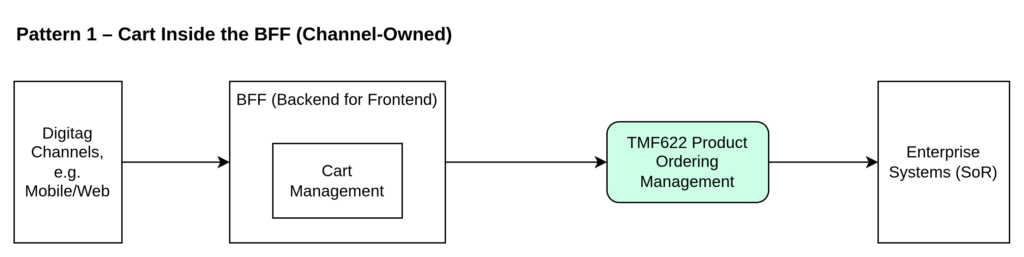
    Pattern 1 – Cart Inside the BFF (Channel-Owned)

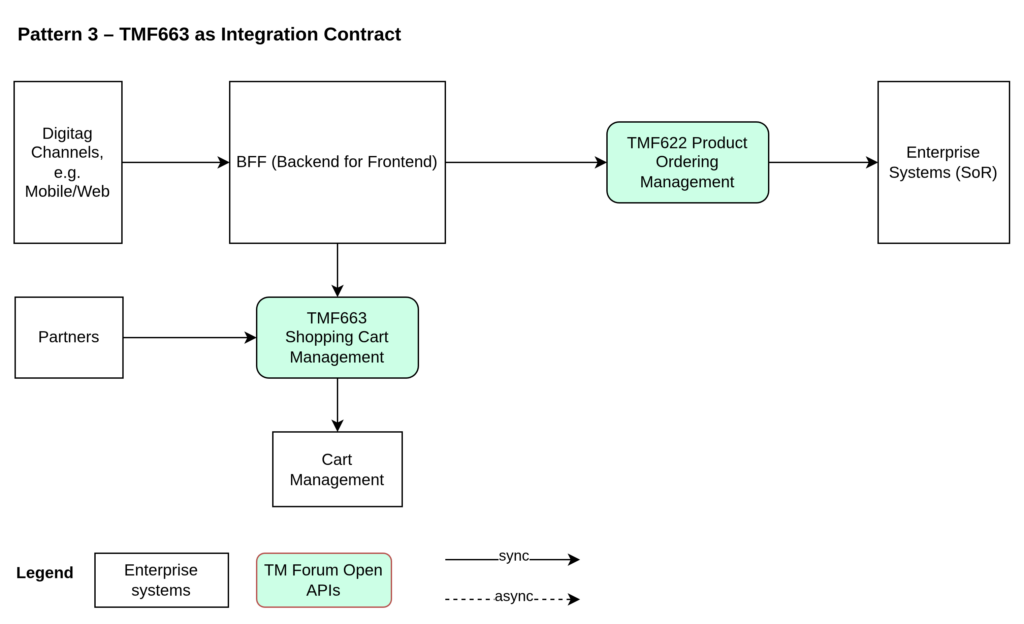
    TMF663 – Shopping Cart Management. Pattern 1 – Cart Inside the BFF (Channel-Owned).

    In this approach:

    • Digital Channels (e.g., Mobile/Web) interact directly with the BFF (Backend for Frontend).
    • Cart Management is implemented inside the BFF.
    • The BFF submits orders to TMF622 Product Ordering Management.
    • TMF622 integrates with Enterprise Systems (SoR).

    Architectural Characteristics

    In this pattern, the shopping cart is not a separate domain capability.
    It is embedded within the channel layer.

    The BFF is responsible for:

    • Managing cart state
    • Handling product configuration
    • Preparing the ProductOrder payload
    • Calling TMF622

    There is no reusable cart service outside the channel context.

    When It Fits

    • Single or tightly controlled digital channel
    • Minimal partner exposure
    • Strong UX ownership
    • Fast delivery priority

    Architectural Trade-Off

    Cart logic is tightly coupled to channel implementation.
    Reusability across channels or partners is limited.

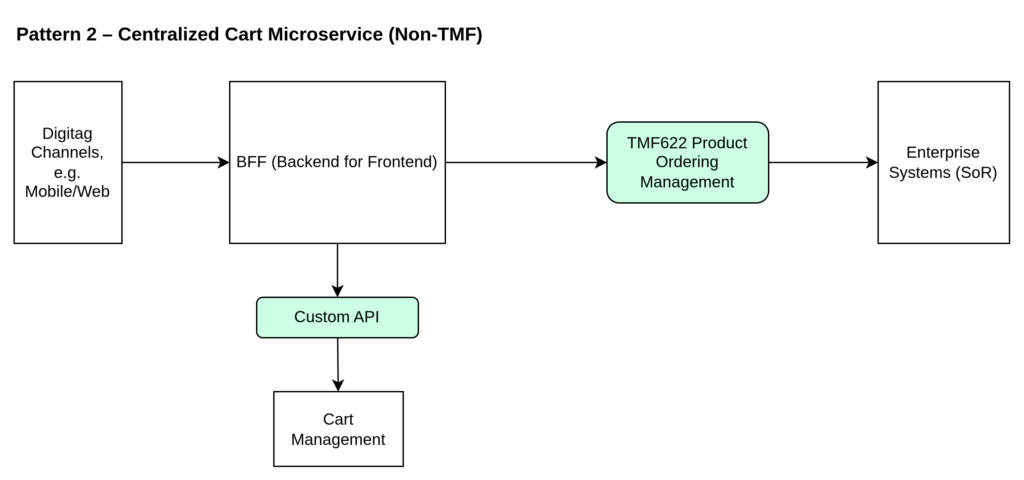
    Pattern 2 – Centralized Cart Microservice (Non-TMF)

    TMF663 – Shopping Cart Management. Pattern 2 – Centralized Cart Microservice (Non-TMF).

    Here, cart becomes:

    • Digital Channels interact with the BFF.
    • The BFF calls a Custom API.
    • That API exposes a centralized Cart Management service.
    • The cart service supports order submission via TMF622 Product Ordering Management.
    • TMF622 integrates with Enterprise Systems (SoR).

    Architectural Characteristics

    In this model, the cart becomes a domain-level microservice.

    Key aspects:

    • Cart logic is removed from the BFF.
    • Cart is exposed through a custom (non-TMF) API.
    • It can serve multiple channels.
    • It manages cart persistence independently of UX logic.

    The BFF orchestrates between channels and the cart service but does not own cart state.

    When It Fits

    • Multi-channel environments
    • Need for shared commercial intent
    • Internal domain reuse without ecosystem standardization
    • Organizations comfortable with custom API contracts

    Architectural Trade-Off

    While reusable, the API is proprietary.
    External integrations require mapping rather than native TMF compatibility.

    Pattern 3 – TMF663 as Integration Contract

    TMF663 – Shopping Cart Management. Pattern 3 – TMF663 as Integration Contract.

    In this model:

    • Digital Channels and Partners both interact with the BFF.
    • The BFF integrates with TMF663 Shopping Cart Management.
    • TMF663 represents a formalized cart boundary.
    • Orders are submitted to TMF622 Product Ordering Management.
    • TMF622 integrates with Enterprise Systems (SoR).

    Architectural Characteristics

    Here, the shopping cart becomes a standardized integration boundary.

    TMF663:

    • Exposes cart capabilities through a TM Forum Open API.
    • Enables partner access.
    • Decouples cart management from the channel layer.
    • Provides ecosystem-level interoperability.

    Cart logic is elevated from an internal capability to a commercial integration contract.

    When It Fits

    • Partner ecosystems
    • B2B2X models
    • Marketplace exposure
    • Multi-vendor architecture
    • Strategic TM Forum alignment

    Architectural Trade-Off

    This introduces additional abstraction and governance.
    It is justified when interoperability and ecosystem scalability are priorities.

    When TMF663 Makes Architectural Sense

    You likely need TMF663 if:

    • You operate multiple digital channels,
    • You integrate partners who must create carts,
    • You require persistent pre-order state across systems,
    • You want clear separation between UX logic and commercial domain.

    You probably don’t need TMF663 if:

    • You have one tightly controlled channel,
    • Cart is purely session-based,
    • No cross-domain reuse is required,
    • Simplicity is your primary driver.

    The Real Architectural Decision

    Shopping cart is not about APIs. It is about ownership of pre-order state.

    • If cart logic is deeply UX-driven and temporary, then channel ownership may be enough.
    • If cart represents shared commercial intent across systems, then domain ownership becomes necessary.

    TMF663 is valuable when the cart becomes a reusable commercial asset, not just a UI artifact.

    Common Anti-Patterns

    1. Implementing TMF663 but keeping cart logic inside BFF anyway.
    2. Treating cart as orchestration pre-stage.
    3. Embedding pricing and qualification rules inside cart service.
    4. Over-engineering cart for small digital contexts.

    Relationship to the Order Lifecycle

    In a well-structured order lifecycle, validation should happen before commercial intent is persisted.

    A cleaner lifecycle flow can be structured as follows:

    1. Perform Qualification
      Validate commercial and technical feasibility using:
      • TMF679 – Product Offering Qualification
      • TMF645 – Service Qualification
    2. Manage and Persist Commercial Intent
      Store and maintain the validated configuration in:
      • TMF663 – Shopping Cart Management (optional architectural boundary)
    3. Submit the Executable Order
      Create and submit a formal customer order through:
      • TMF622 – Product Ordering
    4. Orchestrate and Decompose the Order
      Coordinate fulfillment logic and manage order state within the Order Management domain
      (typically consuming TMF622 events and interacting with downstream APIs such as TMF641 where required)
    5. Activate and Provision Services
      Trigger technical fulfillment and manage service lifecycle using:
      • TMF641 – Service Ordering
      • TMF638 – Service Inventory

    In this model:

    • Qualification verifies commercial and technical feasibility first.
    • Only valid, sellable configurations are added to the cart.
    • The cart stores already qualified commercial intent.

    The formal order lifecycle begins only when a TMF622 ProductOrder is submitted. TMF663, if used, sits between qualification and order submission. Its purpose is to organize and persist validated intent – not to perform eligibility or orchestration logic. When designed this way, the cart becomes a clean transition layer. When qualification is skipped or deferred, the cart turns into a staging area for errors that will surface later in order management or activation.

    Conclusion

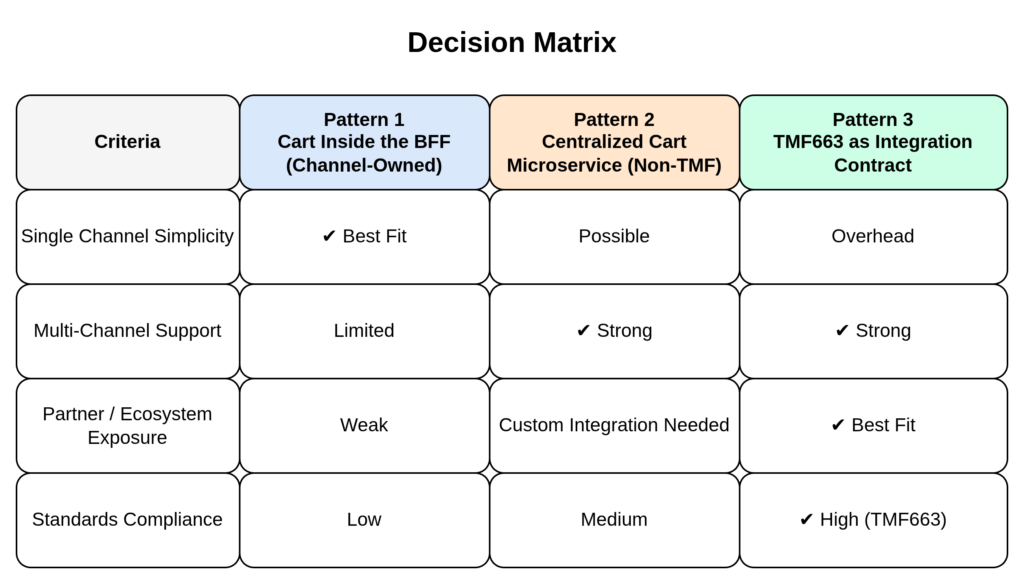
    TMF663 – Shopping Cart Management - Decision Matrix.

    There is no single “correct” way to structure shopping cart management.

    As we’ve seen, you can:

    • Keep the cart inside the digital channel,
    • Implement a dedicated domain cart service, or
    • Expose TMF663 as a standardized integration boundary.

    Each option is valid — depending on your scale, channel strategy, partner model, and architectural maturity.

    Now that you see the different patterns and trade-offs, the question is no longer “Do we need TMF663?”

    The real question becomes:

    Which option best fits your context, complexity, and long-term integration goals?

    Architecture is about making deliberate choices — not following standards blindly.

  • TMF Open APIs – Customer Order Capture

    From Qualification to ProductOrder

    Telecommunication architectures often struggle not with service activation or network execution, but with the very first step of the lifecycle: translating customer intent into a clean, valid order.

    Many transformation programs introduce complexity at this stage by tightly coupling digital channels to backend systems, embedding business rules inside frontends, or overloading orchestration platforms with responsibilities that belong to domain boundaries.

    This article explores a pragmatic approach to customer order capture using TM Forum Open APIs as stable integration contracts — focusing on how commercial validation, technical feasibility, and order submission can be implemented without creating architectural bottlenecks.

    The discussion builds on the master architecture presented in TM Forum Open APIs Without the Complexity Trap and focuses specifically on the capture layer.

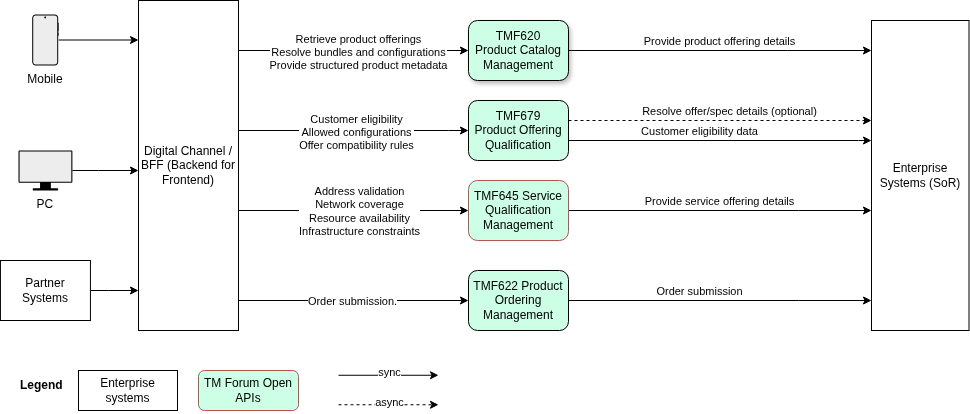
    Diagram 1 – Customer Order Capture Flow

    Customer Order Capture:
- TMF620 — Product Catalog Management
- TMF679 — Product Offering Qualification
- TMF645 — Service Qualification
- TMF622 — Product Ordering Management

    Architectural Scope

    This article focuses on the commercial entry point of the lifecycle — the transition from customer interaction to standardized product order submission.

    Core APIs covered:

    • TMF620 — Product Catalog Management
    • TMF679 — Product Offering Qualification
    • TMF645 — Service Qualification
    • TMF622 — Product Ordering Management

    These APIs represent the boundary between digital engagement and downstream operational domains.

    Key Architectural Principle

    TM Forum APIs should act as:

    • stable integration contracts
    • domain boundaries
    • interoperability interfaces

    They should NOT:

    • define internal data models
    • dictate orchestration logic
    • force digital channels to mirror backend complexity.

    The goal of customer order capture is simple:

    Produce a clean, validated ProductOrder representing commercial intent.

    Everything else belongs downstream.

    Engagement Layer — Digital Channel / BFF

    Customer interaction begins in digital channels:

    • Web portals
    • Mobile applications
    • Partner systems

    The BFF (Backend-for-Frontend) plays a crucial role:

    • Aggregates multiple backend APIs
    • Shields frontend from domain complexity
    • Maintains UX-specific workflows.

    However, a common anti-pattern is turning the BFF into a business logic engine.

    Pragmatic rule:

    Validation logic lives behind TMF APIs, not inside the channel.

    Product Discovery — TMF620 Product Catalog

    The lifecycle begins with browsing commercial offerings via TMF620.

    Responsibilities:

    • Retrieve product offerings
    • Resolve bundles and configurations
    • Provide structured product metadata.

    Architectural pattern:

    TMF620 often acts as an API facade over legacy catalog platforms.

    Benefits:

    • Stable contract for digital channels
    • Decoupling from catalog implementation
    • Incremental modernization possible.

    Important design choice:

    The catalog provides information — it does not validate eligibility.

    Commercial Qualification — TMF679 Product Offering Qualification

    Product Offering Qualification validates commercial constraints:

    • Customer eligibility
    • Allowed configurations
    • Offer compatibility rules.

    Typical inputs:

    • customerId
    • selected offering
    • requested characteristics.

    Typical outputs:

    • qualificationResult (qualified/notQualified)
    • validation messages
    • adjusted configuration suggestions.

    Common complexity trap:

    Embedding qualification logic inside order processing.

    Pragmatic approach:

    Qualification remains a separate validation boundary.

    This allows:

    • early failure detection
    • faster UX feedback
    • reduced orchestration complexity.

    Technical Feasibility — TMF645 Service Qualification

    One of the most important architectural separations is:

    Commercial validation ≠ Technical feasibility.

    TMF645 handles:

    • address validation
    • network coverage
    • resource availability
    • infrastructure constraints.

    Why separate?

    If technical feasibility is checked only during activation:

    • orders fail late
    • customer experience suffers
    • orchestration becomes complex.

    Using TMF645 early:

    • prevents invalid orders entering lifecycle
    • reduces downstream rework.

    Transition Boundary — TMF622 Product Ordering

    Once qualification is complete and customer confirms purchase, the digital channel submits a ProductOrder via TMF622.

    TMF622 acts as:

    The boundary between commercial intent and operational execution.

    Responsibilities:

    • Capture standardized commercial request
    • Provide initial acknowledgement
    • Hand ownership to order management domain.

    Key design goals:

    • ProductOrder payload should be minimal but complete.
    • Avoid embedding downstream execution details.

    Example conceptual structure:

    • orderItem
    • productOffering
    • customer reference
    • requested characteristics
    • relatedParty.

    Designing a Clean ProductOrder

    A pragmatic ProductOrder:

    • Represents what the customer wants, not how to execute it.

    Avoid:

    • technical resource details
    • network-specific parameters
    • service-level workflows.

    These belong to decomposition inside Order Management.

    Recommended practices:

    • include clear correlation identifiers
    • ensure idempotent submission
    • keep optional attributes truly optional.

    State Management at Capture Stage

    Typical lifecycle states after submission:

    • acknowledged
    • inProgress.

    Digital channels should:

    • rely on asynchronous updates rather than polling excessively.
    • treat TMF622 response as acceptance of intent, not completion.

    Common Anti-Patterns

    1. Fat BFF

    Embedding:

    • qualification logic
    • catalog rules
    • decomposition logic

    inside the channel layer.

    Result:

    • duplicated rules
    • inconsistent behavior.

    2. TMF-First Internal Modeling

    Designing internal microservices directly around TMF schemas.

    Result:

    • tight coupling
    • inflexible evolution.

    3. Central Workflow Engine Too Early

    Using external BPM tools to orchestrate order capture.

    Better:

    Simple capture triggers domain-owned orchestration later.

    Integration Pattern Summary

    Customer Order Capture architecture should:

    • Use TMF620 for discovery
    • Use TMF679 for commercial validation
    • Use TMF645 for technical feasibility
    • Submit via TMF622 as standardized boundary.

    This separation ensures:

    • early validation
    • cleaner orchestration downstream
    • reduced coupling.

    What’s Next

    This article focused on capturing commercial intent and producing a clean ProductOrder.

    In the next publications, we move inside the Customer Order Management domain and explore:

    • Product-to-service decomposition
    • State machines vs workflow engines
    • Asynchronous orchestration patterns
    • Handling partial fulfillment and failure scenarios
    • Updating Product Inventory (TMF637) from lifecycle events.
  • TMF Open APIs – Pragmatic Order Lifecycle Using TMF622 and TMF641

    The previous article introduced a pragmatic architectural approach for using TM Forum Open APIs as integration contracts rather than internal system models. While high-level architecture diagrams help clarify domain boundaries, the real complexity in telecom systems appears when commercial intent becomes operational execution — specifically within the order lifecycle.

    This article moves from architectural vision to practical execution. It describes how product orders progress through their lifecycle using TMF622 Product Ordering and TMF641 Service Ordering, demonstrating how orchestration can remain lightweight, domain-driven, and resilient without introducing unnecessary middleware complexity.

    The goal is not to describe TM Forum specifications themselves, but to show how they can be applied pragmatically in real enterprise environments.

    The Real Problem: Order Lifecycle Complexity

    Many telecom implementations encounter difficulty not because of TM Forum APIs, but because of architectural decisions around orchestration.

    Common patterns seen in real projects include:

    • Treating TMF622 as a central orchestration engine.
    • Introducing heavy workflow platforms controlling all lifecycle logic.
    • Tight coupling between ordering, inventory, and fulfillment systems through synchronous dependencies.
    • Modeling internal systems directly on TMF schemas.

    These approaches often lead to rigid architectures that are difficult to evolve and slow to deliver change.

    A pragmatic alternative is to treat TMF APIs as integration boundaries while keeping orchestration logic inside a domain-owned Order Management or Customer Order Management (COM) component.

    In this model:

    • TMF622 captures commercial intent.
    • Internal orchestration manages lifecycle progression.
    • TMF641 bridges commercial orders with technical fulfillment.
    • Asynchronous feedback drives state transitions.

    High-Level Order Lifecycle Flow

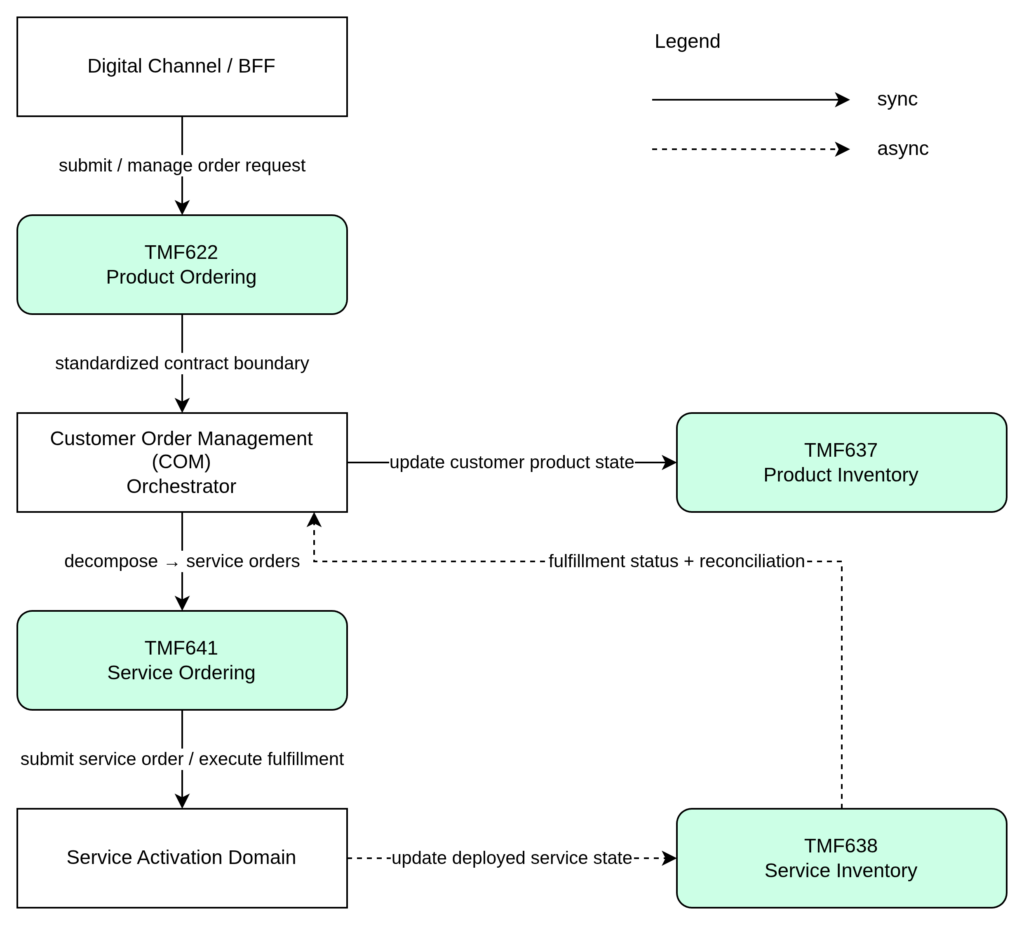
    Pragmatic Order Lifecycle Using TMF622 and TMF641

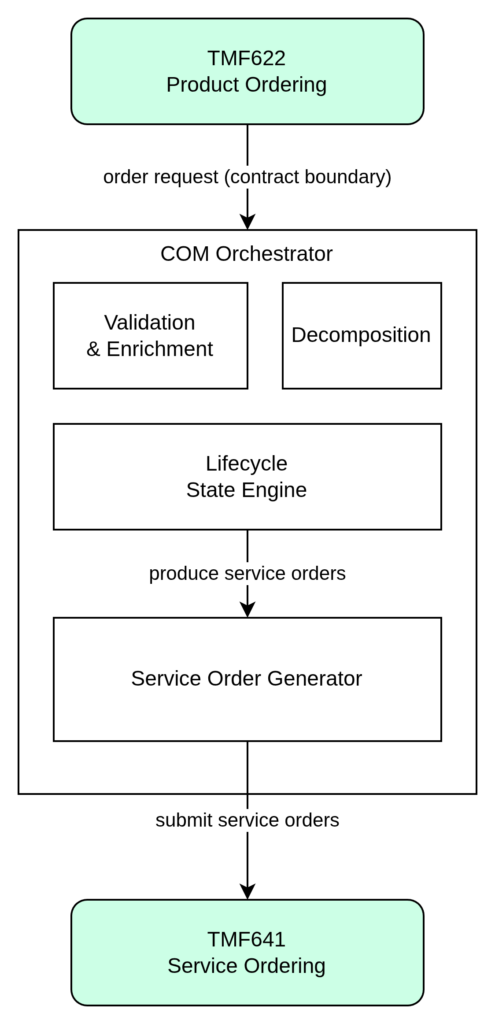
    The lifecycle begins when a customer submits a confirmed purchase through a digital channel. The request enters the system through TMF622 Product Ordering, which acts as a standardized boundary between commercial engagement and operational processing.

    Internally, the Customer Order Management System assumes responsibility for:

    • validating order context,
    • managing lifecycle state,
    • decomposing product orders into service-level actions,
    • coordinating fulfillment execution.

    Instead of executing orchestration inside TMF interfaces themselves, the COM operates as a domain service that interprets external contracts and manages internal workflows independently.

    The typical lifecycle stages include:

    1. Order capture through TMF622.
    2. Validation and enrichment.
    3. Product-to-service decomposition.
    4. Service order creation via TMF641.
    5. Fulfillment execution.
    6. Asynchronous feedback processing.
    7. Product and service inventory synchronization.

    This separation maintains architectural clarity: TMF APIs remain interoperability interfaces, while orchestration logic stays within the owning domain.

    Synchronous vs Asynchronous Interaction Strategy

    One of the most important architectural decisions involves determining which interactions should remain synchronous and which should become event-driven.

    In pragmatic telecom architectures:

    Synchronous interactions are used where immediate validation or deterministic responses are required, such as:

    • order submission,
    • qualification checks,
    • catalog queries.

    These operations benefit from predictable response patterns and straightforward transactional behavior.

    However, fulfillment execution and lifecycle progression are inherently long-running processes. Attempting to model them synchronously introduces fragility and operational risk.

    Therefore, asynchronous workflows should drive:

    • fulfillment status updates,
    • service activation progress,
    • inventory reconciliation,
    • order lifecycle transitions.

    Asynchronous feedback allows independent scaling of fulfillment components and reduces tight coupling between systems.

    Order Orchestration Without Overengineering

    Pragmatic Order Lifecycle Using TMF622 and TMF641

    A common misconception is that complex telecom order orchestration requires a centralized workflow engine controlling every step.

    While workflow platforms can provide visibility, they frequently become architectural bottlenecks:

    • forcing global coordination,
    • introducing additional operational layers,
    • making domain ownership unclear.

    A more pragmatic approach uses a domain-owned orchestrator inside the Customer Order Management layer.

    Key characteristics include:

    • lightweight state machines rather than monolithic workflows,
    • event-driven state transitions,
    • clear ownership of lifecycle progression.

    The orchestrator reacts to events such as:

    • service activation completion,
    • fulfillment failure notifications,
    • inventory updates.

    This pattern enables flexibility while maintaining clear domain responsibility.

    Data Model Boundaries and Anti-Corruption Layers

    Pragmatic Order Lifecycle Using TMF622 and TMF641

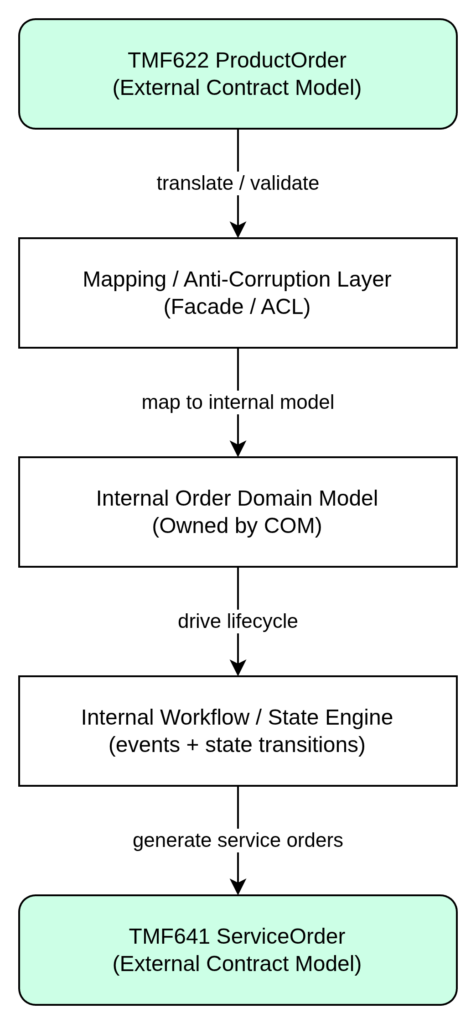
    Another critical design principle is maintaining separation between external TMF models and internal domain representations.

    TMF data structures define integration contracts between systems. They should not automatically dictate internal modeling.

    Instead:

    • TMF622 represents the external product order contract.
    • The COM translates this structure into internal order representations.
    • TMF641 service orders are generated from internal models.
    • Inventory updates are mapped back into standardized interfaces.

    This anti-corruption approach protects internal services from schema drift and prevents cascading changes across domains when specifications evolve.

    Inventory Synchronization and Lifecycle Authority

    In this architecture, service inventory and product inventory play distinct roles.

    TMF638 Service Inventory represents operational reality — the authoritative record of deployed technical services.

    Fulfillment systems update service inventory as activation progresses.

    These updates flow asynchronously back to the COM, where they serve two purposes:

    • advancing order lifecycle state,
    • enabling reconciliation between expected and actual deployment.

    Once service deployment reaches a stable state, the COM updates TMF637 Product Inventory to reflect customer-facing subscription state.

    Separating technical reality from commercial representation avoids coupling operational systems directly to customer-facing domains.

    Common Architecture Mistakes

    Several recurring anti-patterns appear in telecom transformations:

    • Using TMF622 as a workflow engine rather than an integration boundary.
    • Introducing synchronous dependencies on inventory during fulfillment.
    • Embedding qualification logic inside ordering flows.
    • Modeling internal services directly around TMF schemas.

    These decisions increase complexity and reduce flexibility over time.

    A pragmatic architecture instead prioritizes domain ownership, asynchronous lifecycle management, and contract-based integration.

    Conclusion

    The order lifecycle represents the transition from commercial intent to operational execution — and therefore is where integration architecture decisions have the greatest impact.

    By treating TM Forum Open APIs as stable integration contracts and placing orchestration responsibility inside a domain-owned order management layer, organizations can achieve:

    • reduced coupling,
    • improved resilience,
    • clearer ownership boundaries,
    • and incremental evolution of legacy environments.

    This approach allows teams to leverage TMF standards without introducing unnecessary architectural complexity.

    What’s Next

    This article focused on the high-level lifecycle and orchestration approach. In the next publications, we will dive deeper into detailed execution flows, including:

    • asynchronous event-driven lifecycle patterns,
    • practical request/response sequences,
    • data model mappings between TMF contracts and internal domains,
    • and reconciliation logic between service and product inventory.
  • TMF Open APIs Without the Complexity Trap

    Pragmatic Integration Patterns Using TMF620, TMF679, TMF622, TMF637, TMF641, TMF633, TMF645 and TMF638

    Telecommunication architectures increasingly adopt TM Forum Open APIs to standardize integration across OSS/BSS ecosystems. These APIs provide a shared semantic language that enables interoperability between systems from different vendors and internal domains.

    However, real-world implementations often struggle — not because of the APIs themselves, but because of how they are applied architecturally. Many organizations introduce unnecessary complexity: heavy middleware layers, rigid orchestration engines, or “TMF-first” internal modeling that couples everything to standard schemas and slows delivery.

    This article presents a set of pragmatic integration prototypes demonstrating how core TM Forum APIs can be used effectively as stable integration contracts, while avoiding common complexity traps. The goal is to show an approach that is realistic for enterprise landscapes, but still incremental and maintainable.

    The prototypes focus on the following APIs:

    • TMF620 Product Catalog Management
    • TMF679 Product Offering Qualification
    • TMF622 Product Ordering Management
    • TMF637 Product Inventory Management
    • TMF641 Service Ordering Management
    • TMF633 Service Catalog Management
    • TMF645 Service Qualification Management
    • TMF638 Service Inventory Management

    Together, these APIs cover a complete lifecycle from product discovery and qualification, through ordering and orchestration, to fulfillment and operational tracking.

    Architectural principles

    Before exploring specific patterns, it is important to clarify the architectural perspective used in these prototypes.

    TM Forum APIs should be treated as:

    • stable integration contracts
    • domain boundaries between systems
    • interoperability interfaces

    They should not automatically define internal architecture, internal data models, or orchestration strategy.

    The core principles applied here:

    • Use TMF APIs as integration boundaries rather than internal models.
    • Implement TMF APIs as API facades / anti-corruption layers when integrating legacy or vendor systems.
    • Keep orchestration inside a domain-owned Order Management / Orchestrator (COM) rather than in external workflow platforms by default.
    • Combine synchronous APIs at the boundaries with asynchronous lifecycle feedback where it improves resilience and decoupling.
    • Support incremental modernization rather than big-bang transformations.

    In practice, many telecom transformations fail when TM Forum APIs are treated as architectural frameworks rather than interoperability contracts.

    End-to-End flow overview

    To understand how these TM Forum Open APIs work together in a pragmatic integration architecture, it is useful to examine the complete lifecycle from customer interaction to operational service state.

    Rather than presenting TMF APIs as isolated endpoints, this architecture shows how they form a set of integration contracts between clearly separated domains: digital engagement, commercial management, order orchestration, and service fulfillment.

    The goal is not to prescribe a rigid framework, but to illustrate how standardized APIs can be combined into a coherent flow while preserving domain autonomy and minimizing coupling between systems.

    Several important design choices shape this architecture:

    • Digital channels interact only with stable TMF contracts rather than internal system implementations.
    • Qualification is separated into commercial validation (product offering qualification) and technical feasibility (service qualification), preventing late-stage failures during fulfillment.
    • Product ordering defines the boundary between commercial intent and operational execution.
    • A domain-owned order management system performs orchestration, avoiding centralized integration bottlenecks.
    • Operational reality is reflected through service and product inventories, enabling lifecycle tracking and reconciliation.

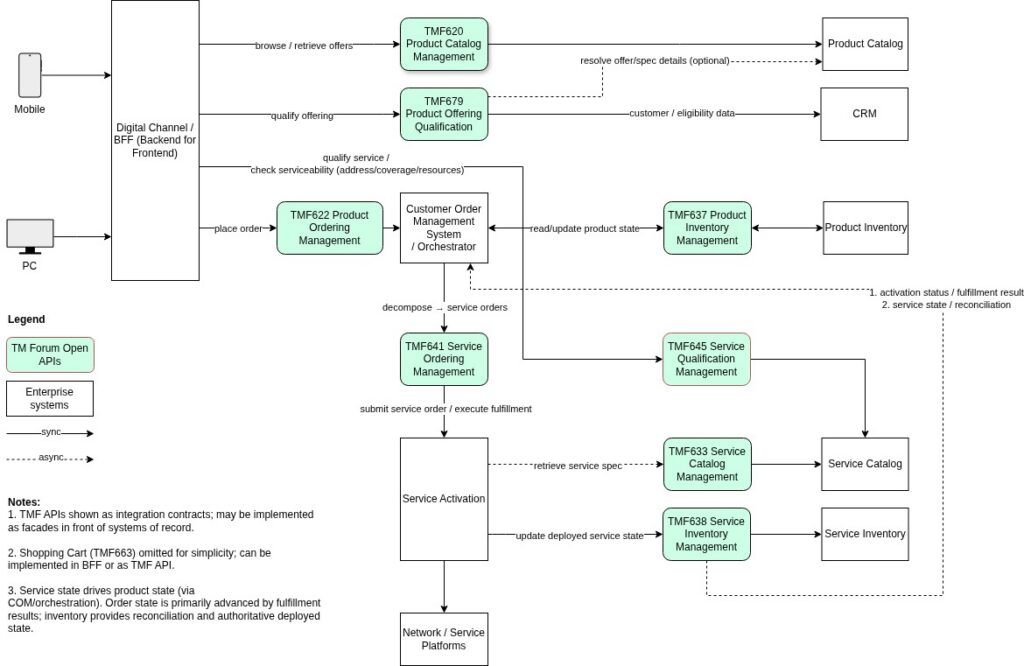
    The diagram below presents a high-level view of this lifecycle, emphasizing architectural responsibilities rather than implementation details.

    Pragmatic Integration Patterns Using TMF620, TMF679, TMF622, TMF637, TMF641, TMF633, TMF645 and TMF638:
- TMF620 Product Catalog Management
- TMF679 Product Offering Qualification
- TMF622 Product Ordering Management
- TMF637 Product Inventory Management
- TMF641 Service Ordering Management
- TMF633 Service Catalog Management
- TMF645 Service Qualification Management
- TMF638 Service Inventory Management

    The lifecycle begins in a Digital Channel / BFF (Backend-for-Frontend). The BFF performs synchronous interactions with commerce-facing APIs:

    • TMF620 Product Catalog is used to browse and retrieve commercial offerings.
    • TMF679 Product Offering Qualification validates eligibility and configuration constraints for the selected offering. In some implementations, qualification may require resolving offer/spec details from the catalog — this is treated as an optional supporting lookup, not a mandatory dependency.
    • TMF645 Service Qualification checks serviceability (address / coverage / resource constraints). This keeps “can we technically deliver this?” separate from “is this product commercially valid?”, reducing hidden coupling and late-order failures.

    Once the customer confirms the purchase, the channel submits the request via TMF622 Product Ordering. This API acts as a key architectural boundary: it captures commercial intent using a standardized contract, while shielding downstream systems from channel-specific variations.

    Behind TMF622 sits the Customer Order Management System / Orchestrator (COM). The COM owns the order lifecycle and orchestration logic and is responsible for decomposing a product order into service-level actions. The COM then triggers fulfillment through TMF641 Service Ordering.

    Service activation executes the service order using underlying network/service platforms. During execution, the activation domain may retrieve service specifications via TMF633 Service Catalog, and it updates operational reality via TMF638 Service Inventory, which represents the authoritative record of deployed service state.

    A critical part of the lifecycle is feedback and reconciliation. Fulfillment results and service state updates flow back asynchronously to the COM to advance and complete order state:

    • activation status / fulfillment result (primary driver of order progression)
    • service state / reconciliation (authoritative deployed state used for alignment and correction)

    The COM then updates TMF637 Product Inventory, keeping responsibilities separated:
    service inventory reflects deployed technical reality, while product inventory reflects customer-facing product/subscription state.

    Note: Shopping Cart (TMF663) is omitted for simplicity in this diagram. It can be implemented inside the BFF (internal cart) or exposed as a separate TMF API depending on the channel strategy.

    What’s next

    The purpose of this publication is to establish the architecture and integration patterns without drowning in specification-level detail. In the next publications, I will describe the detailed flows and state transitions per step — including practical examples of request/response sequences, event-driven feedback, and data model mappings (qualification inputs, order decomposition outputs, inventory updates, and reconciliation logic).