Customer Order Management Domain Design & Orchestration with TMF622, TMF641, and TMF637
In the previous article, we examined how customer intent is captured and validated before being submitted as a standardized ProductOrder via TMF622. Now we move into the most critical domain of the lifecycle: Customer Order Management (COM).
Customer Order Management (COM) is where commercial intent is translated into technical execution. Done well, it keeps orchestration logic transparent, systems decoupled, and order state reliable. Done poorly — whether by becoming an ESB, a BPM monolith, or a thin pass-through — it becomes the bottleneck that breaks every large-scale telecom BSS deployment.
This article demonstrates how TMF622, TMF641, and TMF637 can be used in a pragmatic, domain-owned orchestration model — and explains the design decisions behind each choice.
The Role of Customer Order Management
Customer Order Management is frequently misunderstood. Its scope is often either too narrow (a simple API proxy) or too broad (a central workflow engine). Neither works at scale.
| COM is NOT… | COM IS… |
| A simple pass-through integration layer | Owns the order lifecycle state |
| A centralized ESB routing all messages | Contains decomposition logic |
| A BPM monolith with complex workflows | Governs orchestration and coordination rules |
| A proxy that only exposes TMF schemas | Handles failures and exception recovery |
| Correlates fulfillment feedback and events |
The distinction matters architecturally: COM owns behavior, not infrastructure. It does not route messages between systems — it governs how an order progresses through its lifecycle.
Architectural Boundary Recap
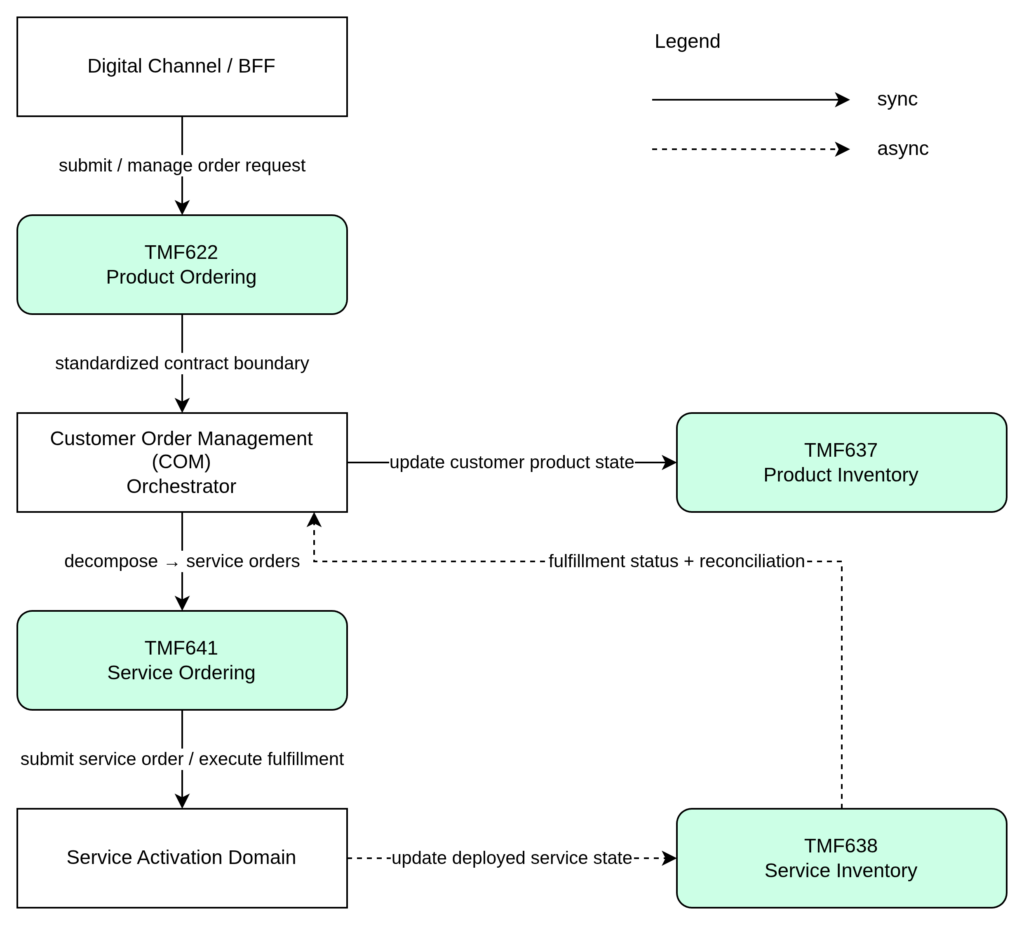
COM sits between the commercial and technical domains, acting as the translation and orchestration layer:
- Upstream — TMF622 Product Ordering captures commercial intent (what the customer bought)
- Downstream — TMF641 Service Ordering triggers technical execution (how it gets built)
- Downstream — TMF637 Product Inventory reflects the customer-facing subscription state
| Key Principle TM Forum Open APIs define the integration contracts between systems. Customer Order Management defines the lifecycle behavior — how orders progress, decompose, and react to fulfillment outcomes. These are separate concerns. Do not conflate the schema with the behavior. |
From Product Order to Service Orders
What a ProductOrder Represents
A ProductOrder captures what a customer wants to buy — not how it gets delivered. It records the commercial agreement: which products or services were requested, at what price, under what terms, and by when.
For example, a ProductOrder might express: „Customer A wants 3 units of Fiber 1Gbps service, billed monthly, starting June 1“ — but it says nothing about which router will carry the traffic, which platform will host the service, or what provisioning steps engineers must follow.
| A ProductOrder DOES represent… | A ProductOrder does NOT represent… |
| Commercial intent | Network topology or routing decisions |
| Customer-agreed products and terms | Service platform configuration |
| Requested start dates and pricing | Provisioning steps or activation sequences |
| Order-level identity and correlation ID | Technical resource allocation |
In short: a ProductOrder answers „what was sold and agreed upon“ — not „how do we build or activate it.“ The downstream technical concerns belong to separate domains and are expressed through TMF641 ServiceOrders.
Order Decomposition
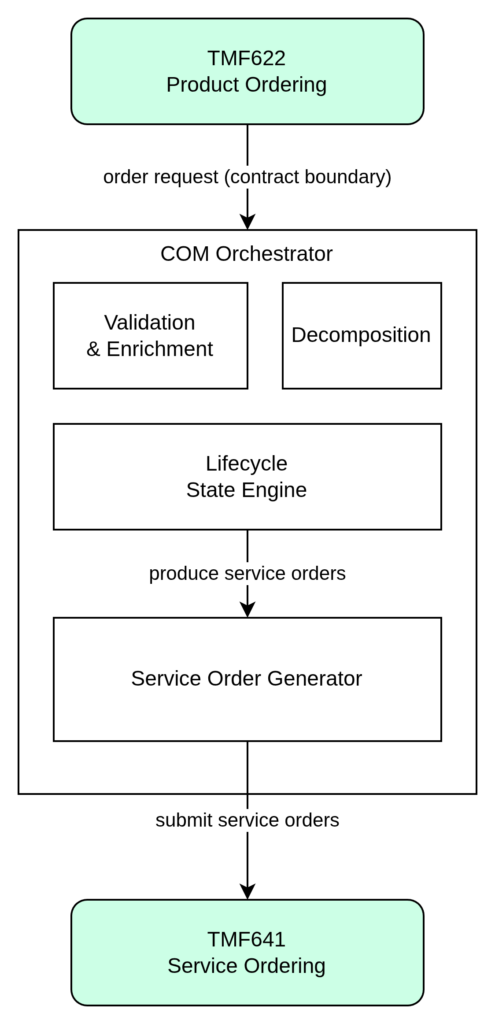
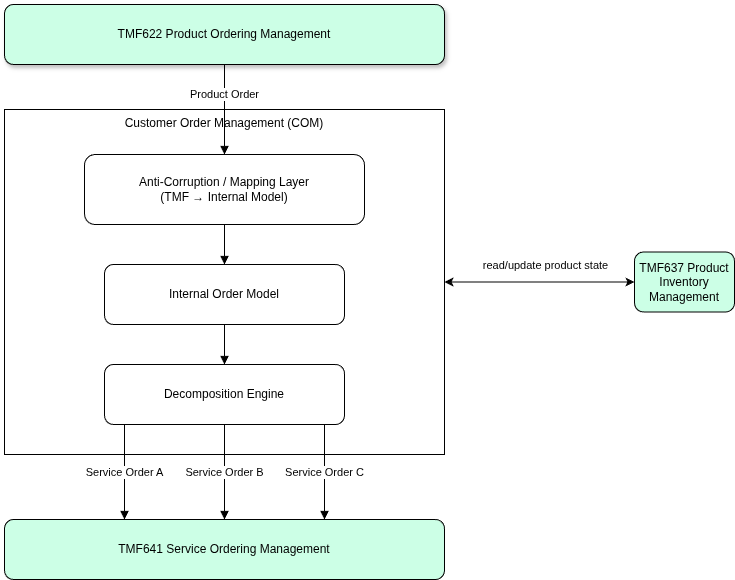
Inside COM, the ProductOrder must be decomposed into one or more ServiceOrders (TMF641). A single commercial product often requires multiple independent service activations:
| Example: ProductOrder — „Business Fiber + Static IP + Managed Router“ Decomposes into: • Access service order (fiber circuit provisioning) • IP configuration service order (static IP assignment) • CPE provisioning service order (managed router configuration) |
This decomposition must be:
- Deterministic — the same ProductOrder always produces the same set of ServiceOrders
- Version-aware — decomposition rules must account for product catalog changes over time
- Idempotent — reprocessing an order due to failure must not create duplicate ServiceOrders
Decomposition as Domain Logic
Decomposition logic belongs inside COM, not in integration layers or external workflow engines. It should:
- Use product-to-service mapping rules defined within the domain
- Operate on internal domain models, not directly on TMF JSON structures
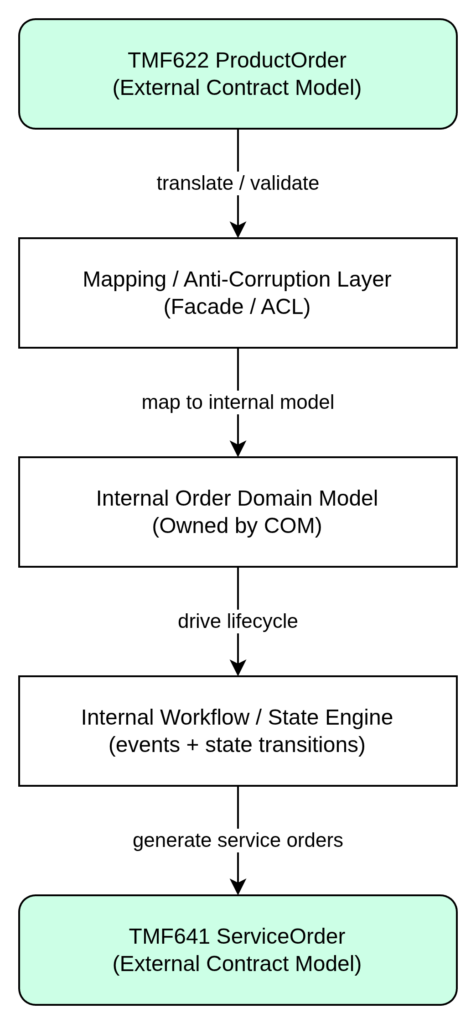
- Be isolated from external API schema changes through an Anti-Corruption Layer (ACL)
The recommended mapping approach is a five-stage pipeline:
| Step | Stage | Description |
| 1 | Receive | Accept TMF622 ProductOrder as the external integration contract |
| 2 | ACL Transform | Decouple the TMF schema from internal models via an Anti-Corruption Layer |
| 3 | Domain Mapping | Map to the internal Order domain model used by the Order Management system |
| 4 | Decomposition | Execute the Order Decomposition Engine to generate technical fulfillment actions |
| 5 | Submission | Generate and submit TMF641 ServiceOrder requests to downstream systems |
This approach avoids the anti-pattern of designing the entire system around TMF JSON structures — a trap that makes internal logic brittle whenever the external API evolves.
Orchestration Without a Monolith
One of the most common architectural traps in telecom implementations is introducing a centralized BPM or workflow engine that gradually absorbs the entire order lifecycle. These systems tend to:
- Embed complex orchestration logic in large, opaque workflow definitions
- Own state management in a way that makes external observation difficult
- Become performance and change bottlenecks as order volumes grow
A more pragmatic alternative is state-machine-based, event-driven orchestration. Instead of a visual workflow engine, implement orchestration using:
- An explicit Order State Machine that governs lifecycle transitions
- Domain events that communicate progress and trigger next actions
- Clear, testable transition rules that define how the order moves between states
Order Lifecycle State Machine
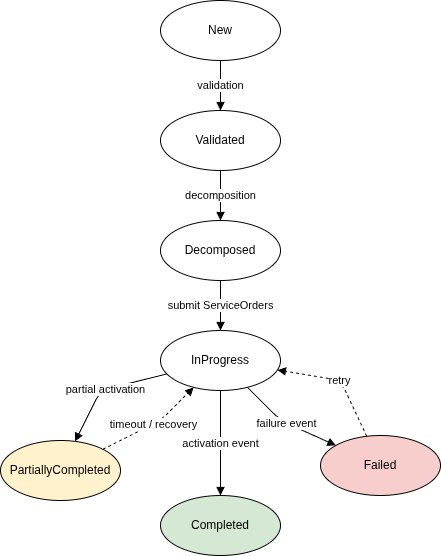
The order lifecycle moves through the following states, each triggered by specific operational events:
| State | Trigger Event | Next Action |
| Validated | Order accepted and validated | Begin decomposition |
| Decomposed | ServiceOrders generated | Submit to TMF641 |
| InProgress | At least one ServiceOrder submitted | Await fulfillment events |
| PartiallyCompleted | Some components succeeded, some pending/failed | Evaluate retry or compensation |
| Completed | All components succeeded | Update Product Inventory (TMF637) |
| Failed | Unrecoverable failure across components | Trigger compensation / notify upstream |
| Why State Machines Over Workflow Engines? Transparent — the current state and permitted transitions are always visible and auditable Testable — each transition rule can be validated independently, without running a full workflow Scalable — state is explicit data; it scales horizontally without centralized orchestration bottlenecks |
Handling Asynchronous Feedback
Service execution rarely completes synchronously. After COM submits ServiceOrders via TMF641, fulfillment systems process requests and return status updates asynchronously. COM must be designed to handle this correctly.
What COM Receives
Typical asynchronous status updates from fulfillment systems include:
- inProgress — fulfillment has started but is not yet complete
- completed — the service component was successfully activated
- failed — activation failed, with error context
- partialActivation — some sub-components succeeded, others did not
How COM Must Respond
For each incoming event, COM must:
- Correlate the feedback message with the correct orderItem using the correlation ID
- Update the internal order state based on the outcome
- Evaluate whether the overall ProductOrder can advance to the next lifecycle stage
| Design Principle Order state progression must be driven by actual fulfillment outcomes — not by the immediate response of synchronous API calls. A 200 OK from TMF641 means the ServiceOrder was accepted, not that the service was activated. |
Partial Failures and Recovery
In real-world fulfillment, not all service components succeed simultaneously. One component may complete while another fails due to a resource shortage, a downstream timeout, or a configuration conflict. COM must have a defined recovery strategy for each scenario.
Recovery Options
| Strategy | When to Use | Key Consideration |
| Retry | Transient failure (timeout, resource temporarily unavailable) | Use explicit retry counters to prevent infinite loops |
| Compensate | Partial success where completed steps must be undone | Compensation logic must be defined per service type |
| Roll back | Critical failure where no partial state is acceptable | Ensure rollback is idempotent and auditable |
| Mark PartiallyCompleted | Some components are acceptable without others (by business rule) | Requires explicit product catalog guidance on optionality |
| Recommended Approach Keep retry logic inside the domain layer, where business rules are well understood. Avoid embedding retry behavior in external workflow or orchestration platforms. Maintain explicit retry counters. Unbounded retries are an operational risk, not a safety net. |
Product Inventory Update — TMF637
Once fulfillment reaches a stable state, COM updates the Product Inventory using TMF637. A critical architectural principle governs this step: product and service inventories must remain separate.
- TMF638 Service Inventory reflects technical service reality in the network and platforms
- TMF637 Product Inventory represents the customer-facing subscription state
COM acts as the translation and alignment layer between these two domains. It maps service states to product states and triggers reconciliation if mismatches occur.
State Mapping
| TMF641 Service State | TMF637 Product State | Notes |
| completed | active | All components fulfilled; customer-visible |
| suspended | suspended | Service paused; subscription retained |
| failed | pendingTermination or failed | Business rule governs customer notification |
| partialActivation | pendingActive | Awaiting remaining components; not yet customer-visible |
| terminated | terminated | Service decommissioned; subscription closed |
This mapping ensures that customer-visible subscription status accurately reflects the underlying service activation state, while preserving the domain separation between service operations and product lifecycle management.
Synchronous vs Asynchronous Interactions
In order management architecture, it is critical to clearly separate synchronous API interactions from asynchronous operational feedback. Conflating the two leads to brittle, blocking systems that fail unpredictably at scale.
Synchronous Interactions — Request Acceptance
Synchronous calls are used for request submission and immediate validation. They confirm that a request has been received and is structurally valid — but they do not guarantee fulfillment.
- Submission of customer orders via TMF622 Product Order
- Creation of service fulfillment requests via TMF641 Service Order
| What a synchronous response guarantees: • The request is structurally valid • It has been accepted for processing • Processing has started What it does NOT guarantee: fulfillment completion. Long-running fulfillment activities must never block synchronous API calls. |
Asynchronous Interactions — Fulfillment Feedback
Actual service fulfillment occurs asynchronously across multiple downstream systems. These systems emit events or callbacks that COM must process to advance the order lifecycle:
- Service activation progress and completion updates
- Failure notifications from fulfillment systems
- Inventory reconciliation events from TMF638 or TMF637
Why This Separation Matters
| Benefit | Explanation |
| Resilience | Failures in fulfillment systems do not block or degrade API responses |
| Scalability | Long-running operations are handled through events rather than blocking threads |
| Transparency | Order state progression is driven by real fulfillment outcomes, not API latency |
| Loose Coupling | Upstream systems are not tightly bound to downstream execution timing |
Avoiding Common Anti-Patterns
1. COM as an ESB
COM must not become a routing hub for all integrations. It owns order lifecycle state and decomposition logic — nothing more. When COM starts routing messages between unrelated systems, it accumulates accidental complexity and becomes a single point of failure.
2. Deep Coupling to TMF Models
Internal state machines and domain logic must not depend directly on TMF JSON structures. External schemas change with API versions. An Anti-Corruption Layer decouples the external contract from the internal model, allowing both to evolve independently.
3. Centralized Workflow for Everything
Not every step in the order lifecycle requires BPM modeling. Many telecom fulfillment flows are predictable, rule-driven, and state-based. Introducing a visual workflow engine for these flows adds operational overhead without architectural benefit. Start with a state machine; escalate to a workflow engine only when the complexity genuinely demands it.
Integration Pattern Summary
When implemented correctly, Customer Order Management is a domain-focused orchestrator — not a middleware platform. It keeps orchestration complexity contained, treats TMF APIs as integration boundaries rather than internal data models, and produces systems that remain evolvable as products and technology change.
COM should:
- Own lifecycle state — no external system should drive order progression
- Decompose ProductOrders deterministically and idempotently
- Trigger ServiceOrders via TMF641 and treat the response as acceptance, not completion
- Process asynchronous fulfillment events to drive state transitions
- Update Product Inventory via TMF637 only after reaching a stable fulfillment state
- Remain domain-focused — integration routing belongs elsewhere
When these principles hold:
- Orchestration complexity is contained within a single, observable domain
- TMF APIs remain clean integration boundaries, not architectural foundations
- Systems remain independently deployable and evolvable
What’s Next
In the next article, we move into the Service Activation domain and explore how technical execution is handled once COM has submitted its ServiceOrders:
- TMF641 execution patterns and state management
- The role of TMF633 Service Catalog in driving activation logic
- TMF638 Service Inventory as the authoritative deployed state
- Reconciliation strategies for handling drift between network reality and customer product state