Kategorie: Chatbots

All about chatbots

  • AI Agent vs. Classic Chatbot

    Business Automation · KMU-Guide

    AI Agent vs. Classic Chatbot

    Welche Technologie passt zu welchem Geschäftsprozess – und wie treffen Sie die richtige Entscheidung?

    📅 Juni 2026  ·  ⏱ 6 Min. Lesezeit  ·  🏷 Automatisierung · KI · Entscheidungshilfe

    Automatisierung als Wettbewerbsvorteil

    Der Druck auf Unternehmen, effizienter zu arbeiten, steigt – gleichzeitig wachsen die Möglichkeiten, repetitive Arbeit zu automatisieren. Zwei Technologien stehen dabei derzeit im Mittelpunkt: klassische Chatbots und KI-Agenten.

    Ob Kundensupport, interne Helpdesks, Vertriebsunterstützung oder komplexe Datenprozesse – digitale Assistenten übernehmen heute Aufgaben, die früher ausschließlich menschliche Mitarbeiter erledigten. Für Unternehmen im DACH-Raum stellt sich dabei eine entscheidende Frage: Welche Technologie löst mein konkretes Problem am besten?

    Die Antwort ist nicht immer offensichtlich. Ein klassischer Chatbot und ein KI-Agent sehen von außen ähnlich aus – beide beantworten Fragen, beide kommunizieren in natürlicher Sprache. Doch unter der Haube unterscheiden sie sich grundlegend in Intelligenz, Flexibilität und Einsatzbereich.

    💡

    Kurz vorab: Die „richtige“ Technologie hängt nicht vom Budget ab, sondern vom Anwendungsfall. Dieser Artikel hilft Ihnen, den passenden Weg zu finden – mit klaren Definitionen, Praxisbeispielen und einer Entscheidungsmatrix.


    Was ist was? Definitionen und Kernunterschied

    Klassischer Chatbot

    Regelbasierter Dialog-Assistent

    Ein Chatbot folgt vordefinierten Gesprächsabläufen (Flows) oder nutzt NLP, um Nutzereingaben zu klassifizieren und passende Antworten auszuliefern. Er arbeitet innerhalb eines festen Regelwerks und eskaliert bei unbekannten Anfragen an einen Menschen.

    KI-Agent

    Autonomes, handelndes System

    Ein KI-Agent analysiert Ziele, plant eigenständig Schritte, ruft externe Tools und APIs auf und trifft Entscheidungen – ohne jeden Schritt vorab im Code abzubilden. Er lernt aus dem Kontext und passt sein Vorgehen dynamisch an.

    Der wesentliche Unterschied liegt in der Entscheidungslogik: Ein Chatbot wählt aus vorbereiteten Optionen. Ein KI-Agent denkt sein Vorgehen im Moment der Anfrage. Das klingt nach einem graduellen Unterschied – hat aber enorme Auswirkungen auf Aufbau, Wartung und Einsatzbereich.

    MerkmalKlassischer ChatbotKI-Agent
    EntscheidungslogikRegelbasiert / NLP-KlassifikationLLM-gestützt, situativ
    Tool-NutzungBegrenzt, vorher definiertDynamisch, beliebige APIs
    Anpassung an neue FragenErfordert manuelles UpdateAutomatisch durch Kontext
    Gedächtnis / KontextInnerhalb einer SessionSitzungsübergreifend möglich
    ImplementierungsaufwandGering bis mittelMittel bis hoch
    Transparenz / KontrolleSehr hochBedingt (Monitoring nötig)
    BetriebskostenNiedrigHöher (LLM-Token, Infra)

    Wann ein klassischer Chatbot die richtige Wahl ist

    Chatbots glänzen überall dort, wo Prozesse strukturiert und vorhersehbar sind. Wenn Sie genau wissen, welche Fragen Nutzer stellen werden, und klare Antworten darauf haben, ist ein Chatbot die effizienteste Lösung: günstig im Betrieb, zuverlässig in der Ausgabe, leicht wartbar.

    FAQ & Kundensupport-Automatisierung
    Wiederkehrende Fragen zu Öffnungszeiten, Preisen, Produkten oder Lieferzeiten – der Chatbot liefert konsistente Antworten rund um die Uhr, ohne Wartezeit.

    📋

    Lead-Qualifizierung & Ersterfassung
    Interessenten werden strukturiert durch eine Reihe von Fragen geführt. Das System erfasst Kontaktdaten, Budget und Bedarf – und übergibt qualifizierte Leads an den Vertrieb.

    📅

    Terminbuchung & Reservierungen
    Geführte Buchungsprozesse (z. B. Arztpraxis, Dienstleister, Gastronomie) mit Kalenderintegration laufen vollautomatisch und entlasten das Frontoffice spürbar.

    🏢

    Interner Helpdesk / IT-Support (Tier 1)
    Password-Resets, Onboarding-Checklisten, Gerätebestellungen – standardisierte Abläufe, die Mitarbeitende bisher per E-Mail oder Ticketformular angestoßen haben.

    📦

    Bestell- und Statusabfragen
    Integration in CRM oder Shop-System: Kunden erhalten Lieferstatus, Rechnungskopien oder können einfache Stornierungen auslösen – ohne Agentenkontakt.

    🌍

    Mehrsprachiger Kundenservice
    Chatbots können parallel in Deutsch, Englisch, Französisch und weiteren Sprachen antworten – ohne Mehraufwand im Team.

    Faustregel: Können Sie den Großteil der erwarteten Anfragen in einem FAQ-Dokument mit 30–50 Einträgen abbilden? Dann ist ein Chatbot wahrscheinlich die wirtschaftlichste Lösung.


    Wann ein KI-Agent die richtige Wahl ist

    KI-Agenten sind sinnvoll, wenn Prozesse variabel, mehrstufig oder stark kontextabhängig sind – also überall dort, wo ein Chatbot-Flow zu schnell an seine Grenzen stößt. Der Agent kombiniert mehrere Datenquellen, hält Ziele im Blick und handelt selbstständig.

    🔍

    Komplexe Kundenanfragen mit Systemzugriff
    Der Agent ruft Kundendaten aus dem CRM ab, prüft Vertragsstatus und Produktkonfiguration, und gibt eine individuell zugeschnittene Antwort – in einem einzigen Gespräch.

    ⚙️

    Mehrstufige Geschäftsprozesse
    Automatisierung von Abläufen, die mehrere Systeme betreffen: z. B. Angebot erstellen → CRM aktualisieren → E-Mail versenden → Kalender-Termin anlegen – alles auf einmal.

    📊

    Forschungs- und Rechercheaufgaben
    Marktrecherchen, Wettbewerbsanalysen oder Due-Diligence-Zusammenfassungen: Der Agent durchsucht strukturierte und unstrukturierte Quellen und erstellt einen kompakten Bericht.

    🤝

    Vertriebsunterstützung & Angebotserstellung
    Anhand von Kundenprofil, Gesprächshistorie und Produktkatalog generiert der Agent individualisierte Angebote oder Gesprächsleitfäden für den Vertrieb.

    🔄

    Intelligente Prozess-Automatisierung (IPA)
    Dort wo RPA-Tools (Robotic Process Automation) an UI-Änderungen scheitern, navigiert ein KI-Agent kontextbasiert – robust gegenüber wechselnden Oberflächen.

    📁

    Dokumentenverarbeitung & Datenextraktion
    Rechnungen, Verträge oder Formulare werden gelesen, klassifiziert und Schlüsseldaten in nachgelagerte Systeme übertragen – vollautomatisch, auch bei variablen Layouts.

    ⚠️

    Wichtig: KI-Agenten erfordern klare Governance – also definierte Grenzen, was der Agent tun darf, Monitoring der Entscheidungen und ggf. menschliche Freigabe bei kritischen Aktionen. Ohne diese Rahmenbedingungen entstehen unerwartete Ergebnisse.


    Entscheidungsmatrix: Was passt zu Ihrem Anwendungsfall?

    Die folgende Matrix fasst die wichtigsten Entscheidungsdimensionen zusammen. Bewerten Sie Ihren konkreten Use Case anhand der Kriterien – je mehr grüne Häkchen eine Spalte erhält, desto besser passt diese Technologie.

    KriteriumKlassischer ChatbotKI-Agent
    Anfragen sind größtenteils vorhersehbar〰️
    Klare, einheitliche Antworten erforderlich〰️
    Hohe Nachvollziehbarkeit / Compliance〰️
    Schnelle Implementierung und Go-Live
    Geringes Betriebsbudget
    Prozess umfasst mehrere Systeme / APIs〰️
    Anfragen sind stark kontextabhängig
    Offene, unstrukturierte Anfragen möglich
    Eigenständige Aktionen sollen ausgeführt werden
    Prozess ändert sich häufig oder ist schwer zu spezifizieren

    ✅ Klarer Vorteil   〰️ Bedingt geeignet   ❌ Eingeschränkt / nicht empfohlen

    🔀

    Hybride Ansätze sind möglich: In der Praxis setzen viele Unternehmen beide Technologien kombiniert ein – ein Chatbot übernimmt die strukturierten Standardanfragen (schnell, günstig), ein KI-Agent greift bei komplexen oder eskalierenden Fällen ein. Diese Architektur bietet das beste Kosten-Nutzen-Verhältnis.


    Welche Lösung passt zu Ihrem Unternehmen?

    Ob Chatbot, KI-Agent oder ein hybrider Ansatz – die richtige Entscheidung hängt von Ihren Prozessen, Ihrem Budget und Ihren Zielen ab. In einem kostenlosen Erstgespräch analysieren wir gemeinsam Ihren Use Case und zeigen Ihnen konkrete Optionen auf.

    Kein Commitment, keine versteckten Kosten – nur ehrliche Beratung.
  • Intelligent Chatbots for Business: Practical Guide

    Business Automation · KMU-Guide

    Intelligent Chatbots for Business: Practical Guide

    📅 Juni 2026  ·  ⏱ 6 Min. Lesezeit  ·  🏷 Automatisierung · KI · Entscheidungshilfe

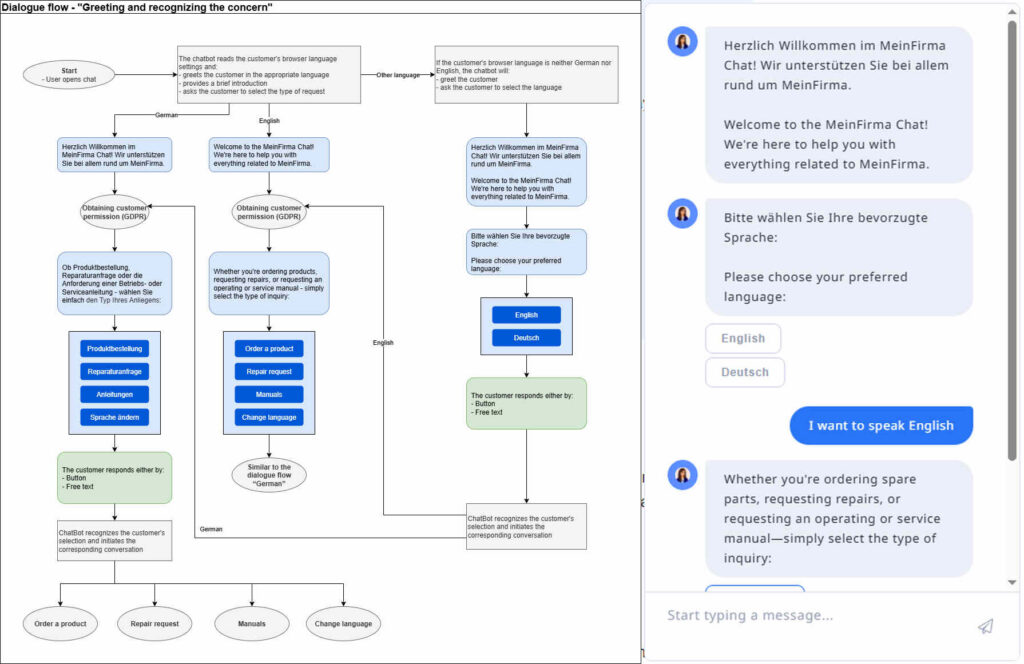
    You can try out the chatbot on this website – just click on the widget icon in the bottom right corner.


    The Business Case: Why Chatbots Matter Today

    Customer expectations have fundamentally changed. Users expect immediate answers, multilingual support, and seamless digital interaction — regardless of time zone or business hours. At the same time, companies face increasing pressure to reduce operational costs while maintaining high-quality service.

    Chatbots have emerged as a practical solution to this challenge. When implemented correctly, they help organizations:

    • Provide instant responses to repetitive inquiries
    • Reduce manual workload for support teams
    • Offer consistent and structured customer interactions
    • Guide users toward products, services, or next actions
    • Capture valuable structured data during conversations
    • Support international audiences with multilingual capabilities

    Unlike traditional automation tools, modern chatbots can combine structured dialog flows with intelligent language understanding, enabling natural yet controlled interactions.

    For many organizations, the primary motivation is not replacing human interaction but optimizing it — allowing human agents to focus on complex tasks while automation handles predictable workflows.


    What Problems Chatbots Actually Solve

    The value of chatbots becomes clear when examining real business scenarios. Instead of being generic “AI assistants”, successful chatbot implementations usually target specific operational challenges.

    Typical use cases include:

    • Customer Support Automation – Chatbots can handle frequently asked questions, guide users through troubleshooting steps, and collect structured information before escalating to human agents.
    • Product and Service Guidance – Interactive conversations can help customers understand offerings, compare options, and navigate complex product portfolios.
    • Order Tracking and Status Updates – By integrating with backend systems, chatbots can provide real-time information without requiring manual support intervention.
    • Structured Data Collection – Forms integrated into conversational flows can gather requests, tickets, or onboarding data more efficiently than static forms.
    • Knowledge Base Access – Chatbots can serve as conversational interfaces for internal or external documentation systems.
    • Lead Qualification and Marketing Interaction – By guiding visitors through questions, chatbots can identify user intent, capture contact information, and route leads appropriately.

    In practice, the most successful deployments start with clearly defined goals rather than attempting to solve every problem at once.


    Types of Chatbots

    Not all chatbots are created equal. Understanding the main categories helps businesses select the right approach.

    Rule-Based Chatbots

    These systems follow predefined conversation paths using buttons or fixed decision trees.

    Advantages:

    • Predictable behavior
    • Easy compliance control
    • Suitable for structured workflows

    Limitations:

    • Limited flexibility
    • Poor handling of unexpected input

    NLP-Based Intent Chatbots

    These bots use natural language processing to interpret user input and map it to predefined intents.

    Advantages:

    • Flexible input handling
    • Structured backend integration
    • High reliability in enterprise contexts

    Limitations:

    • Requires training data
    • Design effort for dialog flows

    LLM-Powered Conversational Assistants

    Large Language Model (LLM) chatbots generate responses dynamically using generative AI.

    Advantages:

    • Highly natural conversations
    • Broad knowledge capabilities
    • Reduced need for predefined responses

    Limitations:

    • Less predictable outputs
    • Governance and security considerations
    • Potential hallucinations

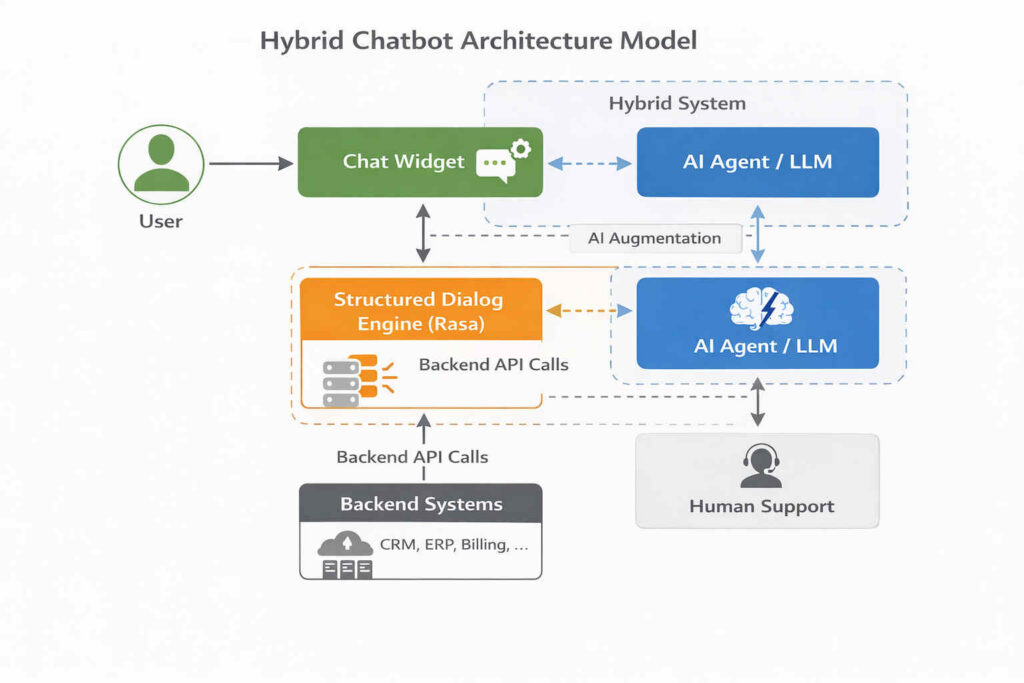
    Hybrid Architectures

    Many modern solutions combine structured dialog flows with AI-powered components. Structured workflows ensure reliability and compliance, while AI enhances flexibility where needed.


    Technology Landscape: Popular Chatbot Frameworks and Platforms

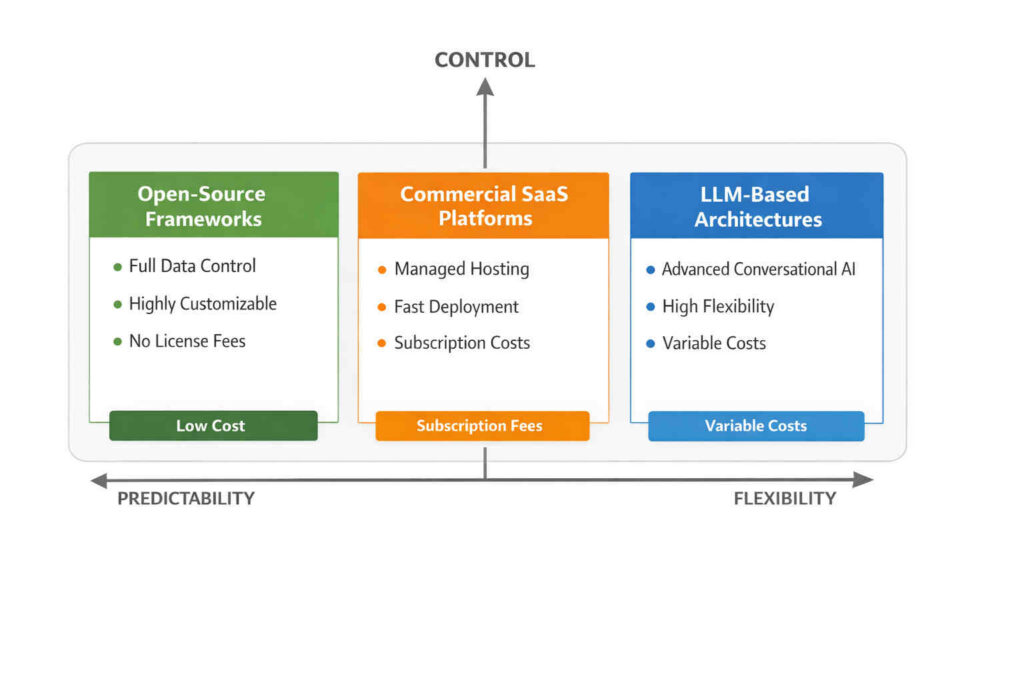
    Organizations typically choose between open-source frameworks, commercial platforms, or custom architectures.

    Open-Source Frameworks

    Examples:

    Characteristics:

    • Full control over data and deployment
    • No recurring license costs
    • High customization flexibility
    • Requires technical expertise

    Best for:

    • enterprise environments
    • complex integrations
    • long-term ownership strategies

    Commercial SaaS Platforms

    Examples:

    • Google Dialogflow
    • Microsoft Copilot Studio
    • Intercom AI chat solutions

    Characteristics:

    • Faster initial setup
    • managed infrastructure
    • subscription pricing
    • potential vendor lock-in

    Best for:

    • rapid prototyping
    • smaller teams without engineering resources

    LLM-Based Architectures

    These solutions integrate models such as GPT-based systems into chatbot workflows.

    Characteristics:

    • advanced conversational abilities
    • dynamic content generation
    • need for careful guardrails and architecture design

    Increasingly, organizations combine LLM capabilities with structured backend logic.

    Diagram “Chatbots – Technology Landscape Comparison”

    Technology Landscape: Popular Chatbot Frameworks and Platforms

    The Reality of Chatbot Development — What Is Actually Hard

    One of the biggest misconceptions is that chatbot development is primarily about selecting a framework or training an AI model. In reality, most effort lies elsewhere.

    • Dialog Design – Creating natural, efficient conversations that guide users toward outcomes requires deep understanding of business processes and user behavior.
    • Backend Integration – Real value comes from connecting chatbots to enterprise systems such as CRM, ERP, or billing platforms. Designing reliable API integrations is often more complex than building the conversation itself.
    • Multilingual Modeling – Supporting multiple languages requires careful intent design, testing, and content management.
    • Fallback Strategy – Handling unknown inputs gracefully is essential to maintaining user trust.
    • Security and Data Governance – Enterprise deployments must consider:
      • data privacy
      • logging policies
      • infrastructure architecture
      • authentication flows
    • Testing Real Conversations – Users behave unpredictably. Extensive testing with real-world scenarios is necessary to achieve reliable automation.

    Common Mistakes Companies Make With Chatbots

    Many projects struggle not because of technology limitations but because of incorrect assumptions.

    Common pitfalls include:

    • Attempting full automation without clear use cases
    • Using generative AI without structured guardrails
    • Underestimating dialog design complexity
    • Ignoring fallback and escalation paths
    • Choosing tools based solely on trends rather than requirements
    • Treating chatbots as marketing features instead of operational tools

    Avoiding these mistakes significantly increases project success rates.


    AI Agents vs Chatbots — Evolution or Replacement?

    With the rise of AI agents, many organizations ask whether traditional chatbots will become obsolete.

    AI agents offer:

    • autonomous reasoning
    • dynamic task execution
    • flexible conversation flows

    However, enterprise environments often require:

    • predictable workflows
    • compliance control
    • auditability
    • structured integration logic

    For this reason, many experts see the future not as replacement but as convergence.

    Hybrid architectures are emerging where:

    • structured chatbot flows manage reliable processes
    • AI agents assist with reasoning, summarization, or complex queries

    This balanced approach provides innovation without sacrificing control.

    Diagram “Chatbots – Hybrid Architecture Model”

    Diagram “Chatbots - Hybrid Architecture Model”

    How to Choose the Right Chatbot Approach

    Selecting the right chatbot architecture depends on business goals, regulatory constraints, integration complexity, and long-term strategy. The technology should follow the operational requirements — not the other way around.

    Below is practical guidance based on typical enterprise scenarios.

    Need FAQ automation? – Use “Structured Chatbot”

    If the primary goal is to automate repetitive questions with predefined answers, a structured chatbot with clear dialog flows is often the most efficient solution.

    Why this works:

    • High predictability
    • Easy testing and validation
    • Controlled user experience
    • Minimal AI complexity
    • Lower development risk

    Structured bots are ideal when:

    • The content is well-defined
    • Compliance and accuracy matter
    • The goal is deflection of repetitive support load

    They are often more cost-effective and stable than LLM-driven solutions for this use case.

    Need to support enterprise workflows? – Use “Hybrid Architecture”

    If the chatbot must integrate deeply with CRM, ERP, billing, or other backend systems, a hybrid architecture is typically the most robust option.

    This means:

    • Structured dialog engine controls workflow logic
    • AI/LLM components assist where flexibility is useful
    • Clear integration layer connects enterprise systems

    Why this works:

    • Predictable business process handling
    • Reliable backend API integration
    • Controlled fallback and escalation logic
    • Reduced hallucination risk
    • Better auditability

    Hybrid models are particularly suited for regulated industries and mission-critical workflows.

    Want to try experimental innovation? – Use “AI Agent Prototypes”

    If the objective is to explore advanced conversational AI capabilities, such as autonomous reasoning or complex information synthesis, AI agent prototypes can be appropriate.

    Why this works:

    • Rapid experimentation
    • Less need for predefined dialog trees
    • Natural interaction style
    • Strong knowledge exploration capability

    However, this approach should be chosen carefully because:

    • Outputs may be less predictable
    • Governance requires additional safeguards
    • Integration into structured business processes can be challenging

    Best suited for innovation labs, internal tools, or knowledge assistants.

    Must follow strict data governance requirements? – Use “Controlled Infrastructure Deployment (On-Premises or Private Cloud)”

    If your organization operates under strict regulatory requirements (e.g., financial services, healthcare, public sector), infrastructure control becomes a primary architectural driver.

    In such cases, you should consider:

    • On-premises deployment
    • Private cloud hosting within the EU
    • Data residency guarantees
    • Controlled logging and access policies

    Why this matters:

    • Compliance with GDPR and industry regulations
    • Full control over customer data
    • Reduced exposure to third-party data processors
    • Auditability and traceability

    Open-source frameworks are often a strong fit here because they allow self-hosting and eliminate dependency on external SaaS providers. However, the key factor is not “open-source” itself — it is infrastructure control and data ownership.

    Strategic Consideration

    Early architectural decisions significantly influence:

    • long-term operational cost
    • scalability
    • vendor lock-in risk
    • compliance flexibility
    • ability to extend functionality later

    A chatbot project should therefore start with architectural assessment rather than tool selection.


    Conclusion

    Chatbots are no longer experimental tools. When designed with clear objectives and integrated into real business processes, they become powerful automation components that improve customer experience and operational efficiency.

    The key is not selecting the most advanced technology but choosing the right architecture for your specific goals.


    Discuss Your Chatbot Strategy

    If you are evaluating chatbot solutions or planning to introduce conversational automation, a structured architectural approach helps avoid costly redesigns later.

    An independent expert perspective can help:

    • assess feasibility
    • select appropriate technology
    • design scalable architecture
    • align automation with business processes

    A short initial discussion can clarify whether chatbot automation is the right next step for your organization.