The previous article introduced a pragmatic architectural approach for using TM Forum Open APIs as integration contracts rather than internal system models. While high-level architecture diagrams help clarify domain boundaries, the real complexity in telecom systems appears when commercial intent becomes operational execution — specifically within the order lifecycle.
This article moves from architectural vision to practical execution. It describes how product orders progress through their lifecycle using TMF622 Product Ordering and TMF641 Service Ordering, demonstrating how orchestration can remain lightweight, domain-driven, and resilient without introducing unnecessary middleware complexity.
The goal is not to describe TM Forum specifications themselves, but to show how they can be applied pragmatically in real enterprise environments.
The Real Problem: Order Lifecycle Complexity
Many telecom implementations encounter difficulty not because of TM Forum APIs, but because of architectural decisions around orchestration.
Common patterns seen in real projects include:
- Treating TMF622 as a central orchestration engine.
- Introducing heavy workflow platforms controlling all lifecycle logic.
- Tight coupling between ordering, inventory, and fulfillment systems through synchronous dependencies.
- Modeling internal systems directly on TMF schemas.
These approaches often lead to rigid architectures that are difficult to evolve and slow to deliver change.
A pragmatic alternative is to treat TMF APIs as integration boundaries while keeping orchestration logic inside a domain-owned Order Management or Customer Order Management (COM) component.
In this model:
- TMF622 captures commercial intent.
- Internal orchestration manages lifecycle progression.
- TMF641 bridges commercial orders with technical fulfillment.
- Asynchronous feedback drives state transitions.
High-Level Order Lifecycle Flow
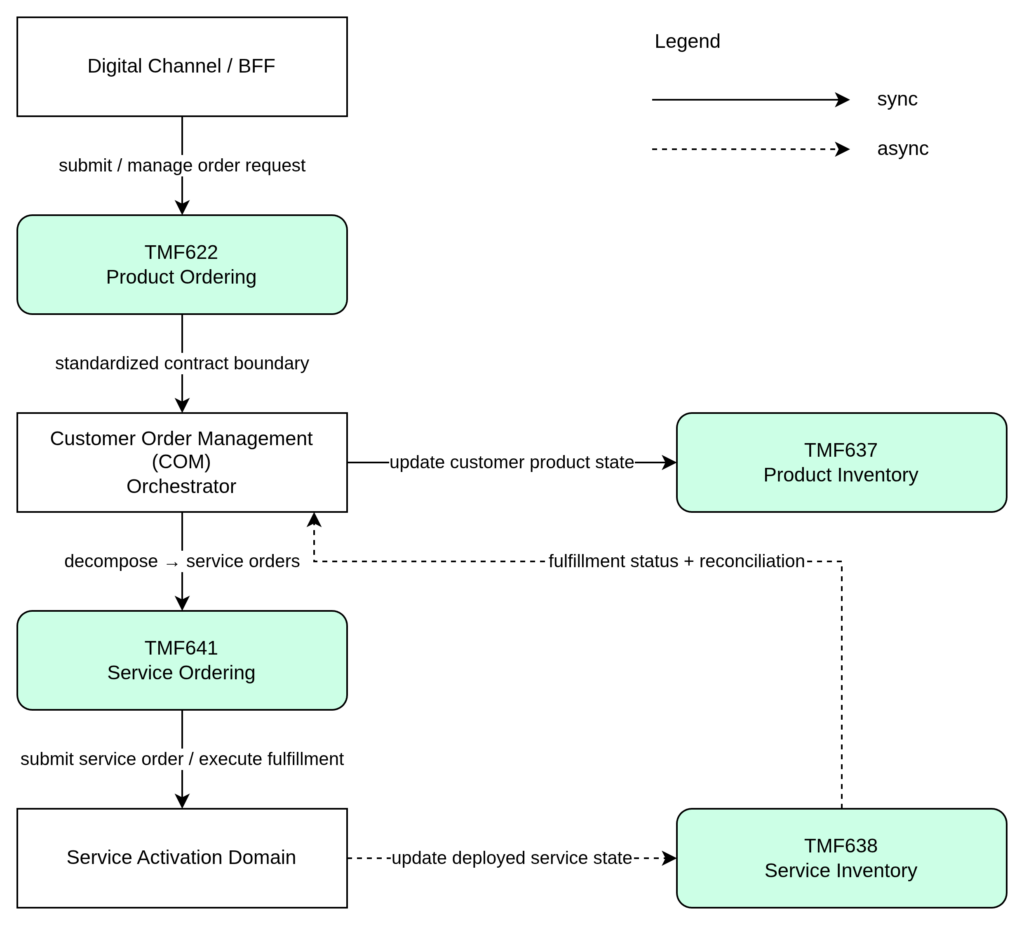
The lifecycle begins when a customer submits a confirmed purchase through a digital channel. The request enters the system through TMF622 Product Ordering, which acts as a standardized boundary between commercial engagement and operational processing.
Internally, the Customer Order Management System assumes responsibility for:
- validating order context,
- managing lifecycle state,
- decomposing product orders into service-level actions,
- coordinating fulfillment execution.
Instead of executing orchestration inside TMF interfaces themselves, the COM operates as a domain service that interprets external contracts and manages internal workflows independently.
The typical lifecycle stages include:
- Order capture through TMF622.
- Validation and enrichment.
- Product-to-service decomposition.
- Service order creation via TMF641.
- Fulfillment execution.
- Asynchronous feedback processing.
- Product and service inventory synchronization.
This separation maintains architectural clarity: TMF APIs remain interoperability interfaces, while orchestration logic stays within the owning domain.
Synchronous vs Asynchronous Interaction Strategy
One of the most important architectural decisions involves determining which interactions should remain synchronous and which should become event-driven.
In pragmatic telecom architectures:
Synchronous interactions are used where immediate validation or deterministic responses are required, such as:
- order submission,
- qualification checks,
- catalog queries.
These operations benefit from predictable response patterns and straightforward transactional behavior.
However, fulfillment execution and lifecycle progression are inherently long-running processes. Attempting to model them synchronously introduces fragility and operational risk.
Therefore, asynchronous workflows should drive:
- fulfillment status updates,
- service activation progress,
- inventory reconciliation,
- order lifecycle transitions.
Asynchronous feedback allows independent scaling of fulfillment components and reduces tight coupling between systems.
Order Orchestration Without Overengineering
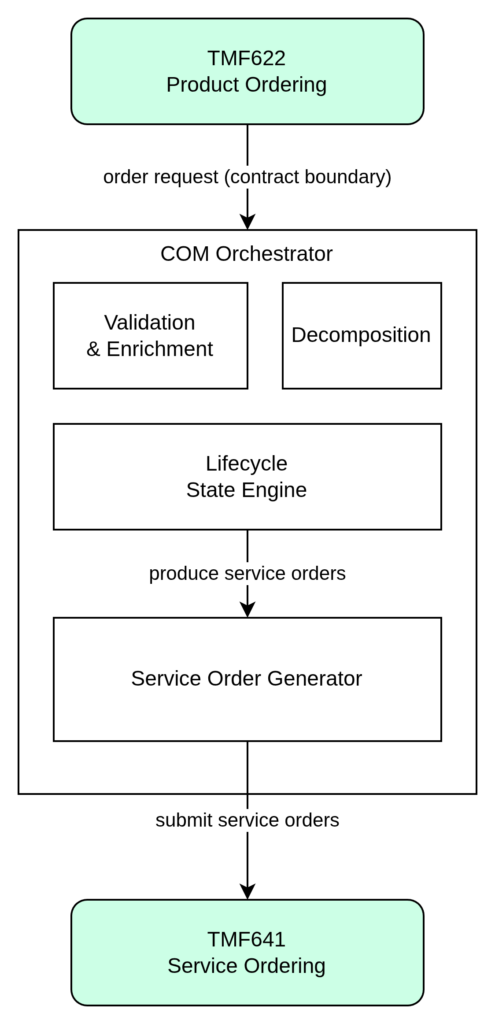
A common misconception is that complex telecom order orchestration requires a centralized workflow engine controlling every step.
While workflow platforms can provide visibility, they frequently become architectural bottlenecks:
- forcing global coordination,
- introducing additional operational layers,
- making domain ownership unclear.
A more pragmatic approach uses a domain-owned orchestrator inside the Customer Order Management layer.
Key characteristics include:
- lightweight state machines rather than monolithic workflows,
- event-driven state transitions,
- clear ownership of lifecycle progression.
The orchestrator reacts to events such as:
- service activation completion,
- fulfillment failure notifications,
- inventory updates.
This pattern enables flexibility while maintaining clear domain responsibility.
Data Model Boundaries and Anti-Corruption Layers
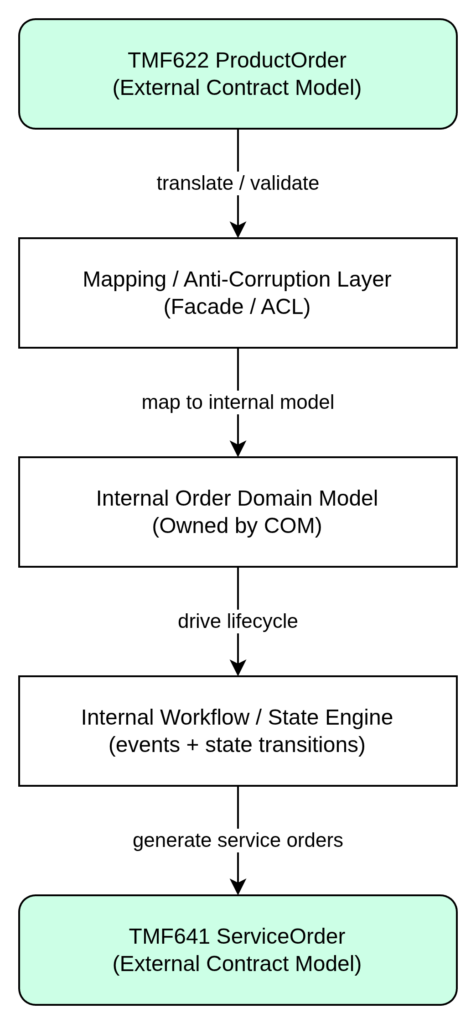
Another critical design principle is maintaining separation between external TMF models and internal domain representations.
TMF data structures define integration contracts between systems. They should not automatically dictate internal modeling.
Instead:
- TMF622 represents the external product order contract.
- The COM translates this structure into internal order representations.
- TMF641 service orders are generated from internal models.
- Inventory updates are mapped back into standardized interfaces.
This anti-corruption approach protects internal services from schema drift and prevents cascading changes across domains when specifications evolve.
Inventory Synchronization and Lifecycle Authority
In this architecture, service inventory and product inventory play distinct roles.
TMF638 Service Inventory represents operational reality — the authoritative record of deployed technical services.
Fulfillment systems update service inventory as activation progresses.
These updates flow asynchronously back to the COM, where they serve two purposes:
- advancing order lifecycle state,
- enabling reconciliation between expected and actual deployment.
Once service deployment reaches a stable state, the COM updates TMF637 Product Inventory to reflect customer-facing subscription state.
Separating technical reality from commercial representation avoids coupling operational systems directly to customer-facing domains.
Common Architecture Mistakes
Several recurring anti-patterns appear in telecom transformations:
- Using TMF622 as a workflow engine rather than an integration boundary.
- Introducing synchronous dependencies on inventory during fulfillment.
- Embedding qualification logic inside ordering flows.
- Modeling internal services directly around TMF schemas.
These decisions increase complexity and reduce flexibility over time.
A pragmatic architecture instead prioritizes domain ownership, asynchronous lifecycle management, and contract-based integration.
Conclusion
The order lifecycle represents the transition from commercial intent to operational execution — and therefore is where integration architecture decisions have the greatest impact.
By treating TM Forum Open APIs as stable integration contracts and placing orchestration responsibility inside a domain-owned order management layer, organizations can achieve:
- reduced coupling,
- improved resilience,
- clearer ownership boundaries,
- and incremental evolution of legacy environments.
This approach allows teams to leverage TMF standards without introducing unnecessary architectural complexity.
What’s Next
This article focused on the high-level lifecycle and orchestration approach. In the next publications, we will dive deeper into detailed execution flows, including:
- asynchronous event-driven lifecycle patterns,
- practical request/response sequences,
- data model mappings between TMF contracts and internal domains,
- and reconciliation logic between service and product inventory.