You can try out the chatbot on this website – just click on the widget icon in the bottom right corner.
The Business Case: Why Chatbots Matter Today
Customer expectations have fundamentally changed. Users expect immediate answers, multilingual support, and seamless digital interaction — regardless of time zone or business hours. At the same time, companies face increasing pressure to reduce operational costs while maintaining high-quality service.
Chatbots have emerged as a practical solution to this challenge. When implemented correctly, they help organizations:
- Provide instant responses to repetitive inquiries
- Reduce manual workload for support teams
- Offer consistent and structured customer interactions
- Guide users toward products, services, or next actions
- Capture valuable structured data during conversations
- Support international audiences with multilingual capabilities
Unlike traditional automation tools, modern chatbots can combine structured dialog flows with intelligent language understanding, enabling natural yet controlled interactions.
For many organizations, the primary motivation is not replacing human interaction but optimizing it — allowing human agents to focus on complex tasks while automation handles predictable workflows.
What Problems Chatbots Actually Solve
The value of chatbots becomes clear when examining real business scenarios. Instead of being generic “AI assistants”, successful chatbot implementations usually target specific operational challenges.
Typical use cases include:
- Customer Support Automation – Chatbots can handle frequently asked questions, guide users through troubleshooting steps, and collect structured information before escalating to human agents.
- Product and Service Guidance – Interactive conversations can help customers understand offerings, compare options, and navigate complex product portfolios.
- Order Tracking and Status Updates – By integrating with backend systems, chatbots can provide real-time information without requiring manual support intervention.
- Structured Data Collection – Forms integrated into conversational flows can gather requests, tickets, or onboarding data more efficiently than static forms.
- Knowledge Base Access – Chatbots can serve as conversational interfaces for internal or external documentation systems.
- Lead Qualification and Marketing Interaction – By guiding visitors through questions, chatbots can identify user intent, capture contact information, and route leads appropriately.
In practice, the most successful deployments start with clearly defined goals rather than attempting to solve every problem at once.
Types of Chatbots
Not all chatbots are created equal. Understanding the main categories helps businesses select the right approach.
Rule-Based Chatbots
These systems follow predefined conversation paths using buttons or fixed decision trees.
Advantages:
- Predictable behavior
- Easy compliance control
- Suitable for structured workflows
Limitations:
- Limited flexibility
- Poor handling of unexpected input
NLP-Based Intent Chatbots
These bots use natural language processing to interpret user input and map it to predefined intents.
Advantages:
- Flexible input handling
- Structured backend integration
- High reliability in enterprise contexts
Limitations:
- Requires training data
- Design effort for dialog flows
LLM-Powered Conversational Assistants
Large Language Model (LLM) chatbots generate responses dynamically using generative AI.
Advantages:
- Highly natural conversations
- Broad knowledge capabilities
- Reduced need for predefined responses
Limitations:
- Less predictable outputs
- Governance and security considerations
- Potential hallucinations
Hybrid Architectures
Many modern solutions combine structured dialog flows with AI-powered components. Structured workflows ensure reliability and compliance, while AI enhances flexibility where needed.
Technology Landscape: Popular Chatbot Frameworks and Platforms
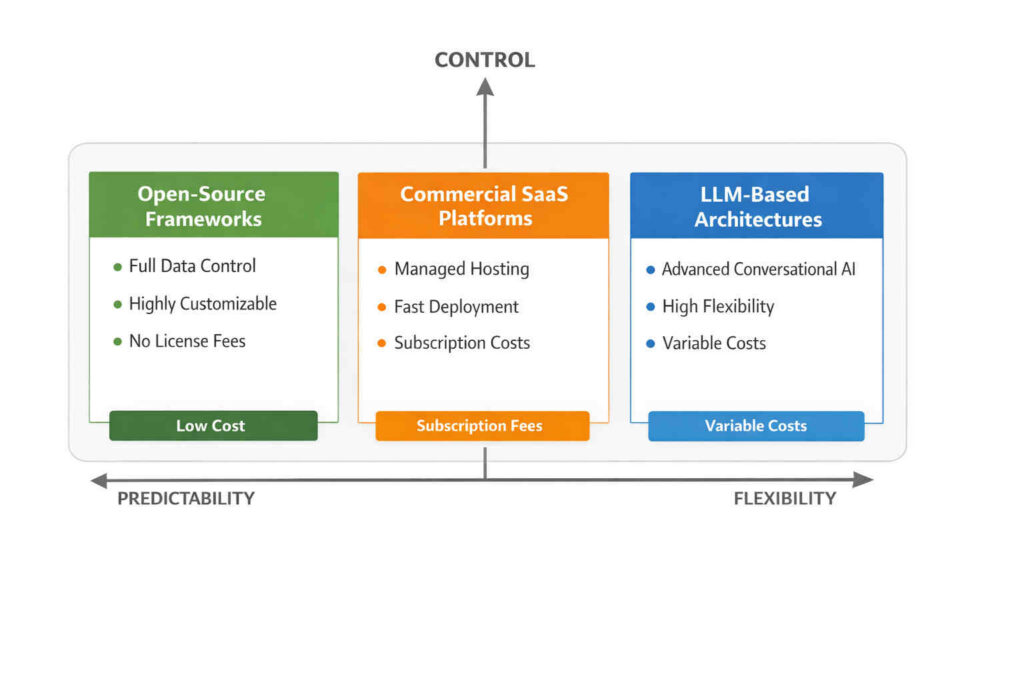
Organizations typically choose between open-source frameworks, commercial platforms, or custom architectures.
Open-Source Frameworks
Examples:
- Rasa Open Source
- Botpress (open-core)
- Microsoft Bot Framework SDK
Characteristics:
- Full control over data and deployment
- No recurring license costs
- High customization flexibility
- Requires technical expertise
Best for:
- enterprise environments
- complex integrations
- long-term ownership strategies
Commercial SaaS Platforms
Examples:
- Google Dialogflow
- Microsoft Copilot Studio
- Intercom AI chat solutions
Characteristics:
- Faster initial setup
- managed infrastructure
- subscription pricing
- potential vendor lock-in
Best for:
- rapid prototyping
- smaller teams without engineering resources
LLM-Based Architectures
These solutions integrate models such as GPT-based systems into chatbot workflows.
Characteristics:
- advanced conversational abilities
- dynamic content generation
- need for careful guardrails and architecture design
Increasingly, organizations combine LLM capabilities with structured backend logic.
Diagram “Chatbots – Technology Landscape Comparison”
The Reality of Chatbot Development — What Is Actually Hard
One of the biggest misconceptions is that chatbot development is primarily about selecting a framework or training an AI model. In reality, most effort lies elsewhere.
- Dialog Design – Creating natural, efficient conversations that guide users toward outcomes requires deep understanding of business processes and user behavior.
- Backend Integration – Real value comes from connecting chatbots to enterprise systems such as CRM, ERP, or billing platforms. Designing reliable API integrations is often more complex than building the conversation itself.
- Multilingual Modeling – Supporting multiple languages requires careful intent design, testing, and content management.
- Fallback Strategy – Handling unknown inputs gracefully is essential to maintaining user trust.
- Security and Data Governance – Enterprise deployments must consider:
- data privacy
- logging policies
- infrastructure architecture
- authentication flows
- Testing Real Conversations – Users behave unpredictably. Extensive testing with real-world scenarios is necessary to achieve reliable automation.
Common Mistakes Companies Make With Chatbots
Many projects struggle not because of technology limitations but because of incorrect assumptions.
Common pitfalls include:
- Attempting full automation without clear use cases
- Using generative AI without structured guardrails
- Underestimating dialog design complexity
- Ignoring fallback and escalation paths
- Choosing tools based solely on trends rather than requirements
- Treating chatbots as marketing features instead of operational tools
Avoiding these mistakes significantly increases project success rates.
AI Agents vs Chatbots — Evolution or Replacement?
With the rise of AI agents, many organizations ask whether traditional chatbots will become obsolete.
AI agents offer:
- autonomous reasoning
- dynamic task execution
- flexible conversation flows
However, enterprise environments often require:
- predictable workflows
- compliance control
- auditability
- structured integration logic
For this reason, many experts see the future not as replacement but as convergence.
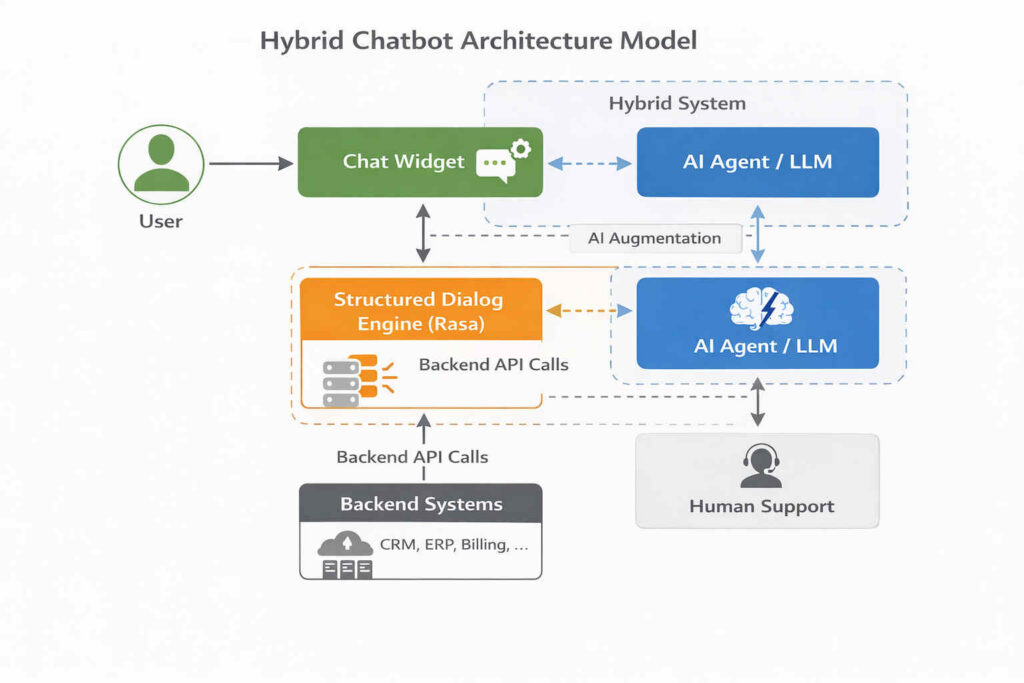
Hybrid architectures are emerging where:
- structured chatbot flows manage reliable processes
- AI agents assist with reasoning, summarization, or complex queries
This balanced approach provides innovation without sacrificing control.
Diagram “Chatbots – Hybrid Architecture Model”
How to Choose the Right Chatbot Approach
Selecting the right chatbot architecture depends on business goals, regulatory constraints, integration complexity, and long-term strategy. The technology should follow the operational requirements — not the other way around.
Below is practical guidance based on typical enterprise scenarios.
Need FAQ automation? – Use “Structured Chatbot”
If the primary goal is to automate repetitive questions with predefined answers, a structured chatbot with clear dialog flows is often the most efficient solution.
Why this works:
- High predictability
- Easy testing and validation
- Controlled user experience
- Minimal AI complexity
- Lower development risk
Structured bots are ideal when:
- The content is well-defined
- Compliance and accuracy matter
- The goal is deflection of repetitive support load
They are often more cost-effective and stable than LLM-driven solutions for this use case.
Need to support enterprise workflows? – Use “Hybrid Architecture”
If the chatbot must integrate deeply with CRM, ERP, billing, or other backend systems, a hybrid architecture is typically the most robust option.
This means:
- Structured dialog engine controls workflow logic
- AI/LLM components assist where flexibility is useful
- Clear integration layer connects enterprise systems
Why this works:
- Predictable business process handling
- Reliable backend API integration
- Controlled fallback and escalation logic
- Reduced hallucination risk
- Better auditability
Hybrid models are particularly suited for regulated industries and mission-critical workflows.
Want to try experimental innovation? – Use “AI Agent Prototypes”
If the objective is to explore advanced conversational AI capabilities, such as autonomous reasoning or complex information synthesis, AI agent prototypes can be appropriate.
Why this works:
- Rapid experimentation
- Less need for predefined dialog trees
- Natural interaction style
- Strong knowledge exploration capability
However, this approach should be chosen carefully because:
- Outputs may be less predictable
- Governance requires additional safeguards
- Integration into structured business processes can be challenging
Best suited for innovation labs, internal tools, or knowledge assistants.
Must follow strict data governance requirements? – Use “Controlled Infrastructure Deployment (On-Premises or Private Cloud)”
If your organization operates under strict regulatory requirements (e.g., financial services, healthcare, public sector), infrastructure control becomes a primary architectural driver.
In such cases, you should consider:
- On-premises deployment
- Private cloud hosting within the EU
- Data residency guarantees
- Controlled logging and access policies
Why this matters:
- Compliance with GDPR and industry regulations
- Full control over customer data
- Reduced exposure to third-party data processors
- Auditability and traceability
Open-source frameworks are often a strong fit here because they allow self-hosting and eliminate dependency on external SaaS providers. However, the key factor is not “open-source” itself — it is infrastructure control and data ownership.
Strategic Consideration
Early architectural decisions significantly influence:
- long-term operational cost
- scalability
- vendor lock-in risk
- compliance flexibility
- ability to extend functionality later
A chatbot project should therefore start with architectural assessment rather than tool selection.
Conclusion
Chatbots are no longer experimental tools. When designed with clear objectives and integrated into real business processes, they become powerful automation components that improve customer experience and operational efficiency.
The key is not selecting the most advanced technology but choosing the right architecture for your specific goals.
Discuss Your Chatbot Strategy
If you are evaluating chatbot solutions or planning to introduce conversational automation, a structured architectural approach helps avoid costly redesigns later.
An independent expert perspective can help:
- assess feasibility
- select appropriate technology
- design scalable architecture
- align automation with business processes
A short initial discussion can clarify whether chatbot automation is the right next step for your organization.